Category Archives: Uncategorized

A THRILLING, RAUNCHY ROVER, IF SOMEWHAT CAVALIER PRODUCTION

the-rover-production-photos_-2016_2016_photo-by-ellie-kurttz-_c_-rsc_203480

Non-stop fun is the stamp of Loveday Ingram’s exuberant, and very sexy production of Aphra Behn’s The Rover for the RSC, in the perfectly proportioned Swan Theatre, Stratford. Complete with hysterical Flamenco forays, touches of tango, a stilt walker, and excellent on-stage band. With a Conchita Wurst look-alike, the bearded lady boy among a tranch of devil masks, in what is very nearly The Rover – The Musical, I half expected someone to break out into Don’t Cry For Me Argentina.

Except Naples is the setting for the late 17th Century Restoration play, at Carnival, to turn everyone’s Worlds upside down, then restore them to the same old cynical order. A steely 1920’s cast-iron stairwell backs the simple set, to represent both the keys to the Kingdom and the Whorehouse, in a very hard world, and for the arrival of four exiled English Cavaliers led by Belvile and our particular Don Giovanni, Millmore: Very possibly modelled on the notorious Earl of Rochester, he who penned poems about dildos and things and died at 33 of booze, syphilis, and genius. This production is good Karma, with The Libertine about Rochester’s life on at the Theatre Royal in London, and Millmore is played with wonderful gusto and skilled comic timing by Joseph Millson, giving a tour de force performance he revels in.

From the moment the Prologue is given to the charming and excellent Faye Castelow though, playing Millmore’s equal-to-be, Helena, so that we really know this play was written by a woman, indeed the first English female dramatist and also a spy in Antwerp for Charles II, we are in safe directorial hands. A knowing self-awareness breathes through all the strong performances, that liberates everyone to many kinds of play. Since Millmore is trying to play fast and loose with every pretty woman that meets his eye, so the director’s cuts have played loose too and streamlined things well, if you wonder if cries of “Mummy” or “Kinky” are quite 17th Century.

Then they have gone for knockabout comedy, and ad libs too, including some great audience interaction, not least when Millmore is drunk, that always delights a crowd. If turning a line about old men and impotence on a greying member of an audience that seemed predominantly over sixty might have been a bit close to the bone! No pulling of punches here then, in the lusty manhood stakes. The climax, with an explosion of rose petals from the ceiling, nearly had people up and dancing on their feet and crutches.

This Rover certainly underplays the darker side of Behn’s play, based on one by Thomas Killigrew, where even the finest women could hardly avoid being labelled Wife, Nun, or Whore. The shadows grow in the story of the very funny and then nasty Blunt, the stuttering English Gent with his hand on the purse strings, played wonderfully by Leander Deeny, who is gulled by a prostitute, described in the original cast list as a ‘jilting wench’, into believing he has found true love. There is little time in life’s seething energy for his brand of hurt though, his hatred of being laughed at, so he is driven off stage in the first half by the semi-demonic revellers. Only to return demonically himself in the second half on the edge of doing something very nasty indeed, where a comedy edges toward potential tragedy, to remind us what can happen in the real world.

What is revolutionary in Aphra Behn, and so provides the explosive energy of poetry and thought throughout, is her ‘feminism’ is no mere complaint about manly men, hate of them either, but a cry for woman to be equal in all. Or at least her and Millmore, since by the end you do believe the pair on stage have found their true match. Thus it is two sisters and their kinswoman who set the plot in true motion too, as Florinda longs for Belvile and Helena refuses to disappear into a nunnery. So, disguised as gypsies, they hit the town like the Cavaliers and paint it red.

The main plot sees the honourable Belvile trying to find his lady, against the machinations of the nasty foreigners trying to arrange marriages, and along with a joke about drawing the longest sword, a Toledo blade, a pair of splendid guilded boxer shorts appear, belonging to a very good Don Pedro, endless filthy double entendres ensue, and there’s even a burst of Rule Britannia. The secondary plot involves the Courtesan Angellica Bianca, and since Behn lived when the theatre was very close to the brothel, perhaps reflecting her own initials and sentiments too, who falls for lusty Millmore. Alexandra Gilbreath is both moving and funny as the whore who gives her ‘virgin heart’ away, to no avail. Though a special mention for her slinking side-kick in a bowler, Alison Mckenzie’s knowing Moretta, who gives a nod to Joel Gray’s compere in Cabaret. This is a world that in truth seethed with violence, sex and fear, where a true Courtesan might make much of herself, but the whore and the poor always paid the price in the end, although Blunt shows men can be victims too. Though since Behn was a Royalist – the play is also called The Banish’d Cavaliers – it is Millmore’s poverty, along with his wit and courage, that gives him his nobility and wins him the prize; not only Helena, but her lovely fortune.

You can read reviews of King Lear and Cymbeline below.  David Clement-Davies

The photo shows Faye Castelow and Joseph Millson as Helena and Millmore in the RSC’s production of Aphra Behn’s The Rover, in the Swan Theatre Stratford. Copyright Ellie Kurttz.


Leave a comment

Filed under Culture, Poetry, The Arts, Uncategorized

CYMBELINE FINDS HER TIME, OR BRITAIN ALSO LOSES THE PLOT?

cymbeline-production-photos_-may-2016_2016_photo-by-ellie-kurttz-_c_-rsc_192899

Thanks to the RSC, and Gillan Doran’s wonderfully ambitious programme for the 400th anniversary, not least for bringing me to a play I’d never even read, Cymbeline. Despite a sinking heart opening the programme to see a picture of Dave Cameron, and a journalist lecturing on about Brexit and why after being neglected for so long this is a play that has at last “found its time.” Hmmm. Shakespeare is always profoundly politically attuned, though better at exposing the imperatives and mechanisms, the nasty guts, than being didactic or ever lecturing. Was the graffiti on the concrete wall then, along with the programme’s nod to Banksi, or an anguished model of a Refugee boat, to make us suffer a Referendum all over again? I think the real irritation is that for nearly three and a half hours it had me imagining Gillian Bevan’s stout, very capable Cymbeline, part Britannia, part Boudicca, as Theresa May, (with respect, a bit of a look-alike), or is that Theresa-may-not? Not that Bevan is at all Lilly livered, and now I know Cymbeline means Cymbeline and there we are!

As for their Brexits, or their Entrances, in a proudly multi-cultural cast, what also irritated is directors (now trendily called Creatives at the RSC) thinking that a lot of running on and off stage and gabbling difficult lines passes either for theatrical energy or realism. Though when the actors settle into thinking and feeling through the words and poetry, there are some excellent performances. Not least from Bethan Cullinane as Cymbeline’s much tested daughter Innogen, the black actor Markus Griffiths as a very funny Cloten, James Clyde’s excellently malevolent Duke, and the Irish actress Jenny Fenessy throwing off the tyranny of the poor understudy to play Pisania, while a treasure chest of language is thrown open.

Jokes aside, busy director Melly Still it is quite right to suggest Brexit’s relevance, since Shakespeare was born out of the trauma and liberation of a disintegrating Christendom, (a reason today’s violent Religious and Scientific divides  or Terrorism might be even more pertinent), if Europa was a word and concept only just emerging at the time. As still Top Monarch, Queen Bess, who made a lot of cash from Hawkin’s African nastiness, and thugs like Francis Drake, saw the loss of any kind of Empire in France, though viciously trying to plant Ireland. While King James mooted but failed to achieve a Union with Scotland. So how did Britain really thrive and invent herself? By putting money in everyone’s purses, well those at the top, from little London, and ruling the waves elsewhere, away from the internecine battles  erupting in Europe. Oh brave New World.

You can argue then that much of Shakespeare is also inevitably about the very writing of a new English Imperial identity, if only through the most glorious expression of the English language. The world’s centre of Gravity was certainly shifting violently though by 1600, in a moment that probably did define how Globalisation and Capitalism would develop and which has not seen an equivalent sea change until now. It’s not just Brexit, of course, but how the Internet is probably the equivalent of the Printing Press revolution. Perhaps Shakespeare is a bit to blame then, at least for that outburst by Tory MP Jacob Rees-Mogg limply invoking tigers, to give Cameron a prod. I think Henry V is about the conscious manufacturing of a powerful new political rhetoric, soon adopted by the ‘Establishment’.  Even as a once far more intimate Monarchy separated itself from the lower orders, and banished honest Jacks to the bilges and top sails, it conquered half the World, with planting, privateering trade and slavery, and owned it for a very long time indeed.Is that what modern Breixteers want? Not of course that Bill did all this alone, bless him. The Virginia Company was founded in the year the Globe went up on Bankside, 1599, just opposite that walled fortress of London, still a Global epicentre today in UK PLC, and the little Tudor cannons of the terrifyingly powerful and private East India Company were bristling from a fort in Madras by 1607.

That year Shakespeare’s youngest brother Edmund died at just 27, an actor too, and his daughter Susanna was married in Stratford. While ‘savages’ were attacking the new fort at Jamestown, King James’s town, and a little merchant ship called the Red Dragon, Henry Tudor’s badge, did performances of both Hamlet and Richard II off the coast of Sierra Leone. Britain had truly set to sea, and it was coming back in bucket loads. For hundreds of years the scholarly Establishment claimed that record had to be a forgery though, because the Common Man could not possibly understand their Bard, if still stuffing him down School children’s throats. To improve us all and claim Shakespeare was essentially Conservative and there’s nowhere like an England!

If we think Euromillions is an innovation though, the first free standing lottery was launched in 1612 to help colonise Virginia, soon taken up by all thirteen original Colonies, to give very early origins to that ‘American Dream’. Talking of which, having a snack in Café Rouge before the show I’d opened The Times to read with even more sinking heart that the usually balanced and liberal Matthew Paris had just suggested we toughen up on the asylum rules by suggesting what constitutes danger should now only be the threat of Death! Then that Donald Trump was ahead in the bell-weather State of Ohio, invoking the example of Brexit. If we think our own Liberal sentiments (or not) can sway US Politics though, when people were asked to email Americans to complain, they got some very rude replies indeed, about being stupid, Lilly-livered Brits and worse.

A little credence then to the relevance of the traumatised Brexit line, four centuries on, although the production has faced much criticism. Some slack too in Ms Still peopling a Roman court with Mafiosi Eurotrash in lounge suits, sipping cocktails and speaking in Italian, translated onto big screen sur titres, that then translate Latin too, when the big Romans claim their imperial tributes from the smelly Britains. Who dares to translate the greatest translator and interpreter of them all – Shakespeare? Well, Melly Still! That rather heavy handed moment is about the river of history, peoples and languages that made Britain and which Shakespeare’s astonishing English emerged from too. The first dictionary was only printed in England in 1604 and Shakespeare is profoundly a Renaissance writer. While to set us up for losing our heads, the set is dominated by a tree stump, in a glass box, perhaps to echo the production of King Lear. The rest is as hip, with film, and part concrete and vegetative back revolves, to suggest Nature will always break on through, complete with images of modern Rome’s Empire-littered streets and Dad’s Army Invasion maps to have you suddenly asking – Who D’yer Think Yer Kidding?

Actually I should underline that Cymbeline is a tragi-comedy. So to any grasp I got on the plot, untangling which might win you Brain of Britain. Cymbeline’s daughter Innogen and Posthumus are star crossed lovers, or most crossed by Cymbeline, so Posthumous has to flee abroad. There, boasting of Innogen’s love and fidelity, he is tested by Oliver Johnstone’s excellent Iachimo, who travelling to Blighty, as Rome seeks tribute, emerges from a chest in her bedchamber to discover Innogen asleep, nick her bracelet, and spy a starry mole by her breast, rude fellow. So being able to trick Posthumous into believing he has done the act of darkness and Innogen is false. Like Michael Gove Iachimo pays Manhood’s price later, when the War of Men without Women erupts into horror, or is that Boris Johnson?

There is a tangle of poison that isn’t poison and lots of people trying to bump each other off, like Boris Johnson and Michael Gove. As Cymbeline revolts against Rome, Innogen flees to the forest, to encounter an exiled General good-of-heart, Graham Turner’s splendid Belarius, and her kidnapped brother and sister, Arveragus and Guideria, emphasising all the healing Nature virtues, and played very well by James Coonie and Natalie Simpson, especially Simpson as Guideria. Though in the tangle of tree roots or Brain-stem ganglia they first appear swinging from, and the whooping hunting cries, perhaps nicking far too much from Avatar. Mind you, did you see that article in the Sunday Times about tree roots being connected and talking to each other, even nurturing or throttling their young, in this global world of ours? With a very peculiar dream Mask, when Jupiter is invoked, to explain the meaning of names via a prophecy, everyone loses identity in going to war, or finds their manhood, though the Brits win, but still need a Cultural head, so pay tribute to Ancient Rome. So Cymbeline ends with the most astonishingly uncomfortable series of resolutions, more than any in Shakespeare, that had many laughing aloud, including me.

Cymbeline is certainly about a crisis of identity, but it sits not at all in Shakespeare’s overtly Historical or straight political plays. It comes among the later Romances, like Pericles, The Winter’s Tale and The Tempest, when politics, life and suffering had probably confounded the Bard a great deal and he turned his hand to achieving effects through acts of artistic magic. Perhaps his brother Edmund’s tragic death was influential in that sea change. Pericles was written in 1607, for instance, all about incest and lost daughters, but with a family crest that shows a withered branch only flowering at the top. It may be more true though that rather than Cymbeline not being popular for centuries because we had an Empire now, imposing its own tributes, it is because it is a very easy plot to lose. Melly Still throwing the baby and the bath water at it hardly simplifies, or leaves us quite knowing how to vote either. Even if Jacob Rees-Mogg should be told that despite the Histories, most of Shakespeare’s plays are set in interesting foreign and Renaissance climes. I thoroughly enjoyed Cymbeline though and it did not drag for a moment, though the bloke playing the School Master at the new Edward VI museum, backed I think by Mr Gove, told me, rightly or wrongly, it originally ran to five hours! Enjoyed it because just when you’re wondering how Cloten, chasing after Innogen, can get away with possibly being Posthumous in his very ill fitting clothes, so to trick Innogen into believing her lover is dead, his beheading by Guideria is almost hysterical. While Innogen’s burial, then waking to mistaken grief, and true horror, is probably one of the strangest things I’ve ever seen in the theatre. Not least too because Shakespeare, inventing everything, even comes up with the phrase “Brain of Britain”!

 The photo is from the RSC’s rather startling and controversial production of Cymbeline, directed by Melly Still, showing a disguised Posthumous going to war with the Romans, as everyone wrestles for their identity and they try to shake us over Brexit.  Photo Copyright Ellie Kurttz. Ticket courtesy of the RSC Stratford on Avon.


Leave a comment

Filed under Culture, Environment, Language, Poetry, The Arts, Uncategorized

FINDING NEW GEMS IN THE STRATFORD-SHAKESPEARE CROWN

dsc_0002

It was the woman at the New Place ticket office grudgingly lending me a cheap biro, then sourly commenting that not even the Birthplace Trust staff get discounts from the RSC, that had me wondering how everyone really rubs up together in little and hugely over-commercialised Stratford-Upon-Avon.  The house on Henley Street is at the centre of it, Shakespeare’s family house, and the shop where John was a whittawer, a maker of expensive white leather gloves, though the name The Birthplace does give the Bard the gravity of some kind of British Secular Christ.  But the Birthplace Trust are the chief Guardians of Shakespeare’s historical and physical legacy, running, with Royal backing, his house, the archive, and several properties, from New Place to  Hall’s Croft, Anne Hathaway’s House and Mary Arden’s farm.

“The Jewel in the Crown” of all Shakespeare exhibits around the world is how the reopening of New Place is described, highly ambitiously, in the bumf. New Place being the site of the house Shakespeare bought in 1597 for around £120 (I thought it was sixty) and the second largest in Stratford.  The house is no longer there, though the gardens are, where that mulberry tree was, until it was cut down.  It now has a smart new wooden entrance, where Bill’s front door was,  and sculpture park, I’m afraid I found rather fey and underwhelming, with lots of weather veins and things. Though I liked the Shakespeare Processional frieze, if I think that there already. There is also a new walk through-exhibition and shop in the Jacobean house next door, that belonged to Thomas Nashe.  That isn’t at all bad, with the odd little period object in drawers about the place and good time lines to make it interactive, though very much designed for kids and families, to bring ’em in. Well, the folk in the shop, where you can buy imitation jewellery for £75 and £140, were pleased that since opening in August his year it has topped its target of 12,000 visitors.  Though I was annoyed at the door that tickets, which let you into several properties, are £17 but you cannot buy individually.  So you can make a deal out of the merciless Shakespeare industry that has developed,  if you get it right. The foodies were trying to get it right that weekend, with a three-day event of global cuisine, at the reinstated Food Festival in tents around the town, and a bright red Pimms teapot. While a Michaelmas fair at Mary Arden’s farm, my favourite in terms of hockey recreations of Shakespeare’s living world, had mummers, cider makers, basket weavers, archers, falconers and a fellow with a splendid eagle owl to delight the wide-eyed kids.

But for me the real jewels in the crown, if not owned by the Birthplace Trust at all, came just over the way from New Place. First was the splendid little Guild chapel, just across the road, I had never seen before and Shakespeare must have known very well indeed. Since the medieval Catholic frescoes have been somewhat uncovered, with excellent placards to explain and recreate, it perfectly elucidates Andrew Graham Dixon’s point in the programme to the RSC’s King Lear (see review below), about England being culturally and visually blinded in the Puritan whitewashing of images, so giving space to the explosion of the secular word to make us see again, or in a different way.

How thrilling though to stumble next door on Chapel street into a brand new exhibit, The King Edward VI School Museum.  I had often walked past, hoping to catch an imaginative glimpse at Shakespeare’s shining morning face, because he was very probably educated here, six days a week, from 6am to 6pm, for seven years, if his real education was a pastoral one, in life and nature.  So perhaps were his brothers Edmund, Richard and Gilbert. What better way to start to understand the man, and with a very mature exhibit?  Lo and behold, the grammar school itself, given royal charter in Edward VI’s brief reign, one of those 120 or so that still exist, with more mooted by Theresa May, and which is a State funded free school, have, with the help of a million and a half from the Lottery Fund, just opened the place up to pedagogy, or lovely private enterprise. Modern pupils still have morning lessons there too.

It is exceptionally well done, a beautiful building, with positive comments from theatrical luminaries like Sir Ian Mckellan blazoned on the wall, a great little film by the always infectious historian Michael Woods, in the old counting house, very welcoming staff and none-invasive but interesting touch screen displays. Upstairs in the schoolroom even a very knowledgeable Magister, in costume, to tell you about how they learnt Latin and Greek, though I’m not at all sure Shakespeare would have had fluent Latin, sat not at desks but opposite each other, and had to learn things by rote.  Quite enough to make any young Shakespeare play truant and run off to the grounds of Charlcotte to hunt deer, or to London to become the greatest and raunchiest playwright that ever lived. The Bard of course, that “upstart crow”, never went to University, unlike Robert Greene or Kit Marlowe, but still topped them all.  Probably one of the reasons people come up with their snobbish Earl of Oxford or Francis Bacon theories, though what would it do to the Stratford gold mine if it was ever proved?

Still part of the modern school, that has created a trust to preserve and open the building, it is really the epicentre of the historical town too. For here before the Reformation was the Guild of the Holy Cross, that turned into the town council, one Shakespeare’s father John sat on, for all his naughty dealings.  Where a court was held too, downstairs, and upstairs perhaps professional players had to perform before snooty aldermen to get a licence. I say perhaps because with lack of records a deal is still speculation in the whole Shakespeare story, from the bogusness of Hall’s Croft, to certainties about most of the properties.  But it was there, and because it thrives as an active and artistic school to the present, that I really felt in touch with the living Shakespeare story. The ‘school master’ was a bit sheepish about how the Museum is doing, but then it is in competition with The Birthplace, and still has to be properly placed on the Shakespeare map.  It should and will be, because it’s very good indeed and should certainly have no one creeping unwillingly to school!

David Clement-Davies was given entry courtesy of The Birthplace Trust and independent King Edward School Museum. The photo is of the knowledgeable ‘Elizabethan’ school master in situ.


Leave a comment

Filed under Community, Culture, Education, The Arts, Uncategorized

A VERY SOGGY SUMMER PUDDING

DSC_0138


“A relentless task” is the phrase The Director of Eden Arts, Adrian Lockhead, uses to express his attempts to create artistic events that also display Public accountability. In the light of questions, criticisms and suggestions made here about this year’s Summer Pudding Festival at Appleby Castle, on the 20th of August last, and his hand in the pudding mix.   The remark came in the wake of the ‘disaster’ the event proved financially, according to Mr Lockhead, the event’s head chef, if you like, indeed bringing a threat to jobs, he says. After a near glorious week of midsummer sunshine saw such a torrential and relentless downpour, it touched the hearts and flagging spirits of many.

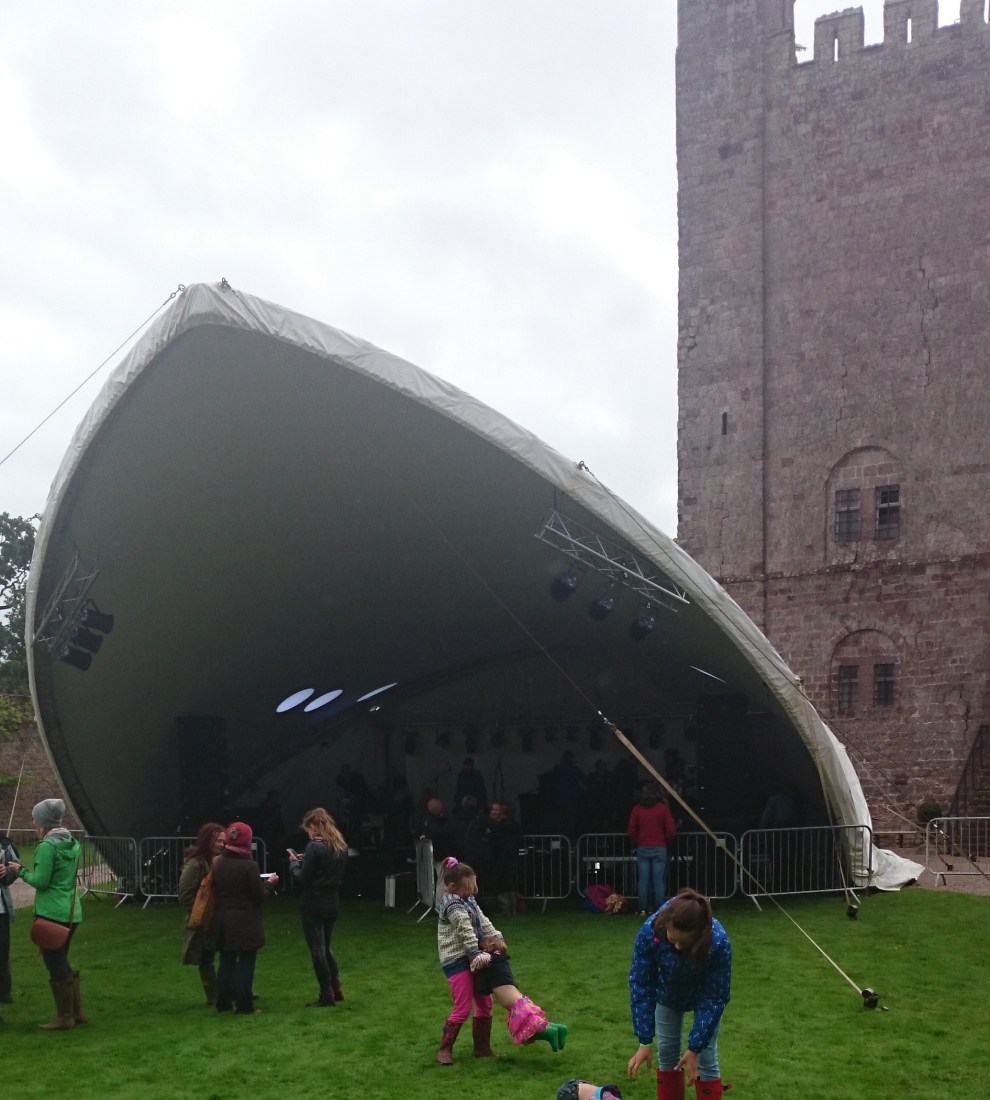
If not quite a total washout then, with folk and families still braving the day, it proved a very soggy summer pudding indeed, certainly worthy of input from the great British Bake-Off team. Perhaps next time they should invite Mary Berry. The After Party in front of the splendid Concert stage, erected in the Castle Keep, like a Great White Shark’s mouth, and hosting excellent bands, was still over populated by folk from the acts themselves, despite the efforts of a giant and charming stilt-walking White Rabbit to welcome all.

I was among those initially praising Adrian Lockhead’s efforts, and the whole style and ambition of the thing too. Especially now the owner of Appleby Castle Sally Nightingale has so stated her intention of throwing open wide the Castle gates once again, making valiant efforts to do so too. With colourful banners blazoned across the A66 though, and imaginative flyers dropping into your puddings from The Cumberland and Westmorland Herald, a great deal of work was done by Eden Arts and high expectations certainly raised.   It had all received Arts Council backing and impressive Corporate Sponsorship too, and I for one was much looking forward to it. Locals were impressed both with the £2 entry for same Postcode friends, but with deals done with local shops, for discounts if you had an arm band.

Ironically the Pudding could not have had worse weather though, even for Cumbria, and in the middle of August too, so perhaps it is dangerous to invoke such Gods of Flood and Storm. It was hugely unlucky, beyond even the powers of Adrian Lockhead to cater for, perhaps. Yet Cumbrians are well used to waiting and not going out because of the weather. While does that justify his saying to me, perhaps a little glibly as soon as I met him, “Well, we’ve done all we can”?

That is certainly to blame the weather, when other things might be in play too. But why then was there little or no response to my asking how such an event might be made weather-proof and advertised as such? Time involved was mentioned, yet it was not only the problem of great gloopy pools of muddy water appearing at the gates, unswept away, or the WW1-like duck boards outside the Vintage Tent turning into Paschendale. Not the kind of Vintage your really need. But the fact I know of at least one marquee offered free of charge and refused. Which also points to questions raised about where the acts came from and why there was not more local input and involvement?

Of course folk soldiered on valiantly, jokes were cracked, fun was had, trails and walks enjoyed, some of the many Porta-loos used, and this is Cumbria, as one young singer bravely intoned. The frustration here though is not the problem of doing anything by committee, even of relentless accountability, nor the desire for anything but quality and joy to draw visitors and generate excitement. But Mr Lockhead’s obvious disinterest in engaging in new or outside ideas, or accepting some creative criticism for his dish. So ignoring the offer of an Independent report on the Festival, along with wider suggestions for other ways in which Appleby might me made a long-term focus for Art and Commerce in the region, which it well might.

The Castle is not only of huge historical significance and a wonderful setting, as a late-clearing evening began to reveal, and a previously seen performance of As You Like It too, but is part of the long-looked-for spiritual centre of the town, though perhaps a spirit that needs truly recovering still, and one not only about Lady Anne Clifford. Other odd things happened then that might bring into question a certain professionalism, and basic courtesy too, from several quarters.

So though to a suggestion that things be explored more deeply and Appleby actually be put firmly on the map again, with an Annual ‘Art Flood’ instead. Which would commemorate this year’s flood disaster certainly, and the probability of future problems too, now the Climate changes, as it always will. But not just to raise money or spirits, and focus on one thing alone, but with a brilliant County and National flood of Art, Music, Literature and Theatre, and over a longer period. Who knows, you could even invite that fellow who wrote his book about Sheep. That is with no disrespect at all to the people of Appleby, nor to the excellent acts and bands that did appear, but a belief that Cumbrians deserve the very best and if you really build (or cook it), they will come. This Summer Pudding then, foul weather or not, was not yet it and since all have different tastes, I would like a starter, fish course and main too, to go alongside any just desserts.

Whether the idea of a one day pud is delicious or not then, obviously making it so vulnerable to the elements, it should always have been treated as a wider test case and a way to stimulate both new ideas, but also much deeper reciprocity. Adrian Lockhead claims that the vast majority of comments he has received were very supportive, yet I wonder if that is true of the people not really invited to the party, or those not interested in just muddling through, or if he should not engage with all, and as relentlessly as the Cumbrian weather.

The photo shows the ‘Shark stage’ at the Summer Pudding in front of Appleby’s ancient and remarkable Keep, with folk waiting for a party.

Leave a comment

Filed under Uncategorized

Lost Shakespeare sonnet unearthed?

In the four hundredth anniversary year of William Shakespeare’s death, laid to rest in Holy Trinity church in Stratford in 1616, a storm of excitement and controversy has erupted over the claimed discovery of a lost Shakespeare sonnet, which if proved genuine would change the cannon forever and which for its content has wide ranging implications over the question of the Bard’s purported Catholicism.

The single Elizabethan page, Elizabethan on quilted paper at least, and seeming to be in that classic, scrolling “Secretary” script, was unearthed in papers once belonging to the American couple The Wallaces, who came to England in the 1920’s to read through half of the millions of documents in the National Archive. In doing so they uncovered an original signature and two court cases, one relating to Shakespeare’s time on Silver Street, another when the Bard was accused of ‘Murder and Affray’ in Southwark by the corrupt Surrey Sherriff Sir William Gardiner, in 1596. Which ties the Bard directly to the theatrical entrepreneur Francis Langley, who built the Swan in Paris Gardens, and two still mysterious ladies, Dorothy Soeur and Anne Lee.

It remains a mystery though as to why the Wallaces, who grew increasingly paranoid about the British Establishment watching them, or filching their discoveries, and eventually returned to Wichita Falls in Texas to use their considerable investigative powers to unearth their own private oil well during the Texan boom, never revealed the existence of the sonnet, which is signed ws.

It’s form is classic Iambic Pentameter too and with the accepted Shakespearian rhyming structure, and though the page is now under lock and key, awaiting spectral analysis on the ink, its lack of punctuation and variable spelling points to its authenticity.  It is reproduced here with only some modern spellings for clarity:

when somer blushes with the dropping leaf
and all the naked worlde uncloaks its shame
when calvin winter stalks the earth beneath
mouthing ffalse psalters to the god of blame
i build cathedrals to a joyous eve
erect profanelye alters to her grace
and like a preacher make the worlde believe
her beauties constant and her truthe her face
for all the seasons halte within her thrall
as though she might hatche eges outside their nest
make spring of winter somer from the fall
or bring forth sweet milk from a virgin brest
so i on trees in forests prick her name
in falling adam loves to fall again

Critics of the find however point to the fact that the papers were also in the hands of the notorious nineteenth century scholar and forger John Payne Collier, who was so publically discredited and disgraced in The Athaneum Magazine. The Shakespeare story is in fact filled with frauds and hoaxes.  Scholars also point to textual oddities such as the American, or perhaps New World usage of the term Fall, for Autumn, of course punning on the Fall in the Biblical Garden of Eden, when Eve tempted Adam with the fruit of the Tree of Knowledge, bringing controversy and debate as to whether the term was even in currency at the period.

References to Calvinism and False doctrines have also raised a storm of new claims and counter claims that Shakespeare was in fact a secret Catholic, a theory, with the Reformation, resisted in Protestant England for four hundred years.  One of the most exciting aspects of the find though is a barely legible scrawl at the bottom of the page, which relates to a payment for a bundle of lute strings, of one shilling and a penny, and dates it to 1599, the year the wooden Globe Theatre was put up on Bankside.  The sonnet has increased interest and speculation though because of its strong sexual innuendo and references to pricking pages of love poetry on trees, in forests. Perhaps specific echoes of Orlando and Rosalind in the Forest of Arden, and of old Adam too, from one of Shakespeare’s best loved plays, As You Like It, also believed to have been written in 1599.


Leave a comment

Filed under Uncategorized

DX DELIVERY AND YOUR PASSPORT TO BAD PRACTICE AND EXACT EXPLOITATION?

DX_Group_Logo

Perhaps Petar Cvetkovic, the CEO of the mail and self-styled logistics company DX (their slogan is ‘delivered exactly’) might engage in one of those jolly TV programmes where management secretly mucks in on the shop floor and gets to know what it’s really like. More likely he has a managerial horror of becoming that much scorned White Van Man, from the way people are generally treated by his ‘management’, in their case a very inexact use of the word too.

Why should the fifty five year old executive even bother though? After all, according to Company Check, he holds the directorship of 16 listed companies and has resigned from the board of another 11. Over the last few months and weeks though Phoenix Ark Press have done it for him, with a man on the ground working out of their depot in Penrith. The result, Mr Cvetkovic, is disgust with the way people are exploited and the stupidity of the company ‘ethic’ too. It comes with freely delivered advice to the good British public never to go near DX, and, if you can, to order via Royal Mail, Parcel Force, DPD or another other rival. These days it’s only a little pause for thought, after all, and a discerning movement of the finger, in choosing retail Companies who use different operatives.

Except if you’re expecting one of Her Majesty’s great British passports through the post though, because apparently DX have the monopoly. They deliver other things too, Wiggle packages, Boo Hoo (hoo), White Stuff, Parcel Monkey, the monkeys, and so on, but one of their mainstays are our great British Passports. Quite a responsible and, in those bygone days when British business meant anything truly positive, if it ever did, even a thing commanding a tiny degree of respect? It certainly results in drivers being vetted for criminal records, credit issues, general dodgieness and so on.

Perfectly proper, as perhaps is some kind of penalty for not delivering your passport through the right letterbox. Except that there seems to be a standard and appalling 8 weeks wait to even work, with no concern or apology, and virtually no proper training either. While DX thinks it has the right to impose a £250 fine for every miss-posted letter of transit. With a three week wait for your first pay cheque too, doesn’t that strike you as a kind of bonded labour, that having a British passport was supposed to have abolished long since, and perhaps not entirely legal either? A three strikes and you’re out system would be far more reasonable, and less damaging to people’s real lives too. But maybe it’s only cynics or multi-company executives who fail to treat others like grown-ups, and start with the premise that everyone else is a crook, lazy or irresponsible, and not them at all.

Even such a fine might be justifiable, if the rewards given to their drivers matched the responsibility they are expected to carry. But, like the value of delivering your bicycle repair kit, or lovely White Stuff, so the drivers are paid 50p per passport, and 46p per mile. Apparently, that has not changed in at least 6 years. Now in rural areas that does present a margins problem, yet in that £72 or £82 charged by HM Passport office for processing our passports, what exactly does Her Majesty’s government set aside from you and us for p and p, to deliver perhaps hefty profits so exactly to DX owners and bosses? How many are issued per week too, and how much are our passports worth in the wider sense too? ‘Civis Britanicus Sum’? Fat chance. Any information request must go to them, and as for DX, they never answer any questions. Meanwhile, since 46p per mile is what any self-employed person is allowed to offset against tax in petrol, it might be worth HM Revenue investigating DX’s accounts to see if they are claiming on that too, to double their profits. We have not done so yet.

That level of pay though may prove fairly acceptable in such high density places as Manchester or London, despite one walk out there, but with no variance or weighting in what DX people get Nationwide, while in rural areas like Cumbria it amounts to pretty exact exploitation. Not least because drivers are expected to provide their own vehicles, Sat Navs, pay their fuel, while waiting to be paid, incur all the wear and tear costs of thrumming up and down the M6, or over impossible if beautifully scenic roads, so recently suffering floods and appalling and dangerous conditions. Laughably they have to pay £60 a month rental on those signing machines too, you have to fiddle with on your doorstep, so DX looks professional and serious.   So, on certain routes, the promise given of about £120 per day to invite drivers in turns out to be impossible to achieve for new drivers, even working 9 hours, and sometimes 12. That seems to be pretty exact misrepresentation too.

We calculated though, exactly or not, that some of their drivers are really touching the minimum wage, despite the responsibility of handling your vital passport, and being punished outrageously for getting it wrong too. With the pressures they’re putting on drivers, and the people running their shabby depots, arguably life threatening pressures in these recent weather conditions and famous Cumbrian flooding, it is far more likely they will get it wrong, and walk out as well. Meanwhile, the hard core of drivers sew up the easiest and most lucrative routes, (perhaps who can blame them considering such a culture of basic intimidation), and the real strain is put on the people coming through, not used to the topography, and often quickly walking out, as our bloke did.

What exactly will DX do about all this? It seems, exactly nothing at all. Precisely because the company was born out of the strikes by the Royal Mail through the seventies, before becoming privately owned in 2006, and with the rise of internet shopping too, that’s done such harm in many areas we may all be waking up to. While, in our experience, DX cares not a fig for the people it takes on so contemptuously as self-employees, and is perfectly willing to loose too. Allegedly, when one London depot tried to resist it by standing together, they sacked everyone and hired agency staff, until they could get more long term drivers. Noble British strike breaking, to ensure Mr Cvetkovic’s salary, and such vital services as passport delivery too? Not when the ‘culture’ of that company is so cynical and depressing, top to bottom. You would have thought prominent retail companies too have some small concern with what reputation is attached to the arrival of their Label in the post.

Then, in 2014, and with 3000 employees, DX floated itself on the AIM small company stock exchange. Which, considering informed commentators like Tom Whinifreth call that badly regulated market ‘the AIM casino’, makes you pause too. If you’re a concerned or even a ruthless shareholder then, you might prick up a wary ear to the opinion of the company from several on the inside. Or listen to one member of the public last week, after spending three hours on the phone complaining, and having looked up consumer comments he described as flooding onto the internet, to match the bad weather. Just pit that against stopping to ask directions of a smiling Royal Mail girl, in her smart red van, who beamed at the concern they show for their people, the perks they offer, the holiday incentives and the shares too.

Not vast money an hour, the Royal Mail, but actually it isn’t all about money, and goes with a real air of respect for lives, for work, safety and some job satisfaction. Take too the experience of a car blowing up near Kendal and borrowing water for the engine, from a bloke, it turns out, who had just packed in DX and now works for Parcel Force. From both the point of view of good business practice and treatment of people, eventually such a fly by night attitude to a workforce makes a business both distasteful and potentially unsustainable, as it tries to hold the market. Especially if prospective drivers get to know of the risks they are taking going near DX.

Their vaunted logistical business exactitude might be directed then to a little easy software investment and development, or time given to supporting warehouse managers, working a 70 hour week, or warning drivers of seriously blocked routes and so on. Instead it is clearly turned on to the thought that anyone in need of a job will do such work in the end, and so can run on just parcelling them off into the wild, blue yonder, and seeing who is desperate enough to sink or swim. In our humble, White Van Man opinion though, and for lots of reasons, the writing is certainly on their forcibly rented signature machines.

If Britain was really great too, perhaps Her Majesty Passport’s Office, that boasts a ‘Good Practice’ code, might use such a monopoly contract to inculcate some real culture again, top to bottom, by suggesting anyone handling our once World valued passports should be given a little more respect and value too. Indeed try to ensure it, by giving it back to Parcel Force, DPD, or The Royal Mail! Meanwhile the public too might spare a thought on the doorstep for people trying to cross tough terrain, to often unnumbered or unnamed houses, and give even a DX person a little smile and a real thanks, considering what they really earn. In the meantime, out of respect for the jobs DX drivers are forced to do, if not their culture, next time we’ll vote with our feet, especially now the car’s ruined, and we’re proudly Ex-Delivery, and get a passport in person. Then take a well-earned holiday! Exactly.


If you’re interested in any of the social and cultural issues in this article please share and reblog via Social Media and vote with your fingers.


Leave a comment

Filed under Uncategorized

RADIO FOUR RAISES ITS GAME!

If you missed Tina C – Her Story on Radio 4 tonight 6.30-7pm rush back and listen. Is the bubblingly hysterical Christopher Green the new Chris Morris, the genius of his age behind the much attacked Brass Eye? Um, no idea, but thank God programmes like that are being broadcast mainstream and more strength to Mssss Green’s brilliant elbow. Go on, listen…

Leave a comment

Filed under Uncategorized

SHAKESPEARE’S BROTHER – EDMUND SHAKESPEARE

phoenixark's avatarPhoenix Ark's Blog

Published work on Edmund Shakespeare, London and Southwark, back on July 1st 2012, was too long, so it has been reworked into short storytelling chapters, the first of which starts today. There are still a few errors, or slight mistakes to be checked back with our original notebooks, though there are very definitive elements to come too. It is a thrilling adventure in Shakespeare and local history. The chapters will become part of the project Shakespeare’s Brother, posted above. Readers are very much encouraged to write in with corrections, or to point out glaring errors.

SHAKESPEARE’S BROTHER – The biography of a borough and an unrecorded life

by David Clement-Davies

Our revels now are ended. These our actors,
As I foretold you, were all spirits and
Are melted into air, into thin air:
And, like the baseless fabric of this vision,
The cloud-capp’d towers, the gorgeous palaces,
The…

View original post 5,502 more words

Leave a comment

Filed under Uncategorized

THE SHAKESPEARE BLOG – WHERE DID THE SHAKESPEARE’S LIVE IN SOUTHWARK?

London_Bridge_(1616)_by_Claes_Van_Visscher

One of the more intriguing questions in trying to reconstruct Elizabethan Southwark and follow the clues to Shakespeare’s life and story too, with so little evidence, is where he lived.  Today virtually nothing of that wooden, largely rural, Elizabethan world remains, swallowed by concrete and the spawning Metropolis.  There is of course St Saviour’s church, which only became Southwark Cathedral in 1905.  Although described by Henry VIII himself as a ‘verie great churche’, perhaps third after the abbey and St Paul’s, where Becket had preached the night before his murder and on the Canterbury Road too, it was far more dilapidated in Shakespeare’s day, especially after the Dissolution.   Then, beyond what was the Liberty of The Clink, where Winchester House stood,walking into the neighbouring Liberty of Bankside, there is the little ‘wherryman’s seat’, a  slice of stone in the wall, where a waterman sat, in a district of watermen, overseeing fares up and down the river.  It is just off that line of modern restaurants that includes The Real Greek, up from the Anchor pub.  Once the stewes stood here, the famous brothel houses, and since a colorful surveyor’s map in the Metropolitan Archive describes it as allowing space for ‘two cartes de front’, ie side by side, that topography has changed little.  Walk down that street and the circular shape of the buildings testifies to the site of the old bear-baiting pit, even today,  that I think also became the site of Henslowe’s Hope theatre in 1614.  Walk on and you get to what was once earthen Maid Lane, modern Park Street, where you can see the outline of and information signs for the famous Globe theatre.  Down from that, away from Southwark Cathedral and on the other side of the street, but inside a modern building, are the foundations of Phillip Henslowe’s Rose Theatre.  On from there you will pass into what was once the liberty of Paris Gardens. There Sam Wannamaker’s great reconstruction of The Globe stands, near to or on what was once The Swan theatre, hence the name of the Swan Restaurant.

Start again from St Saviour’s though and you begin to get another flavour of the times. Hard by the wall there is still a Green Dragon Court, which testifies to the existence of the ubiquitous Green Dragon Inn there and the records of St Saviours are full of babies born in the Green Dragon.  Through there, running onto Borough High Street, was once Frying Pan Alley and there stood The Frying Pan. It was a builder’s merchant and Henslowe’s accounts are full of purchases from the Frying Pan of ‘tymber and nailes’ for his theatres, and also his houses and tenements.  Both sides of the Church then had chained gates, as there were all over London, that could be raised in time of threat or revolt, to block off the streets.  Where Henslowe himself lived was on Clink Street, effectively running out of the West door of the church, at The Bell on Clink street, I think on the river side of the Street and effectivly number 4, according to the Token books.  It did not put him opposite or hard by the prison, the Clink, the bishop’s prison by Winchester House, as some have it.  You would not expect someone of Henslowe’s status, not only an impressario but later Warden of the Church, Master of the Game and Keeper of the Royal Barge House, to live right opposite a prison, though his accounts also record him lending money to writers to bail them out of Clink.  But walk back through Green Dragon Court and you get to the noisy modern Borough High Street, overcrowded by the railway bridge, leading up to and over modern London bridge and to London Bridge Station.  That was once earthen Long Southwarke, the main southern entry point to the walled City over the river.  It’s western side has shifted fifty yards, since old London Bridge was fifty yards to the east.  But along it were wooden two-storied Elizabethan taverns and tenements, in an area that had 300 taverns and where the records show the Bishop of Winchester granted licences for the tavern owners to fetch water from the Thames in their carts.

Down Borough High Street though, on the left walking away from the river and along a little alley, a sign on the side of a printer’s shop testifies to the presence of Chaucer’s immortal Tabard Inn.  The White Hart Inn was just up the way, beyond the still standing George,  on the same side of the street.  There Jack Cade stayed with his men during his rebellion under Henry VI, as Shakespeare recorded in his play, touching colour that was very local to him too. There too Sir John Fastalf’s servant Payne went to see Cade, as is recorded in a letter in the Paston letters.  I think Shakespeare new of that history and translated real characters like Payne and John Fastalf into Falstaff. Almost right opposite Cade met and was double crossed by the Bishop of Winchester, William Waynflete, inside the old St Margaret’s Church, so central to our and Edmund’s story.  He fled to Rochester, then Susex, was captured, decapitated and paraded through the city with his head in his lap.  From St Margaret’s of course, dissolved at the Reformation and turned into a Compter, there are records of ‘pleyers’ performing in the 15th Century, the old Mystery and Miracle plays.  St Margaret’s Cross stood on the site of the modern War Memorial, which was also the starting point for St Margaret’s then Southwark Fair.  The Norman Church stood there, in the middle of the King’s Highway, right up to Hogarth’s day, and afterwards it became the site of the Town hall and is now a Slug and Lettuce bar.    Walk down the road and you get to the remaining wall of the notorious Marshalsea Prison, where Ben Jonson and Gabriel Spenser went in 1597, and so would Dickens’ father.  St George the Martyr church beyond was the place Henry V stopped in 1415 on his return from Agincourt to be heralded by minstrels.  St George’s though was the effective lytch gate into the southern city and ‘london’ then, surrounded by open countryside and St George’s Fields and Winchester Park. Where Elizabethans hunted, picnicked and went falconing.  The maps all show wooden ribbon developments along Long Southwarke and the river, though immigration and building was taking off in Shakespeare’s time.  Beyond the road ran to Newington, and the archery fields of Newington butts, where there was another wooden theatre Shakespeare may well have performed at as a young man.  Though only a mile away, in what is the modern Elephant and Castle, it proved too far out for the wealthy city folk and partly led to Henslowe’s building of the Rose on Maid Lane.

So back on Maid Lane, near that marker for the Globe, look around and ask where The Vine tavern stood, where Edmund is recorded in 1607 and very probably died too, since he was buried on this side of the river.  It was in a grouping of ‘Hunt’s Rents’, passed down from that Warden of St Margaret’s under Henry VI, John Le Hunte, to his ancestor Edward Hunt Esquire. It may have been hard by The Globe, or further back towards Clink Street in what is modern Vineopolis, but it had first belonged to the Brotherhood of Our Lady of Assumption at St Margaret’s. There will be another blog on the lease.  There were of course other taverns along Maid Lane you can pick out from the scruffy Token Books, like the Three Tonnes and the Elephant, mentioned by Shakespeare in Twelfth Night, appealing to a very local crowd.  Following those Token Books, as street names themselves began to sure up, is a fascinating business, through the three neighbouring riverside liberties of the Clink, Bankside and Paris Gardens. Another Liberty was The Mint, and there are also seperate Token Books for The High Street, namely Long Southwark.  But so you pick up names like Pepper Stairs, The Boar’s Head Tavern, Molestrand, Pigeon Stairs, Upper Ground, in Paris Gardens, and so on.  A poor and tightly packed area of watermen and the ‘stink trades’, butchery and tanning, brothels, many taverns, bear and bull-baiting arenas, and of course theatres, Southwark was a very hard district, and of course London’s entertainment centre par excellence.  It had its grace though, in the surrounding parks, and it is interesting that bouts of plague affected the low, bunched waterside houses much more than the wide High Street.

So, as you get a feel for the place as it was then, the question remains where did Shakespeare himself live and work?  We know from unpaid tax rolls of 1595 and 1596 that he had lived in St Helen’s for a time, which was a Parish just beyond modern Holborn, by the Bishop’s Gate through the wall and north of the river in the City proper. That road ran straight up through the wall, passed the Bedlam Hospital to Shoreditch, where The Theatre, built by James Burbage, and The Curtain theatre stood.  St Helen’s seems to have been an area much favoured by musicians.  From the Court case involving Mary Mountjoy and Stephen Bellot we know that for a time, probably around 1604, though the case was later, Shakespeare lodged on affluent Silver Street, which was a street of Silver workers originally, and also was the site of the hall of the Barber Surgeons.  It was by the Cripplegate through the wall, which would allow easy visits by Edmund and his unknown lady, who lived in the Morefields.  But early ‘biographers’ of Shakespeare suggest that he lived in Southwark for as many as ten years.  He would certainly have commuted there too, on foot, by wherry or on horseback.  The famous Shakespeare antiquarian Edmund Malone claimed possession of a now lost document also placing Shakespeare on Clink Street. Meanwhile  though another document relating to the Bishop of Winchester, and suggesting Shakespeare had Winchester’s protection, put him, by 1598, I think, in a ‘domus et aliorum’, a house with others.  Was that a house attached to the Globe construction on Maid Lane, with other players and the Burbages, though it would have been a very noisy place to work?  It is of course possible that it was the Vine itsel, if that was known to the players.  Then of course it is perfectly possible that Shakespeare lodged and wrote in different places when in London and Southwark.  Interestingly Peter Ackroyd points out that the church spire mentioned most in the plays was St Olave’s, and though there were several St Olave’s inside the city, long gone St Olave’s Church was east of Old London Bridge, on the water. At one point half its graveyard was washed away by the tide. Perhaps Shakespeare even had a room to light a working candle on Long Southwark itself, where he could watch the welter of humanity streaming into the city.

David Clement-Davies January 12th 2015

For writers in the Sixteenth Century it was hard to survive, books and plays often supported by private donations. We seem to have returned to that time, in some ways, so please realise that the research on Edmund Shakespeare and Southwark represents two years of unpaid work.  If you enjoy these blogs then and can afford to support Phoenix Ark Press, please donate below.  Many thanks.

Donations

The picture shows a Wikipedia image of the 1616 Vischer engraving of old London Bridge and St Saviour’s Church. 


Leave a comment

Filed under Uncategorized

THE SHAKESPEARE BLOG – SOUTHWARK, SPIES AND SHAKESPEARE’S MISSING WOMEN

220px-The_Swan_cropped

One of the great problems about Shakespeare, and building up a realistic and factually correct picture of Southwark too, where his brother Edmund died, is working with such little evidence. That highly eccentric American couple, the Wallaces, came up with another piece in the jigsaw when, after reading through 5 million documents, they unearthed a court case involving Mary Mounjoy and Stephen Bellot, relating to Shakespeare lodging with the tirer, the theatrical wigmaker, Christopher Mountjoy on Silver Street, near the Criplegate. It saw Shakespeare giving evidence in court over the question of a promised and unpaid dowry to Bellot, where Shakespeare seems to have helped the couple plight their troth but to have withdrawn his testimony, saying he coud not remember the sum, probably proving an ultimate loyalty to Christopher Mountjoy. There were also all kinds of sexual shenanigans in the Mountjoy household, and Mountjoy was marked down by the judge as a rather disreputable character, adding the prick of scandal to the Shakespeare story. That tale also narrows the circle of Shakespeare’s intimates and ties him to the co-author of Pericles, the very unpleasant George Wilkins. Wilkins owned a tavern brothel on the corner of Turnmill and Cowcross ‘streets’, then outside London Wall and in a semi rural area in developing London. He was had up in court repeatedly for violence against women, including kicking a pregnant woman in the stomach and stamping on another, perhaps two of his working girls. When Stephen Bellot and Mary Mountjoy, whose mother was also called Mary, were pursuing their own love affair they had gone to stay in Wilkins’ tavern. It adds great interest to the brothel element so deep in Pericles, based on John Gower’s Confessio Amantis.

I think a much neglected story though is the other time Shakespeare had a run in with the law, in November 1596, when he was accused, with two mysterious women, Dorothy Soeur and Anne Lee, along with Sir Francis Langley, of ‘Murder and Affray’ by the local Surrey Sherrif Sir William Gardiner. It was standard legal language and had come out of a long standing tussle between Langley and Gardiner, who Langley had called ‘a perjured knave’ in a tavern up in Croyden. At the time Edmund was sixteen, whether he was in Stratford or London, quite the age to pursue a player’s career. To add to the Shakespeare presence in London rather than Stratford their brother Gilbert was a haberdasher for a time in St Bride’s, off Fleet Street. Langley of course was a highly succesful and rather disreputable Algener, who put official stamps on cloth bails to establish their quality and clearly benefited from seizing goods and the potential for bribery too. Who also got his title by buying the manor of Paris Gardens, that third little Liberty along the river Thames in Southwark, walking away from big St Saviour’s church, through The Clink and Bankside. He was fined by the city authorities for not keeping up the Manor properly, probably sitting in the Compter court in old St Margaret’s Church, that had been dissolved sixty years before, and whose Brotherhood of Our Lady of Assumption had once owned The Vine tavern where Edmund died. Langley took the commissioners out to lunch, but at least they kept their integrity by fining him again the following year.

Langely of course also built the Swan theatre in Paris Gardens in 1595 to cash in on the growing theatre trade that Henslowe’s Rose had well established on nearby Maid Lane, which was much more splendid and silvered on the outside. Both young Ben Jonson and Shakespeare were involved with Langely and the Swan then, two years before Shakespeare and the Burbage brothers decided or were forced to take down the oldest permanent London theatre, ‘The Theatre’, up in the Shoreditch. When the lease on Giles’s Alan’s land ran out and he tried to put up the price, so the players transported the valuable wood and their ‘house’ across the water. The newly named Lord Chamberlains Men used it to build the immortal Globe Theatre on Maid Lane, in the Liberty of Bankside, where The Vine tavern also stood. Just up the way from the Rose and ‘forced out of a Marish’, as Ben Jonson wrote in The Execration Against Vulcan. He also described the Globe as ‘The Fort to the whole Parish”. It is the Swan though that had the most interesting and unhappy fate of all the London theatres, because it never really succeeded, certainly after 1597, was sold on by Langley, who died in 1601, and would later be described as being very decayed and ‘hanging down its head, like a dying Swan’. Both the Rose, closed by 1605, and the Swan suffered from the success of The Globe.

But what happened that day when Langley and Shakespeare were caught up in an incident with Dorothy Seour and Anne Lee in November 1596 and who were they? As Horton wrote in his fascinating book on the case, alongside his idea about Justice Shallow in The Merry Wives of Windsor of 1597 being a satire of the deeply unpleasant Sir William Gardiner, who specialised in extortion, it is lovely to see Shakespeare giving him a piece of his mind, or perhaps even the glint of his sword. But why are those two women named and were they having some kind of merry party in a more colourful establishment in Paris Gardens, when an argument broke out? Of course the stewes ran along the river front in neighbouring Bankside, but Paris Gardens was certainly a brothel district too, that housed the famous Cardinal’s Hat, right next door to where the modern Globe reconstruction stands – not on its original site in Bankside, though two minutes walk away. It is very probable that the infamous Holland’s Leaguer, and there is still a Holland Street there, to testify to the influx of Dutch immigrants into the district, came to be in the moated manor house of Paris Gardens. In the reformation period especially remember that Sir names too, so often emerging from trades like Baker, Fletcher, Smith, Thatcher and so on, were really beginning to be defined, partly in the institutionalisation of records and us all. Take for instance the name of one of the carpenters working at St Margaret’s Church 100 years before, under the reign of Henry VI, who is simply called ‘Peter of the Bridge’. The bridge being great London Bridge, the only crossing point over the river into the City then. The Holland clan though, originally a Dutch family, certainly turn up elsewhere as being a kind of London crime family, much involved in prostitution but then business seemed to have involved a lot of people in crime. It is interesting Shakespeare puts a John Holland in Henry VI, as one of the less appealing rebels engaged in Cade’s Revolt. As for Dorothy Soeur and Anne Lee though, I found several Soeur’s in the Token Books from St Saviour’s relating to Paris Gardens. The name is obviously from the French for Sister, but whether that has a religious echo too, or was just a common emergence of a Sirname, I don’t know. Meanwhile of course one of the strongest comments on Paris Gardens, where the Royal Barge house also stood, that came to be owned by Philip Henslowe, in a city where literally everything was franchised, also comes from Ben Jonson, who described Paris Garden’s as ‘that accursed ground.’ There will be another blog on the intriguing figure of Kate Arden, Jonson specifically mentions, and also on who those ‘Sister’s’ are Jonson mentions going to investigate the supposed crime when the Globe burnt down in 1614, but was quickly rebuilt.

Don’t tar anyone, and especially not Shakespeare, with that brush of scandal or rumour, that had so tainted his near exact contemporary and great inspiration Christopher Marlowe. Who schoolboys still fancy was a brothel creeping carouser, not to mention a spy, who ‘died in a tavern brawl’. Francis Meres’ book of 1598, which first mentions Shakespeare as the most important writer of his day, and is critical for dating, specifically alludes to Marlowe’s unhappy fate, contemptuously too in the light of Marlowe’s atheism, as Shakespeare alludes to him in As You Like It, though in a very different voice, and speaking of “a great reckoning in a little room’. That little room was most likely neither a tavern nor a brothel though,but a far more respectable place, one of the many houses across London that offered bed, food and drink. It was in Deptford, where the Marine docks were, and belonged to Eleanor Bull. But there Marlowe was killed by three men who were certainly agents of Francis Walsingham: Apparently over the ‘reckoning’, the bill, but most likely in a semi authorised hit, related to the rivalry between Walter Raleigh and The Earl of Essex, the faked Dutch Church Libels that had been pinned up on the Broadgate wall attacking foreigners, in a UKIP style frenzy, and both Marlowe’s muted atheism and his possession of banned books. Marlowe’s spying credentials were pretty obvious when you remember he went to Cambridge (and the Master of his College would end up hanging himself by his britches) and was at one point in Flanders investigating Counterfeit coin. His murder clearly had an enormous effect on Shakespeare, and his wariness ever after of the public eye, or the disgrace of fortune and men’s eyes, that could be so fatal in Tudor England. Another indication that Shakespeare’s involvement with those two woman probably wasn’t lubricious either though is the fact that in his book on the doctor and astrologer Simon Foreman AL Rowse specifically names Anne Lee as the sister of Sir William Motson, who made a name in the navy.

Yet the stamp and thrill of intrigue certainly surrounds that court case too, and most especially the extraordinary events that unfolded in the coming year, 1597. Just follow the threads. Sir William Gardiner was clearly trying to bring disgrace on a local rival, Francis Langley, whose playhouse the next year staged ‘The Isle of Dogges’. That lost play co-authored by Jonson and Thomas Nashe satirised Elizabeth I’s palace on the Isle of Dogs, where Canary Wharf now stands over the water, or rather her blood hound courtiers. It saw the Swan closed, along with all the theatres that summer of 1597, for the writer’s ‘lewd and seditious’ work. Nashe, who later dismissed the play as an ’embryo’, fled London, and ‘our Tom’ is affectionately mentioned in Meres’ book early next year too as soon to be welcomed back ‘to Rome’, namely the favour of the court and London. By then the hoo-ha was blowing over. Jonson, along with two fellow actors at the Swan, were arrested and put in the Marshalsea prison on Long Southwarke for a couple of months. Francis Langely alone was denied a licence for The Swan though, when the theatres reopened, and though it was known for plays, and staged sword fights and bouts of extemporary verse too, it never really took off and within four years Langely was dead.

But the plot thickens when you discover that in the Marshalsea Ben Jonson was interviewed by Robert Poley, who was a notorious agent of Walsingham’s and one of the three men in that room in Deptford with Marlowe. It was a man called Nicholas Skeres who had stabbed Marlowe in the right eye. Then consider the fact that Langley was also caught up in a case involving a fenced diamond, which reached up to and displeased the Privy Council itself. Also that it is very likely that the order to close the theatres, not because of sedition but the general threat of plague, came down before any mention of sedition, or the actors’ arrest in mid summer. Was the Swan’s closure then and the scandal of that year in fact somehow drummed up and related to the conflict between Gardiner and Langely, by extension Shakespeare, jostling for local influence, in a climate where the control of the theatres was becoming more and more political? Driven too by the kind of cloak and dagger double-dealing, extortion and blackmail common to spies that might well involve fenced diamonds too and which Walsingham’s spy network constantly engaged in, especially his hired men in that little room. Was the report to the Privy Council of a seditious play much more about underhand efforts to hobble Langley altogether, by him, or someone else, including the ubiquitous and connected Phillip Henslowe? That year would certainly echo very darkly through Ben Jonson’s life, who in 1598 would kill his fellow player Gabriel Spenser in a duel on the Hogsmeade, on the edge of Hoxton. He pleaded Benefit of Clergy and was only branded on the thumb, although Spenser started it. But Gabriel Spenser had been one of the players performing the Isle of Dogges at the Swan and one of the three actors, including Robert Shaa, imprisoned in the Marshalsea too. It and the fate of the Swan, rather than any high moral concern with the seemier side of the little Liberty uncharacteristic of Jonson, is much more likely to be the reason he would so strongly label Paris Gardens ‘that accursed ground’ in The Execration Against Vulcan.

But now try to fit Shakespeare back into the jigsaw. The years 1596 to 1599 were certainly monumental in his life and career and by extension perhaps Edmund’s too. In 1596, apart from that court case over an incident with Langley, Dorothy Soeur and Anne Lee, his only son Hamnet had died in Stratford at the age of 11. The next year, as well as writing The Merry Wives of Windsor for the inauguration of their new patron George Carey to The Order of The Garter, the obviously by now highly successful and relatively affluent Shakespeare would buy the second biggest house in Stratford, New Place, although for the comparitively modest sum of £60. Meanwhile, though his plays had already played at The Theatre, The Curtain and Henslowe’s Rose on Maid Lane, Shakespeare was clearly involved with the likes of Jonson and Langley at the Swan in Southwark, as the case proves. That they were trying to form an independent company is suggested from the fact that several of the Henslowe’s players were accused of breaking their contracts for him, and later went back to perform for The Admiral’s Men. Meanwhile Shakespeare and the Burbages must have known that the lease on the land on which The Theatre stood north of the river and city would soon run out, rather than quite the sudden drama someone like James Shapiro describes in his excellent though perhaps too literal book ‘1599’. So was Shakespeare already looking for an independent venue in 1597, where he could lead his company to new heights, and also own the plays and take the house receipts, in a way that Henslowe’s writers and actors never did? Shakespeare’s presence in his own house is hugely important to his swelling confidence and authority. The events of summer 1597 clearly blackened the appeal of the Swan and Paris Gardens though, and just over a year later, in the spring of 1599, the new Globe theatre went up in Bankside instead, on the southern edge of marshy Maid Lane. Almost simultaneously Henslowe, whose diary is filled with the rivalry between his Admiral’s Men and The Lord Chamberlain’s later-to-be King’s Men, saw the lie of the land and rather than trying to compete directly in Southwark built the Fortune Theatre, following the Globe’s design, on Golden Lane north of the river. He would not really ‘return’ either, though he always lived in Southwark by the Church at ‘The Bell’ on Clink Street, until Shakespeare had retreated to Stratford after 1612, when Henslowe built The Hope, opposite The Globe on Maid Lane, in 1614.

The whole saga, along with that celebrated falling out with an original Globe sharer, the bawdy clown Will Kempe, who would later call Shakespeare a ‘shakes rags’ in print, highlights the difficulties and rewards of succeeding in the early theatre business, but also to me an underestimated conflict between Shakespeare and that most prominent Southwark man, Phillip Henslowe. Of course Ned Alleyn’s wife’s famous letter about the return of the players company safely to London after another bout of plague testifies to the closeness of those original actors and companies, while both Shakespeare and Henslowe both became Grooms of the Chamber under James I. But a closeness that could also have a very violent side, like Jonson’s duel with Spenser. Shakespeare was anything but the Puritan, divided self or not, inhabiting a world that was generally so lusty and lubricious, and much was about both independence and money. But it is hard to believe the kind of mind that penned Rosalind in As You Like It, or wrestled with the corruption of brothels in Pericles, described by the players as ‘not debauched’, could have much approved of that Warden of St Saviours, Master of The Game, Keeper of The Royal Barge House and major Southwark landlord, Henslowe. But of that more to come too.

David Clement-Davies 10 January 2015

For writers in the Sixteenth Century it was hard to survive, books and plays often supported by private donations. We seem to have returned to that time, in some ways, so please realise that the research on Edmund Shakespeare and Southwark represents two years of unpaid work.  If you enjoy these blogs then and can afford to support Phoenix Ark Press, please donate below.  Many thanks.

Donations

The picture is the 1595 sketch of The Swan Theatre in Paris Gardens, closed in the summer of 1597, around the staging of The Isle of Dogges and denied a licence.

Leave a comment

Filed under Culture, Education, London, Uncategorized