Category Archives: Culture

HENRY V, THE HOLLOW CROWN, HENRY VI AND EDMUND SHAKESPEARE

Perhaps it’s that Henry V is such a triumphant example of the language of transforming imagination, soaring poetry transporting us all beyond the physical confines of the ‘Wooden O’, that the BBC’s next contribution to The Hollow Crown did not quite soar, despite John Hurt voicing the chorus. It’s why the play, probably first performed in 1599, has become almost a metaphor for British martial rhetoric, intentionally undercut here, and out of Henry’s mis-spent youth at the Boar’s Head, for the making of man and hero. Perhaps it needed Oliver’s theatrical references in the World War II film, or the Te Deum splendour and horror of Kenneth Brannagh’s version, but the moment Henry delivered his warning to the Burghers of Harfleur, with the gates already open, was almost comic. Perhaps that was the director’s intention, to deflate Hal’s semi psychotic but truthful vision of war, but, just as the poetic language speaks to an audience in a theatre, both that and the Crispin’s day speech need a bigger present audience. It is about the making of political and royal rhetoric, despite the ironies of life and horror of war, though with the vision of the truly good King in the frame.

What was so winning though was Tom Hiddleston’s human, sensitive and pasionate Harry, reminding us that love and brothership is behind his journey, at least he hopes, high to low. The strange wooing of Katherine was lovely, with the ravashing Melanie Thierry playing the forced French consort, and reminds that the drive of the play is towards union, from Germaine Greer’s ‘poet of marriage’, as she described Shakespeare. It also places, as ever, the play of language and metaphor at the very centre of everything, as does the famous English-French translation scene, with its sexual punning, getting to the heart of the matter. So of course brave King Harry dies, in fact of dissentry on the way back from France, but Henry VI is sired, truly ushering in those Wars of the Roses, and the perpetual fear of weak Kingship “Whose state so many had the managing, That they lost France and made his England bleed.”

Henry VI was related to Charles I of France, who thought he was made of glass, and a devote King who reportedly wandered the Court, in days where one fashion was for Court ladies to wear dresses with their breasts exposed, with his head in his hands. He is also supposed to have spent the battle of Tewksbery talking to a tree! A clear warning about the danger of heriditary monarchy. But it is work here on Southwark and Edmund Shakespeare, William’s unkown youngest brother, with the real founding under Henry VI of The Brotherhood of Our Lady of Assumpiton in Southwark, that originally owned The Vine where Edmund Shakespeare was staying when he died, that might open a valuable doorway on the very neglected Henry VI play cycle too. Just as it should open a door to Southwark itself and how that place of theatres also echoes back into the plays. Henry VI features a very dishonourable Bishop of Winchester, the power there, a false miracle, at the cusp of a Reformation, and all the themes that of course haunted power and Kingship during the Reformation. Yet perhaps there is another brotherhood at play when Shakespeare speaks of we “few, we happy few, we band of brothers” in Henry V, the brotherhood of the players themselves, excempt from military service, inside the arena of a theatre.

Phoenix Ark Press

For Shakespeare’s Brother Click here

Leave a comment

Filed under Culture, Education, London, Poetry

OLYMPICS, EDMUND SHAKESPEARE AND PLACING A STORY IN CONTEXT

THE EDMUND SHAKESPEARE BLOG

London is about to host an Olympics, but there is also a Cultural Olympics going on and a Shakespeare fest too. There is useful work being done at the moment mapping Elizabethan London, and Southwark. It is work that a lay student can join in with too and an example is the use of the so-called ‘Agas Map’ Click here. A little doubtful here of ‘Virtual Reality’ or ‘interactive history’, often supposed facts and dates too, it still helps readers imagine the ground, four hundred years ago.

To start imagining Bankside though, go there today, and visit Sam Wanamaker’s Globe Project, which stands near the area of old ‘Paris Gardens‘, a Liberty, where Francis Langley’s Swan Theatre once stood, a Bull and Bear baiting arena, and the Royal Barge house on the Thames, that the landlord and impresario Philip Henslowe franchised and re-equipped. Just South East of the modern Globe, parallel with the Thames, runs dreary modern Park Street, which more or less follows the line of old Maid Lane, which for a time became the Broadway or Shaftesbury Avenue of its day. It was on Maid Lane that Henslowe put up his Rose Theatre, and in 1599, the Burbages, with Will Shakespeare a sharer, The Globe. It is possible that another figure involved in the theatres, Jacob Meade or Maide, a prominent waterman, like so many in the district, took his name for Maide Lane.

The Elephant Tavern, perhaps referenced in Twelfth Night, stood on one Maid Lane corner, as did The Vine, in a group of properties called Hunt’s Rents. The Vine included, as did many monastic and also tavern properties, a brewhouse, in a celebrated brewing area by the river, and a ‘messuage’ of land, tenements, stables and gardens. So it was like hundreds of taverns located in Southwark. It was bequeathed in the Online will of Edwarde Hunt, to his ‘beloved wife Mary’, who was pregnant, in 1588. It is uncertain when it went up, but a Vyne is mentioned in the 1530’s, and it belonged to a John Le Hunte, under Henry VI. Or rather to that Brotherhood of Our Lady of Assumption, connected to St Margaret’s Church, granted rights to buy Land and properties by the King of up to Twenty Marks. In the Token Books of Southwark Cathedral, registers of locals buying church tokens handed in to prove communion attendance, Edmund Shakespeare’s name appears at the Vine in 1607. He died that freezing December and was buried on the 31st, though the furiously chill weather extends the possible time of fairly rapid burials. Alan Nelson and his colleague Professor Ingram have been listing all the names in the Token Books to put up on line.

They include the likes of Edmund Shakespeare, Phillip Henslowe, and Edward Alleyn, several actors and some characters who appear in other references to Shakespeare. Keep walking East passed the modern sites of The Rose and Globe excavations, and you get to the point Park Street turns right and South. It was once called Deadman’s Place. If you had gone South West four hundred years ago you would have got to St Margaret’s Cross, where St Margaret’s Church once stood, dissolved during the Reformation, to become a local prison. We think Deadman’s Place is linked to land called, in one document, Lord Farrar’s Place, that St Margaret’s Church bought up for a new burial ground and sepulchre.

Above the Park Street bend, at the modern wine mecca Vineopolis, begins what was once the Liberty of The Clink, running along Clink Street, where London’s oldest prison stood, passed the remains of Winchester House, the London palace of the Bishop of Winchester, and you get to St Saviour’s Dock, where the Golden Hinde replica is, Winchester Street and then Southwark Cathedral. We can now prove that Phillipe Henslove lived in a house that was effectly No 5 Bell Alley, just before Clink Street, on the edge of the Church Square, probably part of another tavern and tenement complex, like The Vine, or the nearby Green Dragon Inn.

Henslowe lived in Southwark for over 20 years, but for several years his Son-in-law the famous actor Edward Alleyn moved in with him. Both were to become Wardens of St Saviour’s Church, for a time. Both were also involved in something called The Great Enqueste. It began with the Coronation of James I, into many affairs, but in Southwark coalescing about complaints against the Church Vestrymen and local administration, that is its own important and fascinating story. Here we think, because the Wardens oversaw legal agreements and purchases, it was very important in the Shakespeare story, and may have been one of the reasons William Shakespeare moved out of the area again. If Charles Nicholls is right about the dates surrounding Shakespeare’s sojourn on Silver Street, around Elizabeth’s death, then it makes sense, if a rival like Henslowe came more to the fore as a Southwark Man, with the Queen’s death.

The topography of the area has of course changed enormously, with the rise in height, the crowding of concrete buildings, and above all the movement of London Bridge, west by over fifty yards. But what remains is the dominating space of St Saviours Church, Southwark Cathedral, and the fact that Bankside, once Stewside, has not moved at all, unlike the North Shore. Olympic visitors disgorging next week at London Bridge Tube Station, or people trying to get away from it all, and rediscover an extraordinarily interesting and important area, threatened by buildings like the Shard and the activities of Thames Water, may find it difficult to imagine. But perhaps the coming blogs and precise details will help. In the meantime, here is a picture of JJ Visscher’s famous engraving of 1616, the year both Shakespeare and Henslowe died.

Let the eye dwell on the bottom shore, across the river from the old wooden, walled City of London. To the right is the small church of no longer standing St Olaves, the spire of which Peter Ackroyd says is mentioned more than any other in Shakespeare’s Plays, although London then had five St Olaves. Go West to the old covered London Bridge, famous throughout Europe, then to the large church of St Saviours, originally St Mary’s Overies, now Southwark Cathedral. Keep going left and you get to Winchester House or Palace, in the Clink Liberty, and then you get to Maid Lane, where the round bear gardens and theatres stood. In time we will pinpoint where Edmund Shakespeare was staying in 1607. (The panorama is taken from Wikepedia. If there are any copyright issues please contact the blog.)

FOR FURTHER EVIDENCE AND WORK SEE SHAKESPEARE’S BROTHER IN THE PUBLISHER’S PAGES, ABOVE


Phoenix Ark

Leave a comment

Filed under Culture, Education, Environment, London, The Arts

EDWARD DEVERE, WILL SHAKESPEARE AND THE IMPORTANCE OF EDMUND SHAKESPEARE

NEW THE EDMUND SHAKESPEARE BLOG

You can read some of the arguments about a Stratford vs supposed Oxford camp, around Shakespeare authorship, mostly in the comments under the post EDMUND SHAKESPEARE, THE EARL OF OXFORD, FALSTAFF AND THE HOLLOW CROWN, in William Ray’s and our notes. First little Phoenix Ark should declare an edge of ‘prejudice’ and that is all instincts here are towards Rowe, Aubrey and the ensuing Shakespeare tradition, of Stratford Will Shakespeare. Not as blind followers of any tradition though, and not without interest in other authorship ‘theories’. Then we would say that there is not a significant Oxford camp, in a theory dreamt up in the troubled 1920s and that any onus towards proving anything lies most assuredly there.

But if anyone starts to trumpet the research they do, Phoenix Ark want to suggest the value, even the singular importance of the Edmund Shakespeare story, in Southwark, to the debate. If a link can be made, and it has not been yet, between a London Hunt family, that owned The Vine in Southwark, where 27 year old Edmund Shakespeare was staying in 1607, (in the tenement rooms of one Edward Woodroofe, and perhaps his wife, probably at least, from the Southwark Cathedral Token Books) and the Stratford Hunts, it is at least suggestive. We tracked The Vine back to The Brotherhood of Our Lady of Assumption, linked to St Margaret’s Church, and founded under Henry VI, in the name of John Le Hunte, Peter Averne and others. But in a highly interconnected world, perhaps Shakespeare’s player brother, young and ultimately tragic Edmund, came to London to stay with people already known in Stratford. That has yet to be proved.

Southwark though, and especially St Olave’s Church, no longer there, but the spire of which is mentioned more than any other in Shakespeare’s plays (Ackroyd), also has strong Wessex ties. But there too, among many players and writers, is another actor in the Shakespeare family. Indeed the tradition of acting families was to emerge out of the Shoreditch, Southwark, and London circles. The significance of brothers in the plays is its own field of study, though echoes in fiction do not absolutely prove historical fact. But beyond any authorship debate, what is wonderful too are the vivid bits of evidence about lives and deaths in Southwark, so evocative of extraordinary times and a world that still raises marvellous passions.

FOR FURTHER EVIDENCE AND WORK SEE SHAKESPEARE’S BROTHER IN THE PUBLISHER’S PAGES, ABOVE

Phoenix Ark Press

Leave a comment

Filed under Culture, London

SHAKESPEARE, SCHOLARSHIP, SOUTHWARK AND THE OXFORD SIDESHOW

All cough in ink, all think what other people think,” Yeats

It is not the acceptance of the absolutes of ‘worthy’ scholarship or ‘establishment’ theory, even if Prince Charles did put his face on the Shakespeare Birthplace website in reply to Anonymous, upholding the very merry Shakespeare industry and RSC land, that makes an ‘attack’ on the Oxford authorship theory for Will Shakespeare important, but because it is an irritating sideshow. In fact, the supposed authority of the scholars on a Stratford Shakespeare can be just as irritating, since documentary evidence is so thin, and truths lost to the veils of time. Half of the reason for scholarly tentativeness seems to be you might get your head bitten off, but in terms of the supposed authority of established truth, of course Shakespeare has been reinvented and rediscovered for four hundred years. As history is a dialogue between past and present. So he has been co-opted as protestant path finder, a staunch monarchist, pure revolutionary, the voice of Brit propaganda, or simply the God of the word.

Perhaps that’s why it is important to resist received authority too, especially when setting out to make discoveries. When trying to present ideas on Edmund Shakespeare to one major publisher, and also bringing up the three signatures in the Catholic English college in Rome, the only comment was ‘they would say that, wouldn’t they?’ Because the Reformation itself still carries such deep echoes. But if a person’s ‘faith’ or lack of it can be a private and intimate thing, or should be, there is much evidence for Shakespeare’s involvement with prominent Catholics, as a society mutated from ‘Catholic’ to ‘Protestant’. So the ‘truth’ carries deep felt echoes and controversies, but is also defended so hotly because there is gold in them there hills. Though it is circumstantial, the residence in his last days of Edmund Shakespeare, Will’s youngest brother, living at The Vine in Southwark, ties into the London Hunt family’s involvement, under Henry VI, and the likes of Peter Averne, with the very Catholic Brotherhood of Our Lady of Assumption in Southwark. Perhaps the overriding point though is that Southwark itself is such a fascinating area and an absolute fault line for London politics and the Reformation too. It does irritate too, much as facts are a guide, when the new voice of American literalism swings onto the scene, if it loses Peter Ackroyd’s sense of the intrinsic mysteries of identity, creativity but above all a shifting English language.

St Margeret’s Church, where the Brotherhood began, was thrown down by Henry VIII and turned into a prison, and its parishoner’s transferred to the large St Saviours, previously St Mary’s Ovaries, now Southwark Cathedral. But at that Cathedral, five minutes walk away, there Becket had preached, there too Bloody Mary staged heresy trials against Protestants, and nearby at St Thomas’ ‘hospital’ they produced the first English language bible, in the form of the Vulgate. It lay on the Canterbury Road, real and metaphorical, running down towards the continent. It was filled with Protestant Dutch, many involved in the tavern-brewing business that swallowed up the district, but also notable for many years for Catholic dissenters, especially under the Jacobites. The Bishops of Winchester there were at the heart of Henry’s divorce and ensuing Reformation battles, but also excerised their power and protection in the liberties, until the Puritans and the Civil War closed them down in London, and the theatres too. So exactly the place, with it taverns, brothels and theatres, used but complained about by the City of London across the water, or local ‘respectable’ folk, to encourage the stews of free thought and creativity. A place to be wary of too. Evidence suggests Will did not live there all the time, in that ‘Domus et Aliorum’, also living in St Helen’s, at the Bishop’s Gate, Silver Street or Stratford, but he may have lived and worked there for ten years and more, and the place has been underestimated in its significance. Go back to the source, though the ‘source’ of Shakespeare’s mind and art is another thing, the different ‘countries’ he journeyed to, as is what we are really talking about when we talk of his ‘identity’. It was Bulgakov who wrote the life of Mr Moliere, Shakespeare’s only comparative rival in Paris, but doubting the easy validity of documentary biography, believed an artist had to inhabit an artist to get close. To do that with a mind like Shakespeare’s, through the currents of his time, can be a slightly dangerous exercise and you might do better just to enjoy the work!

Arguments can be followed in Shakespeare’s Brother, posted experimentally above.

PA PRESS

Leave a comment

Filed under Culture, Education, London, The Arts

2012 AND “END OF THE WORLD” WEBSITES

Well, you will get the facts around The Mayan Calendar and end of world prophecies in the thriller, The Godhead Game, which to reassure sceptical readers is set in 2014, but there are a great many websites catering to interest and more importantly wider themes around the subject. Try this one

Leave a comment

Filed under Culture, Education, Publishing, Thrillers

ANDREW LLOYD WEBER AND THE PRE RAPHAELITES

Talking of Earls or Lords of anything, how awful it was to see Lord Andrew Lloyd Webber on the Pre-Raphaelites. Much as we have a sneaking love of any musical, and putting on a show here and now, but usually written by Sondheim, Rogers and Hammerstein or Bernstein, Sir Andrew’s attempt to step into the spotlight of serious art historian was just a gawping embarrassment. Trying to adopt the tonal stride of Jeremy Paxman, with a bit of grave World War I throw away history chucked in, to twang the thrumming heart-strings, he led us into a wonderland of sentiment and mawkishness, only worthy of some of the worst blogs at Phoenix Ark Press, in the wounds of love or art! Look, was the subtext, at the lovely Pre-Raphaelite works on my sitting room wall, I now own for my private Nation, as I cool it up playing Rock n Roll on my antique piana, and I will share with you how jolly succesful and rich I am, one of you, though not quite, and what an amazingly sensitive person too.

If there is any lone justification for abolishing the House of Lords, or reforming it radically, it is and was the donning by Lord Webber of the blessed Ermine, the Lord Archer of the minim and octave, and now in danger of becoming the Liberace of his own success. So comes another Simon Cowell style TV stitch up, with Superstar. Jesus Christ! As the money triumph of the ever running musical, in our age of countrywide coach tours to the Mama Mia show, did so much harm to the life blood of real theatre. Ah, perhaps it was just TV and the Global ‘culture’ franchise. For those who absolutely loathe the pompous self aggrandisement of Victorian architecture, Webber can defy anyone to hate Keble college, but we hope it falls on his head.

To be a little kinder, he may have many real talents, may have edged saying something interesting about the Arts and Craft movement, but so much of the Pre Raphaelites were not only a side-show, but the mythification of days of yore, in a Tennyson style love of the antique, but turning so much real art to Victorian kitsch and the island of fey. Yes it has beauty, yes at times it carries the visionary, but the programme was not about that, it was about Sir Andrew Lloyds-Bank’s lovely things, and his desire to be taken to the heart of a Nation, as cultural hero, in preparation for more of his TV stuff. Hence his suddenly ‘noticing’ the Superstar crucifixion on the front of the Lady of Shallot’s barge. The mirror cracked, from side to side! The stage show way he was tutored to speak with gravitas to camera was only as obvious as that naughty schoolboy way he tried to hold the eye, and failed, in a very slight attack on Damien Hurst and his sell-out jewelled skull. Well, if you are going to attack, do so, for the love of God, and do it well, but don’t be naughty about it, Sir Andrew. We forgive you, compassionately, but abolish the House of Lords immediately, its full of Pre-Raphaelite ‘style’, and bring back Brian Sewell!

1 Comment

Filed under Culture, Education, The Arts

DEREK JACOBI, RICHARD II AND THE EARL OF OXFORD ‘THEORY’

“Whatever they say I am, that’s what I’m not.” Alan Silitoe.

Always good to see Derek Jacobi, whose I Claudius made everything forgivable, and his programme about Richard II last night, despite that desire to roll the wooorld around the plum of his English tongue. But why, like great actor Mark Rylance, does he go on about the fatuous Edward Devere, Earl of Oxford authorship theory for Shakespeare’s work? Perhaps because both were in Anonymous,or because of strange chips on acting shoulders? He said, with that cheeky grin of supposed assumed knowledge, it would ruffle feathers, or something, but it only ruffles feathers because it is rubbish. We all know nowadays you have to sell a thing by supposedly being controversial, or coming up with the great conspiracy. Though the most moving elements in the programme were actors talking, through the insights of Richard II, of how we are all nothing, specks in eternity, simply a part of the mysterious pattern.

There is a great deal of evidence for the Stratford Shakespeare though, despite the difficulty of reading contemporary records and the obvious desire of a poet and playwright, unlike self trumpeting Ben Johnson, to remain forever mercurial, behind the dangerous, ever watching London scenes. That was about preserving the well-spring of his art itself, dark and light, and not being pinned by anyone. Also the delicate nature of his temperament. There is little or no evidence for the 17th Earl of Oxford, Edward Devere, who published under his own name during his lifetime, as a minor and rather bad poet. There is that little bit of interesting self flattery about Devere being called the ‘spearshaker’ at court, but this was an age of impresses and also the fluid change in the fixity of Sirnames themselves. Did Shakespeare think he was Shakespere, Shakesbye, Shackspere, or was he a mind and spirit on a great journey, capable of inhabiting everyone, who then sured up his own name, as spelling codified, and he found the right to survive and buy New Place in Stratford? To make good where his father had gone wrong.

It is continued social snobbery though that supports the Edward Devere authorship theory, that emerged in the nascent proto-fascist climate of the 1920’s, and incidentally an insult to today’s fluttering Free School movement too. It underestimates how advanced was the Edwardian and later Elizabethan Grammar school education, well beyond learning by rote from the school Horn Book, how grand were some of Stratford’s historical links to London and how a young Shakespeare could well have moved among very educated circles, as a young man, either as player or tutor, or in prominent Catholic families. Besides, if Tony Blair could go on about “education, education, education,” he might go on about what’s being taught, how the teachers around you, in school, life or home are inspiring or destructive forces, or, in the realms of freeing imaginations, sing snatches of “teacher, leave them kids alone.”

The conspiracy thesis of Anonymous, and those who must somehow vindicate lineage alone, perhaps a symptom of any actor’s search for identity too, is that Elizabethan society was highly stratified and players the scum of the earth. All the evidence suggests the opposite, at a time of huge mobility in London and the building of permanent playhouses under James Burbage and others, despite the rich City of London’s attempts to drive them out. The actor Edward Alleyn became a superstar of his day, as did James’ son and Shakespeare’s brother-in-arms, Richard Burbage. Indeed, in terms of the ‘celebrity’ values of their day, perhaps little changes, and it was Burbage’s not Shakespeare’s death that was so mourned in his time. But at least those celebrities set very high cultural standards and the whole of London thrilled to poets and writers, good and bad, as well as brothels, gambling dens, cockpits and bear pits.

As for any claim that writing plays was NQOCD, so not to be linked to an Earl, the Earl of Essex paid for the funeral of Edmund Spencer and writers processed proudly to the grave to throw in their quills. The idea that what was said in those plays could be dangerous, even fatal, so supporting secret authorship, might be more convincing, except for all the other evidence and arguments, and the fact that not only can Shakespeare be as conservative as radical, on the side of Kingship, as against its excess or madness, but he very carefully wrote and rewrote his plays in tune with the changing political weather vane of the time. No time-server, but aware, and also a writer trying to succeed, appealing to popular kinds of opinion, imagination and humour, and going beyond it all. Just as a very aware court protected the players, in part because of its need for the popular pulse and battles with The City of London.

As one commentator briefly said though, on Derek Jacobi’s programme of course, perhaps the most important thing is how all Shakespeare’s plays so breathe and resound with the working life and metaphors of theatre, of the fact of acting, seeming, playing, that you do not pick up as some clever or mediocre nob in the wings. They were written and semi-literally wrought in the revolutionary and thrilling climate of London playhouses, a largely nasty, brutish, dangerous and very smelly place. The Globe Theatre itself, built in 1599 out of the wood of the dismantled Theatre, across the river in Shoreditch, was partly Shakespeare’s owned triumph, and house of vital independence too, sounded out so loudly in plays like Henry V. His independence too from the likes of playhouse owner, bear baiter, Master of the Game, brothel owner, local grandee and all time creep Philip Henslowe. To be fair, Henslowe protected writers sometimes with loans, but fell foul of what he thought it was only about, money. You could go on about the metaphors of Arden forests though in As You Like It, the constant repetition of imagery of gloves or clothes, out of professional working people like his father John, very far from the bottom of any social heap. The journey too of the plays, from experimental bums on seats pot boilers like Titus Andronicus, worthy of blood-soaked Anonymous, through to such an astonishing flowering, speak of one man, one consciousness, rooted in the countryside, on a momentous journey, physical and metaphorical, who lived through his times, and out of Stratford. You do not get to the metaphysical astonishments of Hamlet, under magestical rooves fretted with golden fire, inside the physical echo chamber of his imagination, a working theatre, unless you have walked the boards and written for them too.

Why is it important? Because, apart from truth, given the right soil, and in revolutionary times, genius can grow from and come from anywhere, and die anywhere too, which is not to say Shakespeare did not take on aspirations of the Court, and move increasingly freely in those circles, as patrons fought political battles of patronage around the City of London, that were also about influencing public opinion. The power of imagination is also linked to real life power. As he got his coat of arms and his ceremonial sword that he wore at the accession of James I, and his mind went high to low, probably found more beauty in the high, though far from always, and as much energy in the low. Although Shakespeare died not a hugely rich man, but a moderately wealthy one. Jacobi is an actor who inhabits other’s words, but Shakespeare was actor, poet and playwright too, formative in his understandings and visions, increasingly distancing himself from players, or players that don’t know the purpose of the whole play, or ‘stand beside their part’, and there perhaps is the key. The writer distinguishing himself from the acting he also knew so well. A mind that so imbibed what Shakespeare is all about, living language, where the basic secret lies, of course, at a time of vital metaphorical richness and linguistic fluidity, living and flowering in and through it, completely in tune, perhaps at a time when such imagination was possible, in a way it no longer is. Science has compartmentalized and ‘rationalised’ language itself, so it is hard to even use it in the holist, organic way Shakespeare lived it. That organic connection of language is also about the sonnets and his being a poet.

But that personal relationship to language, a gift for everyone, is not the exclusive preserve of Earls of anything, and great poets and writers come from many soils. Shakespeare also very quickly consumed the sources of his day, in the revolutionary age of the printing presses, from Holinshed to Plutarch, to all the renaissance stories and legends that abounded. He ‘stole’ plots like an ‘upstart crow’, then made them his own, constantly translating through the glass of his soaring, refracting imagination. That attack on an ‘upstart’ came from one of the Oxbridge wits of the time, Robert Greene, who first proved you could make good money from scandalous diaries, as you can’t anymore, and it has marked the divide ever since, that leads straight into the weary Devere theory. So splitting editions between the Arden and Oxford Shakespeares, summoning attacks from the establishment ‘educated’ that ‘he weren’t half as good as them’ and marking a fault line in English consciousness and social values.

There is another element to the ‘proof’ and that is increasing evidence of Stratford links with that vital centre of London life and theatre, Southwark and Bankside. That is one of the themes of coming blogs and original work on Edmund Shakepeare, William’s youngest brother, who is virtually unknown, but was also a player in London, died at only 27, four months after his bastard baby son, in the greatest freeze London and the river had seen in decades, and is buried in beautiful Southwark Cathedral. He lived in a property near the Globe just before his death, called The Vine, that belonged to a Hunt family, and though the link has to be yet made, there were also prominent Hunts in Stratford, one of whom talked of William Shakespeare as the ‘Rocius’ of his time. The Berkeley Shakespeare academic Alan Nelson has highlighted the significance of that.

As Peter Ackroyd argues though, Shakespeare the London playwright was not only known in his day, but a phenomenon, as actor, playwright but also Globe theatre sharer. The secret of ‘no Shakespeare the playwright’ on Stratford documents is about how all signed themselves in legal documents as associated to the Guild trades that legally marked social status and London citizenship. In the country it was about land and property ownership. But many of those people, at a time when Henry VIII’s reformation was also systematizing parish records themselves, making the perceived structures of recorded history, for administrative and tax purposes, for reasons of power, often had very good cause to avoid being put on the record. Shakespeare avoided local London taxes and may possibly have been protected by the Bishop of Winchester, in the Liberties in Southwark. But if Joe Orton advised in Loot, ‘never get caught’, that vanishing act is also about the freedom of the artist, poet and writer. The knowledge of how powerful but also dangerous it can be at the creative centre of the circle.

The work on Edmund though brings to light fascinating unknown material too on players in Southwark, as far back as the reign of Henry VI, a cycle of History plays that have been completely underestimated in their importance in Shakespeare’s ingathering of a time, an age and very specific place too, radical and divided Southwark, an almost physical fault line of the Reformation in London. Henry VI very possibly began the whole history cycle, but it is Henry VI’s reign, really defining the ‘Wars of the Roses’, and what is said about London, power, faith and miracles in those plays, that also links the poet to Southwark, the Bishops of Winchester and the all important religious battles of his day. That makes them just as important as Richard II, if not as good artistically. As Catholicism and Rome were pushed out, or into the shadows, and Kit Marlowe played dangerous games with ‘God’ and the ‘Devil’, and English spying too, Shakespeare turned to the humanist playwright’s art, grounded in very secular themes, the stuff of life, but understanding it all as metaphor to summon the creative energy and visions inside himself, the magic of his art and characters, culminating in Prospero. It was also a journey to other ‘countries’ of reality and imagination, as ‘The Globe’ and England opened in the discovery of the Americas, the breach with Rome, the explosion of City trading expeditions, and Shakespeare felt the tectonic conflicts of his time in his blood.

It is another frustration of Phoenix Ark though that DCD, unagented, and damaged by the story in America, or perhaps it’s just today’s terrified or cynical publishing climate, could not get backing after months of work at the Metropolitan Archive. Perhaps a grand ambition is to make Phoenix Ark Press a ‘Globe Theatre’ for writers then(!), but we’re pleased to give it to readers for free instead. All the world’s a page!

New addition to Phoenix Ark in pages above: Shakespeare’s Brother, the story of Edmund Shakespeare, the missing player, and the biography of an unrecorded life.

Phoenix Ark Press

21 Comments

Filed under Culture, Education, London, The Phoenix Story

A GAME OF SECRETS, A HUNT FOR SKULLS, A BATTLE OF SPIES

In responding to searches on Phoenix Ark’s website, we have noted interest in the article on Drue Heinz and the CIA. The story of Allen Dulles features prominently in the new thriller The Godhead Game by David Clement-Davies, A Game of Secrets, A Hunt for Skulls, A Battle of Spies, available as an eBook via Amazon.com, but here is some of the factual research that helped to inform the story. Drue Heinz was one of Manhattan’s grandest dames for many years and a massive supporter of the arts, but sadly not Phoenix Ark Press. On the other hand, we have never asked!

FROM THE PHOENIX ARK FILES:

It turned up in a World War II visitor’s book, from an aristocratic home, on a hill in Switzerland, with sweeping views to Mont Blanc. There a glamorous American heiress, and a Swiss Baron, banker, and notable art collector, lived out the war in grand style, and with a considerable taste for adventure. Among their more permanent guests was the painter Balthus. They were also intimately connected with a celebrated spy – Allen Dulles – first Civilian Director of the CIA. The hostess of the house would help Dulles retrieve the Ciano diaries from Mussolini’s favourite daughter, Edda. As part of an American East Coast elite, she was at least an informal agent for the OSS, forerunner to the CIA, the Office of Strategic Services. As for Dulles, still said to be a romantic hero at the Agency, and a committed lady’s man, the be-spectacled, swashbuckling, but famously discrete lawyer had crossed into Switzerland, via Lisbon and Spain, as the borders slammed shut on the eve of Operation Torch, the allied invasion of North Africa. He was armed with a banker’s draft for a million dollars, and a virtually free hand, as Berne OSS station chief. That he cherished, and fully exploited, culminating in his work over Operation Sunrise, for German surrender in Northern Italy. His all important Swiss escapade is touched on, fictionalised, but largely avoided, in the film The Good Shepherd, starring Matt Damon. Dulles certainly believed in something that seems to have gone into decline, operatives fully enagaged on the ground, and culturally educated and well informed, rather than doing much second hand, perhaps nowadays down the net. He once famously said that all you really need in life is ‘a little bit of courage’.

Dulles had worked for the State Department, became a lawyer with Cromwell and Sullivan, and was a member of Yale’s infamous Skull and Bones Society, initiate to Presidents and security gurus, alike. In Switzerland he set about building a spy network that saw his intelligence gathering reach Roosevelt’s own desk. Since he had turned Lenin from the American Legation door in Switzerland, in 1918, he would never make the same mistake again, and worked with many. He also contacted every American living there, to ask for help, in what he described to Washington as a ‘somewhat distorted world’. It was the kind of world where agents still wore red carnations, or proffered a pack of Camel cigarettes, rather than Gauloise, to establish their allegiance to Free France, or Vichy. One that saw the British and Americans in touch with Admiral Canaris, employer and lover of Mata Hari, as head of the Abwehr, German Military Intelligence. Until Canaris fell, after the attempt to assassinate Hitler, and the Abwehr were abolished. Canaris was effectively replaced by Walter Schellenberg, who mounted two machine guns on his desk in Berlin, and later settled in Switzerland to write The Labyrinth. One of Allen Dulles’s greatest coups though was securing the help of the heroic Fritz Kolbe, who the British had turned away from ‘the shop’, and whose reports were validated in London by none other than Kim Philby, already working for the Soviets. Actually Dulles was too acute to sign his name in a visitor’s book, although his daughter Joan, and troubled wife Clover Todd, both appear in 1944. As does a patient of the psychologist Carl Jung, who, though he never came to the house, Dulles also consulted in Germany, and had his own OSS code number. There too came Dulles’s station replacement in Berne, Robert P. Joyce, and General Barnwell Legge, American Legation secretary. Legge was heavily criticized in a recent military controversy on the internet, for his involvement in preventing downed American airmen escape, under threat of Court Martial, probably because Dulles did not want their Swiss operation compromised. Also for failing to correct conditions at the scandalous camp at Wilmeroose, although one subordinate called him a caring man.

In a very ‘Special Relationship’, British Intelligence were at the house too, many times. In the person of George Younghusband, military number two at the British Legation, and the Colditz escapee Pat Reid, famous for his escape-themed board game, and for so successfully telling The Colditz Story, after the war. Reid never wrote about his time in Switzerland though. More specifically, on the British front, there is Henry Cartright, head of MI9 in Switzerland. MI9 dealt with escape routes out of Switzerland, although the role of MI6 has been little written about, in terms of the use and significance of information that debriefed escapees must have provided to intelligence networks, for attacks on Germany. Cartwright was a world War I escapee himself, whose best seller on the subject was avid Nazi reading in WWII, for obvious reasons. That house was watched closely by the Swiss Police too, reported for high antics, and for harbouring ‘a nest of spies’. Its owners were friends with the head of the Berne police though, and so probably protected, in the semi neutral atmosphere of smoke and mirrors diplomacy. One affected in Switzerland by the changing winds of war.

Soon after the war though, they received a grateful card from the British Legation, commending the couple not only for hospitality, but for their invaluable help to British and American escapees. It makes a family visitor’s book a very important historical document, as are unseen papers on Hitler and Edda Mussolini. Perhaps significantly, they received no such commendations from US Services, since spying rarely stops. The question still remains though as to how much their Brit guests were aware of the depth of their American connections, because the house’s true significance is testified to by a meeting in 1945, still a mystery, that involved a visit by colonels at the heart of SHAEF, The Supreme Headquarters of the Allied Expeditionary Force, and ETOUSA, American Theatre of Operations, during Operation Overlord. They had helped covertly in a war that would see Nazi scientists smuggled to America too, in the battle for the A-Bomb, under Dulles’s Operation Paperclip, and herald the triumph of American world hegemony, in more ways than simple military victory. If information is power, cash rich America certainly won the covert war, because America soon had vast reserves of European files transferred to Washington. Incidentally, some 6000 secret papers relating to Switzerland, and designated Safehaven, remain closed.

There is one rather surprising name in the visitor’s book too though, on an evening in 1943 – Drue Mackenzie Robertson. She is actually Drue Heinz, future wife of the Baked Bean and Ketchup Multi-Millionaire, Henry J Heinz. She was a doyenne of New York Society for many years – writing letters to the New Yorker in 1944, so she may have been back in the States by then – but also became a celebrated patron of the literary arts. One the flapping Phoenix Ark could certainly do with a little help from – for our love of stories, real and fictional! She is publisher of The Paris Review, established the Drue Heinz Literature Prize, and her foundation endows the Drue Heinz lecture series in Pittsburg. At the Carnegie Museum of Art, her foundation also funds exhibitions at the Heinz Architectural Centre, and supports The Lincoln Centre Review. Having endowed a chair of American Literature at St John’s College, Oxford, and involved with Hertford College too, Drue Heinz has long been at the very epicentre of American Arts and Culture, but also influential in the UK. In 2002 she was made an Honorary Fellow of The Royal Society of Literature.

Born Doreen Mary English, Mrs Heinz clearly had a taste for theatrics earlier on, and as an actress, earned a small part in the movie Uneasy Terms, in 1948. It is all a long time ago, and many lives have passed in-between, so distance affords both mystery, and admiration, for a now grand old literary lady. But what of such tantalising ‘skull and bones’ in her cupboard, and was Drue Heinz really part of the OSS too, America’s Office of Strategic Services, or only linked by association? The term spy became a very moveable feast during the war, but it is an open secret that some of the most fertile areas of unwritten intelligence history are neutral territories, and Switzerland is no exception. Drue Heinz was there that night in Switzerland, 67 years ago, in 1943, and her signature is on the visitor’s page too, below her second husband, Dale Wilford Maher. As a graduate of the US Cavalry School and military attaché, Maher is a dead ringer for a spy, and signs himself ‘Master of the Five by Five”. That entry rather bemused this excited researcher, until, last year, one of the obvious links sprang fully armed from the pages of history, to validate a remarkable story, worthy of a movie, or a very stylish spy novel. ‘Five by Five’ was official Nato parlance for the best quality wireless transmissions, namely ‘reading you loud and clear’.

These people based at the American Legation then, and guests at a private home, were sending back radio reports, as Dulles himself began nightly transmissions from Switzerland, which in a coming technological age changed the cloak and dagger style of British dominated spying. It was the dawn of a new era, and they specialised in American style code words, like ‘Fatboy’ for Herman Goering. Stationed in Berne, in his beautiful flat in the Herengasse, Dulles’s own rather charming code name was Mr Burns, so you might take another glance at the satirical cartoon The Simpsons. To underline the personal touch, that Dulles would stamp all over the CIA, he called the technique for an operative communicating with a plane overhead by radio, ‘J-E Operations’. It came from the initials of Dulles’s daughter Joan, and his sister Eleanor. Despite British fears, Dulles’s work never compromised the greatest British coup though, in his supposedly ‘gung ho’ and open door approach. A coup embodied in the Enigma project, and Ultra transmissions, concealing the fact Britain had cracked and could read all German messages at the start of the war. British archives, although still closed, reveal a wireless transmitor was installed in their own Swiss legation in 1943.

Dulles, whose obsession would soon become the Soviet threat, and who encouraged later assassination programmes, out of the no-holes-barred tactics learnt in defeating the Nazis, notably had shares in the American Fruit Company, and has a rather more suspect role after his heroic war effort. Allied propaganda was one of his specialities in Switzerland, and as a master of dis-information, he was to be involved in a Mind Control programme, and Operation Mockingbird – perhaps he liked Harper Lee – the CIA’s attempt to directly influence the American media. Another visitor to that house would be Captain Tracy Barnes, a so-called ‘Jedburgh Agent’, and code named ‘Trick’, who would later turn up in the Cuban ‘Bay of Pigs’ debacle. It was of course Cuban bedeviled Kennedy who said of the CIA that he would like to scatter the organisation ‘to the four winds’. But what of Drue Heinz, whose Wikepedia profile is rather thin? Tantalizingly, that evening Drue Heinz signed herself in appealingly Mata Hari vein, for such a sparkling Manhattan hostess-to-be – “Queenie – the Striptease Queen!” The intense passions and fortunes of war, and such heady Swiss excitement, may have been too much for some. Dale Maher died in 1948, and his forwarding address on the internet is simply listed as ‘The State Department’. Drue Mackenzie Robertson married Henry J. Heinz II in 1953, becoming his third wife, and so perhaps beginning her powerful and passionate role in fiction and the arts. A passion fully shared by Phoenix Ark Press, although admittedly with a sometimes sceptical eye on other literary powers that be.

If you enjoyed this article, which is exclusive and under copyright, you can donate to building a little writer’s publisher:

Phoenix Ark Press errors: If anything is factually wrong in any articles on the Blog, please write to us direct, and we will enadeavour to check and correct.

1 Comment

Filed under Culture, Education, Thrillers, Uncategorized

EURO 2012 AND THE REAL THRILLER – READ ABOUT THE END OF THE WORLD!

TO celebrate such a glut of sport, and Euro 2012 too, the latest sporting and footballing thriller The Godhead Game by David Clement-Davies will also be available for FREE download on Wednesday, July 4th, exclusively at Amazon.com. As a strange email invitation arrives at the FBI in Washington, a famous American LA Galaxy player is kidnapped, along with several European athletes. So a deadly game begins in the rainforests, involving ritual human sacrifice and based around the end of the Mayan Long Count Calendar, this year. Read it, before it’s too late to read anything else!

Phoenix Ark Press

Leave a comment

Filed under America and the UK, Culture, Fantasy, Thrillers

THE PHOENIX ARK CULTURAL ESSAY – THE LOVELY END OF THE WORLD!

2012 AND THE TWO LANGUAGES?

Just to prove here we are all vaguely nuts, the next Phoenix Ark Cultural essay is on 2012 itself and the much muted Mayan ‘Prophecy’. Much as there is a delight in boyish Professor Brian Cox being so much to the fore at the moment, and all the wonders of Science too – closing your eyes a second to the horror of those Chemical cataclysms like the First World War – it was slightly irritating to hear him say on the Jonathan Ross Show the other day, who like Madonna is of course simply divine, darling, that the end of that calendar is just garbage. Not of course because it is the End of the World, although for someone, somewhere, it always is, and for another a new beginning too. But because of the general interest in it, and the idea it represents some end or change, in the dawn of a new age for Human Consciousness. The Mayans believed in cycles of being, and strange new worlds, until The Spanish and West discovered their old world, or the rival Aztecs, and got away with pretending to be Gods, in their nasty hunt for gold and Christian servitude, in its formalised understanding of it. Well, human consciousness is a very nice idea, as Ghandi said of Western Civilisation, especially new dawns of it, while we need good narrative stories. Tell it to Assad in Syria, by close accounts just the crony of a family regime who have no interest in a political solution, and whose ‘Intelligence Services’ deny the very meaning of language in their horror and stupidity. But in the horrors we have witnessed in the last decade, especially out of unreformed Islam, is there not something more enlightening to be said on the language of God, religions, or at least the Spirit, that might be more helpful than Richard Dawkins going on and on about how Religion is just a virus? Even for Rushdie to write the Satanic Verses, or Phillip Pullman to so astoundingly go to the heart of fantasy and science, but with his final communion still being in some ‘republic of heaven’ demands a certain appreciation of the language, although perhaps a rule of thumb might be when anyone overtalks Science, talk Spirit or imagination, and when they overtalk God, talk Science.

The Mayan end date for jolly old us relates to a Stella, a carved stone, that has the start of what is called one of their Long Counts on it, ending in 2012. Actually the Mayans had various calendars, that worked in complex cycles, and relate both to their astrological and religious years. They were also able to count, and therefore supposedly conceive, in terms of vast periods of time, backwards and forwards, at least their controlling Priests or Royal initiates were, which is supposedly more sophisticated and true than the Christian West’s Six Days Creation, or Archbishop Usher setting the start date of the Earth as Sunday, 23 October 4004 BC. The Mayans knew a little something then, 1200 years before the language, discovery and awareness of modern Science, a word coined in the Eighteenth century, tipped the scales into our realisation of the elements, the fossil record, dinosaurs, Darwin’s rather upsetting Natural Selection, although Evolution is an intrinsic concept in Ovid’s Metamorphoses, and seismic geological activity on Earth. That accumulated knowledge allowing us to contemplate staggering Deep Time, with understandable vulnerability at being so tiny, and now has us peering out into the furthest reaches of spacetime too. Freeing us from the crosses of Sin, guilt and ignorance, perhaps, but at times leaving us just as lost in the void, or unnconnected with one another. So of course did the Babylonians, Egyptians and Greeks know things, looking up and out, and round about. But that is one up for the Mayans, even if, in the 1066 and All That vein of history, human sacrifice is a BAD IDEA.

When you think about it is also a Christian idea, in that very troubling story that reaches back to Abraham and Isaac, in any search for any loving God the Father, and in the eucharistic practice of ‘God Swallowing’, that goes back to very primitive societies. Perhaps drinking the wine and breaking the bread in memory is a gentler way of talking about the feast of life and good fellowship, if you do not want to argue the magic of transubstantiation, but if the Mayans intuited the Gods of their Underworld from the huge underground wells and chasms of Mexico, they also seem to have intuited a bloody great asteroid that may have wiped out the Dinosaurs, and ended their particular lizardy stint on the planet. Now those Underground pools are being threatened by building rods from holiday homes, so there’s one down for Science, or its oversuccesful children.Not wanting to be arcane, but still wanting to resist the contempt some scientists launch at the spiritual and cultural history of tricky, brilliant Mankind, and its journey out of what it could not know, because you can only inhabit the language and knowledge you have – or perhaps, if you like books like The Tao of Physics, always sensed somewhere, like waking up – it is delightful to see scientists like Cox, with Darah O’brien at his side, on telly and looking up, live, at the night sky and the marvellous stars and sharing it with the rest of us. Though we seem so driven by the TV or Internet, and the eye cannot easily resist a moving object, perhaps we wouldn’t need to be instructed on it, if we stopped watching TV and looked up in the night in person instead. Good too to see Brian Cox on the very celebrity driven Royal Society Lecture attacking ‘mumbo jumbo’ in talking about how certain theories in Quantum Mechanics are overused or misquoted. His example was the likelihood of electrons suddenly jumping out of their ‘box’, though not impossible, being billions and billions to one, so in fact we are stuck with various kinds of reality, even if at certain levels matter exhibits a simultaneous wave and particle form. Yet at the same time he said to Mr Ross that ‘that everything can happen in the Universe will happen’ , obviously stressing the possible, and the number of tilts we have at Parallel Universes nowadays would please the Buddha in his supposed love of numbers, or suspicion at the ‘10,000 things’. But if it is a fundamental Law that electrons cannot occupy the same space, so any movement affects any other on ‘the other side’ of the Universe, can Scientists not speak up and say what that might mean to human action, or even thought, and whether we should look again at ideas like Koestler’s psi functions of the mind, kinds of telepathy, Jung’s notion of a connected Universal Unconscious, or some really very wacky theories indeed like, dare we say, Holistic Relativity. When Doctors rightly talk of quacks, fakes and manipulators, though who was the quack in the 17th Century, they also frown at the fully acknowledged effectiveness of sugar pills and placebos, and now seem to acknowledge the vitally important interrelation between the mind and the human immune system.

Science’s liberating power from superstition and Religion, or bizarre moralities, in showing us how the world really works is vital to what we are now, and yet, what about those who feel a kind of impoverishment at the all dominating and often extremely arrogant language of scientists, many who just learn it as a given, and could never themselves have cracked the weird counter intuitions of Relativity? It is good to be ‘rational’ but sometimes not too rational, and while we are animals as well, Coleridge believed there was no great thought without feeling. It was of course that marvellous scientist and wild haired man, Einstein, who said that “The most beautiful thing we can experience is the mysterious. It is the source of all true art and all science. He to whom this emotion is a stranger, who can no longer pause to wonder and stand rapt in awe, is as good as dead: his eyes are closed” and on professor Cox’s part he is trying to share the wrapt awe, like a new religion. Although quotes are just that, out of context from the difficult or extraordinary labour or journey, Einstein also said that you can either see “everything as a miracle or nothing as“, because he understood the double-edged sword of language and probably the need to encompass full, even ancient meanings, not close them down, or banish.

So, being a tad brilliant, like mathematical Wittgenstein stressing language itself is a tool, and not the thing itself, Einstein knew how we are also contained within communicating, reaching languages, if we don’t grunt too much. Science is a language too though, or direction for one, sometimes easily provable, and vital in that methodology to prove and reprove, but very often guided by ‘quantum’ or visionary leaps into the unknown, that are quite as bizarre as imagining God or Gods. In Newton’s and Einstein’s cases couched in the specific language of reaching for ‘God’, like some magnificent seeing out, or seeing in. In saying “God does not play dice with the Universe“, with the confidence of some creating God, he grasped the power and ambition to know absolutes. As mathematics is a language, perhaps aspiring to the language of music, but as ‘religion’ and spirituality were or are a valid language too, if well used, especially in the long emergence of human emotional identity. As Arthur C Clarke said though “To any primitive society any advanced technology will appear as magic’, and 400 hundred years ago, and in places today, they would have burnt you for Witchcraft, for coming up with the science of now, which is exactly why Rome had to be pitched off its infallibility ledge. But on the other hand, perhaps anyone nowadays who travels in time back to that very reaching towards other, the constant push to truth or a whole, is publicly ‘burnt’ for being ridiculous. That is not to encourage David Ike believing the Royal Family are all lizards. Perhaps the very success of Harry Potter though is that bright sparks know we don’t always have to start from scratch and, like muggles, reinvent the wheel.

Yet the very history of Science has seen those absolute steadily pushed from their perches, or at least rearranged, which is not quite the same as encouraging ‘magical thinking’. First Newton’s clockwork vision of the heavens and Gravity, then in the grasping of light, relativity and spacetime, and now the suggestion that a quark may have arrived at one end of the CERN Large Hadron collider faster than the speed of light, which according to Einstein is impossible. To which, by the way, we would dearly love an invite, so we can share some glimpsable meanings with the rest of the laymen in the office, or get out of the box of our heads, where we ‘see’ things too. Meanwhile the gurus of abstract physics chatter with excitement at the muted discovery of the so-called ‘God Particle’ – the Higgs Boson Field. So what is the point, or the wave, of this article? Perhaps it is simply to remind about language, and its connecting vibration of metaphors and multiple meanings too. Perhaps to say too that without art, poetry, music, spirit, the vastly powerful tradition of mythological storytelling, even mumbo jumbo, we are not what we should be, and are reduced to particles and units that can drive us all mad. Like the scientist in William Boyd’s stunning Brazzeville Beach, having a nervous breakdown, as his lover goes off to Africa to discover the brutality of cannibalistic chimpanzees, and the corrupt need for cuddly Flagship species to bring in those popular research grants, as he tries to get his head around the Mandelbrot Set. It is a very beautiful play like Tom Stoppard’s Arcadia, which out of so much cleverness really starts to dance to the music of time, that suggests the aching mystery of how genius is always ahead of its time and can appear completely out-of-place.

But that spiritual and emotional tradition is a langauge absolutely vital to human beings, and a parallel language, that should walk boldly side-by-side the language and purpose of Science. Two super languages trying to be one, and not so much at war, perhaps. They meet, they interconnect, they fight, and hopefully they vie to illuminate, but we for one, if such a thing is possible, do not want to live in a Universe that does not have the language of the human heart, of blessings, love, of the spirit, even sacred and profane, and the extraordinary mystery that still lies on the edge of spacetime, inside and outside the box of beginnings and endings, that it is even possible we have to evolve out of Ovidian nature in order to even comprehend fully. How do you become the thing itself, to understand yourself, or as Yeats put it, “How can we tell the dancer from the dance?” Then you have to be careful how you use that language, and what it transmits to the hearer, because perhaps someone very ill in hospital might not want to hear that the Universe is composed of so much Dark Matter, it can be far too frightening, but their spirit or heart wants to hear that they are going straight to Heaven instead. We are certainly convinced the only Hell is one we make for ourselves or each other, here on earth, inside or out, so fear not dreary death. Scientists are now the high priests, but sometimes they might be less smug about it, or reduce it to silly electrical experiments, that had Jonathan Ross’s hair literally standing on end. We did that in mid school science classes, but if the old madmen and Alchemists did talk garbage, like the Mayans, as well as helping to discover the elements in their cooking pots, Mendeleev also cracked the Periodic table in a dream. Go up to Linton in Devon, with a poet like Shelley in your heart, long before they harnessed the water and streams to create the early hydro-electric dams, and you will sense those immortal intuitions that produced the likes of Mary Shelley’s Frankenstein. Or sit on a Tripod over the Delphic Oracle and contemplate the real vapours that brought psychedelic visions to the Sybles, as they dealt in a reaching abstract language of Gods, that also counted the clock and marked the seasons. But then, yet again, Cox talked of high psychics being real because it was ‘beautiful’, as Crick and Watson said they cracked the structure of the Double Helix because it was beautiful, or New York super scientists speak of the Symmetry theory of particle physics. So perhaps the struggling spirit of a poet like Keats did have something right in his “Beauty is Truth, Truth beauty, that is all ye know on Earth and all ye need to know.”

Or take the mutative and enormously fertile language of Shakespeare, where, out of the ‘dialectic’, to touch a pun, of changing Chaucerian, you can hear the origins of English itself being translated into a new awareness, and a genius was born who might find it impossible to come today, in all our linguistic systematization, that certainly produces accuracy and precision, but can also create profound human impoverishment and separation. In comparison Shakespeare had the most connective imagination of all because there was not split between gods, art and science. Perhaps Scientists need to tell us to keep believing in the phenomenally extraordinary too, but like Bottom in Midsummer Night’s Dream, we love to be translated, and flourish in finding new languages to translate us, and new cultures to be cross fertilised on too. But Shakespeare still has so much to teach about the creative power or the tragic agony of the whole or divided Self. Richard Dawkins may sometimes be inspiring on Unweaving Rainbows, but he ain’t Shakespeare, and for Newton, Einstein, Hubble, so many, it was and is a far, far bigger and more fascinating and, as Einstein said, mysterious journey, born in both Art and Science, than celebrity tricks, and usually wrong to patronize different kinds of searchers through the ordinary miracle of everything.

So, at this end, with Two Languages in the kitbag, and trying to remember a child’s wonder at looking up and reaching out with confidence into the stars, Phoenix Ark are making the Mayans some kind of Flagship Species and thoroughly looking forward to the End of the World – around the December Solstice, although it would be, wouldn’t it, because they liked solstices – and hope you are too.

PHOENIX ARK PRESS

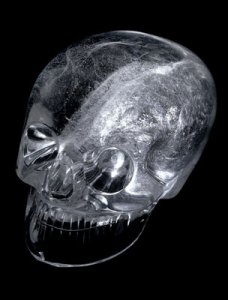
The picture shows the Crystal Skull in the Wellcome Trust gallery at the British Museum, one of several such skulls in London, the Smithsonian in Washington and the Musee de Quay Branly in Paris. It was bought from Tiffany and Co in New York in the 19th Century by the French collector Eugene Boban and is connected to the writings of the English ‘explorer’ Frederick Mitchell Hedges, who sued The Daily Mail in the 1920’s for libel when they accused him of being a fraud, and lost. The British Museum have tested it and far from being pre-Columbian, metal tool wheel scorings prove it is 19th Century, although original pre-columbian skulls exist. It would have been the centre of a world plot in ‘The God Game’, for all to enjoy, if the forces had massed, or perhaps George Lucas had not got there first, in the rather overblown and silly Indianna Jones and The Crystal Skulls, much as Spielburg is a god.

Leave a comment

Filed under Culture, Education, Fantasy, Language