Category Archives: Culture

The Artists of Kalk Bay

image

“Ya, artists of all kinds flock here” says Arabella Caccia, as we look down on the skillful little milk swirl paintings of some very convincing birds floating in the top of our cappuccino in Ohana café. A distant descendent of the model for Leonardo da Vinci’s Mona Lisa Arabella tells me about the never so fraught life of South African painters and sculptors. Of course here it is as tough to survive, let alone make it, as it is for any artist, probably made more so for a white half-European like Arabella by the moves towards ‘decolonialisation’ that have dried up municipal commissions and been encapsulated by the recent ‘Rhodes must fall’ campaigns.

The difference being that as the little single rail metro train chuggs along the sparkling coastline, it’s commuter carrying coaches covered in garish graffiti, roughing it in Kalk bay, Cape Town is a much more pleasant place to do it than many. I have penetrated deep beyond the so called ‘lentil curtain’, south of the city toward the Cape of Good Hope, to visit what might be described as the Greenwich Village of Cape Town. It is just edging toward High Season when tourists descend to enjoy churning turquoise waves, cloud curled blue skies that turn every day into an impressionist painting, restaurants, coffee bars and the many curio, antique, art and souvenir shops that crowd the Main Street.

Like Africa, Kalk bay is a very colorful place, and some lively and appealing art work leaps out at the eye. The witty, highly glazed Greyson Perry style ceramic pots in the window of the gallery Agapanthus, one emblazoned with the jolly motto ‘Holy Shit’. The landscapes, portraits and abstracts that pop out of every window, like those of the appropriately named Artvark. The huge hammerhead shark ever flicking statically past the little Shark Centre, fashioned out of endless strips of galvanized tyre, and bolted together with a thousand screws – recession-beating stuff back in the day, considering the price of casting bronze. On street corners poor Africans try to compete with their touristy trinkets – animals fashioned from twisted wire, metal friezes of the townships crafted out of old coke and beer cans, and piles of bangles, bracelets and beads. They are an echo of the finer but also tourist orientated African artwork on sale on the roadside near tourist destinations; endless animal woodcarvings of giant giraffe, elephant  or hippos with seats for open mouths, but also the often very skilled polished stone carvings, also commonly on sale in places like Kirstenbosch botanical gardens.

image

Considering how much is around, everywhere, you wonder how anyone makes a proper living, but then there are the more experienced fine artists like Arabella Caccia, or Andrei Stead, whose interesting sculpted human half-cutaways  being appreciated in the Christopher Moller Gallery in the centre of town. Nearby at the Everard Reid gallery they were celebrating their 20th anniversary by inviting a young curator to stage an exhibition that was all student-style installations and anguished videos that did not do it for me. They are places it is important for any artist to cultivate and yet with the very high percentages galleries take, perhaps Arabella and her colleagues and friends have come up with the perfect solution. Near always popular and very artsy Olympia café and bakery, that thrums with locals gorging on some of the best seafood in town, they now share studios, foundary and their own gallery too, a hopeful and enterprising solution to any artistic woes.

Four artists work out of the space, Arabella Caccia, bearded Jan Smutts look-alike Jean Tiran, his green motorbike parked in the forecourt, whose fine abstract bronzes and stone carvings also adorn the space, and who doubles as the bronze caster, patina specialist and master craftsman, and ex dentist Chris Bladen, who does some wonderfully realistic bird and fish sculptures. The whole place is owned by a former salvage diver Peter Strydom, whose often humorous bronzes add a fantasy element to the enterprise. Not yet open, their pieces already dot the airy main room, and adorn the long table where they plan to host several dinners to encourage interest. The problem for any artist is their engagement with their own work and unwillingness for the hard sell or to act in the role of gallery owner, even here, which is itself a full time job. Thus their mutually supporting enterprise is unlikely to replace the need to exhibit elsewhere too, while at times they do face the odd complaint from neighbors. The week before I had seen some of Arabella’s lovely symbolist sculptures in the beautiful gardens of Grand Provence winery in Franshoek, which is also showing her paintings in their dedicated gallery. But now their outfit at Kalk Bay is not only a great place to work and be, but a certain place to exhibit too.

Arabella Caccia, who until recently had her studio in her little garage at her home in Kalk bay, is clearly delighted with the new space, not least with the company and working with people she clearly likes. Art can be an isolated business. But now, achieving new success at places like Grand Province, and still hugely interested in the art scene in Central Cape Town, as well as galleries in London, New York and abroad, she is really able to spread her wings. “It’s freed me up for new ambitions and dreams,” she says as she gaffers a giant piece of artist’s paper to the wall, soon to be blooming with a livid Rothkesque red. Arabella has interest in many artistic forms, a firm believer in knowing the classical rules before you break them, and her wonderful oils of often isolated and ethereal yet also grounded woman provide a powerful contrast to the fine masculine sculptures in the gallery. But recently she has developed a series of images and colours she half jokingly describes as ‘visual Haikus’, inspired by her time in the Tsitsikamma forests east of Cape Town. In the forms of tree bark and flowers she is finding shapes not only echoed throughout nature, but also in human lettering itself. Formed into wax casts too by the crafts men and women in the attached workshops she is also turning the shapes into some highly original sculptures. If what I have seen in Kalk bay is anything to go by she and her colleagues are about to take wing.

The photos show the work of united artists Arabella Caccia, Jean Tiran, Chris Bladen and Peter Strydom in their new gallery space on Windsor Street, Kalk bay and work in progress in Arabella Caccia’s studio.

Leave a comment

Filed under Community, Culture, Education, Environment, The Arts, Uncategorized

SNAKES IN PARADISE’S GARDEN

 image

A snake came to my water trough…” DH Lawrence

A morning stroll over gentle Elsie’s Peak for magnificent views of the curling Atlantic surf, down to Cape Point, proved I hope the most auspicious introduction to Cape Town. Since among the leathery, yellow green Protea plants and bright tipped wild flowers my hostess suddenly stopped dead. Not three feet away a bejewelled puff adder pulled its fat gold-black body across the dry earth right in front of us, back into the secret scrub. It sent an electric thrill through us both, at a vital touch of danger in paradise.

Despite the student riots that week then and the burning cars at Cape Town’s University, UTC, with demands for free Tertiary education from the much criticized administration of President Jacob Zuma,  in a ‘Fees must fall’ campaign, the press reports of 60 rapes a month in the nearby district of Phillipi, or ‘those stories’ of Africa that always keep you sharp, or vaguely nervous, so far my touristy experience of exhilarating Cape Town has been of a coastal paradise. If with twinges of guilt at joining the beautiful and select in what sometimes feels like a manicured Urban Golf Course, over yet another glass of delicious South African wine. Along the well mettaled roads, among the smartly streaming cars, afternoon traffic jams and many signs of considerable wealth are the black Big Issue sellers, the fly by night traders, the beggars, the corrugated township huts and those already lost to ‘tik’, Crystal Meth. Yet in the Pick and Pay supermarket at Constantia, black, white and colored pensioners were having a very jolly time at a local get together.

That sense of a paradise though, troubled or not, was confirmed today by a visit to one of Cape Town’s true jewels in her glittering and always colourful crown, the lovely Botanical Gardens at Kirtstenbosch. Opened in 1913 on farm grounds that once belonged to that very incorrect Empire builder, Rand Lord and chairman and go founder of De Biers, Cecil Rhodes, the sculpted beds, scented walks, manicured lawns, ragged gorges and winding forest paths, nestling in the haunches of mighty Table Mountain, are where the wild and well-watered find a perfect harmony.

Rhodes, who planted the Camphor Avenue here, now grown to deliciously shadey proportions, is so iconic, like History itself perhaps, good or bad, that I was surprised to find he died at only 48, with the probably apocryphal words – “so much to do, so little time”. When you know a little more of South Africa’s rich and anguished history, how recent Apartheid was and how recently abolished too, you cannot help but think how much has been done and lived through in so little time. How even that pales into insignificance too though in terms of the gigantic sweep of Geological Time you can glimpse at Kirstenbosch.

They’ve expended much time and great skill too developing the National Botanical Gardens, with its various beds, Arboretum and Concert Lawn, stocking it with a cornucopia of those rare plants that make the Cape quite unique as a botanist’s treasure chest. The gardens boast two and a half thousand species of indigenous plant. Though the likes of Rhodes are hardly figures happily talked about now, with a “Rhodes must fall campaign” too, and that militant trend much criticized and feared too by many white South Africans towards the ‘de-colonialisation’ of African history and culture, echoed in recent protests at Oxford University too, by seeking to remove signs like the Neo Classical Rhodes Memorial. Indeed, just today, Rhode’s statue at UTC was removed, to little concern from white friends here.


‘Sweet waters’ is the original name for Cape Town, and that astonishing cloud topped monolith, six times as old as the Himalayas, is the City’s secret and its true mystery. You can feel it when that bank of cloud that locals call the Table Cloth spills off the mountain’s edge, like the beginning of some Olympian banquet. Up there it clings to the defiantly hardy plants and the indefatigable shrubs, ensuring three times the normal condensation, so constantly feeding the myriad springs that rush down its slopes towards the chilly sea. It is part of the reason for the astonishing variety of flora and fauna at tranquil Kirstenbosch and the lushness of Cape Town too.  “I’ve never seen so many birds feeding together” said the guy with the shotgun Camera, as butterflies, Canary, long tailed Sugar birds and dazzlingly flourescent Sun birds darted, dipped and feasted around us.

There is something else at Kirstenbosch that might make it a microcosm for the whole of South Africa too, part of the fence and hedge established in 1660 right across indigenous cattle routes by the settler and Commander of the Dutch East India Company Jan Van Riebeeck. The very early beginnings of Colonialism and Apartheid. You half expect Donald Trump to burst from the foliage. Except that appalling and unnatural division enshrined as a social ideology and in Law by the Afrikaaners only in the twentieth Century is ostensibly gone in South Africa, and at Kirstenbosch what remains are a new explosion of well labeled plants, flaming choral trees and magnificently curling and splitting trunks – saffron, wild fig and giant mahogany. Ominously identified too in the Garden of Extinction are the 1500 species now in danger on our impossibly small Planet.

I was really won over though by Kirstenbosch’s brand new ‘reptile’. The “Boomslang”, or tree snake, is what they call the brilliantly designed little walkway now curling through part of the canopy, like the city twisting about the giant mountain, and opened in 2014. According to one knowledgble white old timer, who comes here every week, the walkway has increased the Botanical Garden’s visitor rate by 60%. As we listened to the strange quack of mis-named Egyptian Geese, he told me too about the Jan Smutts gorge above us, the famous Boer general had taken up his beloved mountain at the age of 80 to meet the British, who had used the nascent cable car. He was informed and friendly, also telling me how he had played with snakes as a child. In such serene surroundings then I voided wearing my Liberal credentials too heavily when he started talking about ‘them’ having no idea of design, over a book recently produced about Table Mountain and the ‘ugly’ Xhosa name on the cover. I found it rather beautiful.

The day before I had invited myself up to that visual banquet among the Gods, taking the slick modern revolving cable car to the top of Table Mountain. So among tourists as multi-cultural as you can imagine, with many from China, we had all looked down, not only at the city’s astonishing views, but the forbiddingly arid splodge of Robben island, lying ominous in the turquoise bay. It was of course where Mandela spent eighteen of his 27 incarcerated years, breaking rocks in the limestone quarry. In the Press meanwhile the Finance Minister Pravin Gordhan, the well respected Indian Finance Minister, had just announced new funds for Tertiary education. The recent corruption charges leveled against him have now been dropped. Meanwhile, today protests in Pretoria again turned to violence, with calls for President Zuma to resign. Perhaps, with opposition voices crying  ‘not on our watch’ this is a critical moment for South Africa.

The country’s challenges remain vast, with only 1% growth, perhaps a 35% unemployment rate and 738 corruption charges pending against Zuma alone. Though he has just withdrawn opposition to the release of the ‘State capture’ report  which may expose the true levels of corruption. The white Jewish journalist John Matison, who worked for Mandela, is not alone in saying then that the likes of Zuma have morally bankrupted Mandela’s vision of that Rainbow Nation, if beyond the symbolism, and with such vast differentials, it ever really existed.

You would not think that dream dead strolling through the sweet smelling Camphor walk at Kirstenbosch, nor visiting the ever popular Robben Island gateway Museum. Where wall plaques testify so movingly to the spirit that endured so much and yet answered hate, intolerance and fear with dignity and forgiveness. So creating a conscious monument not just to oppression but the vital possibility of human hope. That lies not just in the hands of blacks but all South Africans, and perhaps most especially reformists whites in positions of huge economic power. It is precisely the problem of easy ‘de-colonialisation’, too though, or a few wearing T-shirts like ‘Kill the Whites’, since it invites a pointless and dangerous forgetting.

Yet life’s stings are everywhere too, and I was still in search of my African adventure and our auspicious, if secretive friends. So stamping my feet loudly, I left the path in Kirstenbosch and set off across a little stream, then climbed one of the many stepped earth walks that ring the gardens toward the wilder edges of the mountain. There it was, one of the Lords of Life, as DH Lawrence put it in his poem The Snake, just to my left and making off fast through the tangled tree roots. Perhaps four feet long, it was only a juvenile, yet with the strong yellow brown markings of the Cape Cobra, barely flexing its hood in warning at my ignorant passing.

The thrill at that living reality was the same as the sight of our puff adder, and the gorgeous, intense vibrancy everywhere here. Where, again in Lawrence’s words, you would be a fool to miss your chance, or have any pettiness to expiate. As for old and lost arguments, there are still those voices that cling to some kind of fighting nostalgia about what happened in South Africa, but they are generational and will pass away, in the great sweep of time.

Of course there is another presence in Kirstenbosch now though, among the memorial benches to passed locals who loved the place, a little bust of sweet faced Nelson Mandela – ‘Madiba’. He opened a walk here flowering with pepper bark trees, ‘Mandela’s Gold’ they named the flowers in his honour, their bright yellow buds filled with a pointed purple magic. The pepper bark is a traditional healing plant here and that was always Mandela’s triumph. It was not just his though, but De Klerk’s too, though the astonishing inspiration of Mandela remains both his courage and then suffering, but that he could rise from it all speaking of reconciliation. It is far more than that though, like laying careful walkways and tending well watered gardens, so trying to map the future with a Constitution that is universally admired and will hopefully prevent Zuma copying the pattern of so many African leaders.

Never tempt the fates, nor the snaky auspices, but there is something about friendly, vivid Cape Town though and that joyous and dignified voice of Mandela too that makes this place still potentially so visionary, not just for Africa but perhaps the endangered World. Now we all need to hear the voices. Whatever that future holds there are few more serene and inspiring places to contemplate it all than in the magical gardens of Kirstenbosch.

The photo shows the new “Boomslang” walkway at Kirstenbosch national botanical gardens, Cape Town, South Africa.

Leave a comment

Filed under Community, Culture, Education, Environment, Non Fiction, Uncategorized

A THRILLING, RAUNCHY ROVER, IF SOMEWHAT CAVALIER PRODUCTION

the-rover-production-photos_-2016_2016_photo-by-ellie-kurttz-_c_-rsc_203480

Non-stop fun is the stamp of Loveday Ingram’s exuberant, and very sexy production of Aphra Behn’s The Rover for the RSC, in the perfectly proportioned Swan Theatre, Stratford. Complete with hysterical Flamenco forays, touches of tango, a stilt walker, and excellent on-stage band. With a Conchita Wurst look-alike, the bearded lady boy among a tranch of devil masks, in what is very nearly The Rover – The Musical, I half expected someone to break out into Don’t Cry For Me Argentina.

Except Naples is the setting for the late 17th Century Restoration play, at Carnival, to turn everyone’s Worlds upside down, then restore them to the same old cynical order. A steely 1920’s cast-iron stairwell backs the simple set, to represent both the keys to the Kingdom and the Whorehouse, in a very hard world, and for the arrival of four exiled English Cavaliers led by Belvile and our particular Don Giovanni, Millmore: Very possibly modelled on the notorious Earl of Rochester, he who penned poems about dildos and things and died at 33 of booze, syphilis, and genius. This production is good Karma, with The Libertine about Rochester’s life on at the Theatre Royal in London, and Millmore is played with wonderful gusto and skilled comic timing by Joseph Millson, giving a tour de force performance he revels in.

From the moment the Prologue is given to the charming and excellent Faye Castelow though, playing Millmore’s equal-to-be, Helena, so that we really know this play was written by a woman, indeed the first English female dramatist and also a spy in Antwerp for Charles II, we are in safe directorial hands. A knowing self-awareness breathes through all the strong performances, that liberates everyone to many kinds of play. Since Millmore is trying to play fast and loose with every pretty woman that meets his eye, so the director’s cuts have played loose too and streamlined things well, if you wonder if cries of “Mummy” or “Kinky” are quite 17th Century.

Then they have gone for knockabout comedy, and ad libs too, including some great audience interaction, not least when Millmore is drunk, that always delights a crowd. If turning a line about old men and impotence on a greying member of an audience that seemed predominantly over sixty might have been a bit close to the bone! No pulling of punches here then, in the lusty manhood stakes. The climax, with an explosion of rose petals from the ceiling, nearly had people up and dancing on their feet and crutches.

This Rover certainly underplays the darker side of Behn’s play, based on one by Thomas Killigrew, where even the finest women could hardly avoid being labelled Wife, Nun, or Whore. The shadows grow in the story of the very funny and then nasty Blunt, the stuttering English Gent with his hand on the purse strings, played wonderfully by Leander Deeny, who is gulled by a prostitute, described in the original cast list as a ‘jilting wench’, into believing he has found true love. There is little time in life’s seething energy for his brand of hurt though, his hatred of being laughed at, so he is driven off stage in the first half by the semi-demonic revellers. Only to return demonically himself in the second half on the edge of doing something very nasty indeed, where a comedy edges toward potential tragedy, to remind us what can happen in the real world.

What is revolutionary in Aphra Behn, and so provides the explosive energy of poetry and thought throughout, is her ‘feminism’ is no mere complaint about manly men, hate of them either, but a cry for woman to be equal in all. Or at least her and Millmore, since by the end you do believe the pair on stage have found their true match. Thus it is two sisters and their kinswoman who set the plot in true motion too, as Florinda longs for Belvile and Helena refuses to disappear into a nunnery. So, disguised as gypsies, they hit the town like the Cavaliers and paint it red.

The main plot sees the honourable Belvile trying to find his lady, against the machinations of the nasty foreigners trying to arrange marriages, and along with a joke about drawing the longest sword, a Toledo blade, a pair of splendid guilded boxer shorts appear, belonging to a very good Don Pedro, endless filthy double entendres ensue, and there’s even a burst of Rule Britannia. The secondary plot involves the Courtesan Angellica Bianca, and since Behn lived when the theatre was very close to the brothel, perhaps reflecting her own initials and sentiments too, who falls for lusty Millmore. Alexandra Gilbreath is both moving and funny as the whore who gives her ‘virgin heart’ away, to no avail. Though a special mention for her slinking side-kick in a bowler, Alison Mckenzie’s knowing Moretta, who gives a nod to Joel Gray’s compere in Cabaret. This is a world that in truth seethed with violence, sex and fear, where a true Courtesan might make much of herself, but the whore and the poor always paid the price in the end, although Blunt shows men can be victims too. Though since Behn was a Royalist – the play is also called The Banish’d Cavaliers – it is Millmore’s poverty, along with his wit and courage, that gives him his nobility and wins him the prize; not only Helena, but her lovely fortune.

You can read reviews of King Lear and Cymbeline below.  David Clement-Davies

The photo shows Faye Castelow and Joseph Millson as Helena and Millmore in the RSC’s production of Aphra Behn’s The Rover, in the Swan Theatre Stratford. Copyright Ellie Kurttz.


Leave a comment

Filed under Culture, Poetry, The Arts, Uncategorized

CYMBELINE FINDS HER TIME, OR BRITAIN ALSO LOSES THE PLOT?

cymbeline-production-photos_-may-2016_2016_photo-by-ellie-kurttz-_c_-rsc_192899

Thanks to the RSC, and Gillan Doran’s wonderfully ambitious programme for the 400th anniversary, not least for bringing me to a play I’d never even read, Cymbeline. Despite a sinking heart opening the programme to see a picture of Dave Cameron, and a journalist lecturing on about Brexit and why after being neglected for so long this is a play that has at last “found its time.” Hmmm. Shakespeare is always profoundly politically attuned, though better at exposing the imperatives and mechanisms, the nasty guts, than being didactic or ever lecturing. Was the graffiti on the concrete wall then, along with the programme’s nod to Banksi, or an anguished model of a Refugee boat, to make us suffer a Referendum all over again? I think the real irritation is that for nearly three and a half hours it had me imagining Gillian Bevan’s stout, very capable Cymbeline, part Britannia, part Boudicca, as Theresa May, (with respect, a bit of a look-alike), or is that Theresa-may-not? Not that Bevan is at all Lilly livered, and now I know Cymbeline means Cymbeline and there we are!

As for their Brexits, or their Entrances, in a proudly multi-cultural cast, what also irritated is directors (now trendily called Creatives at the RSC) thinking that a lot of running on and off stage and gabbling difficult lines passes either for theatrical energy or realism. Though when the actors settle into thinking and feeling through the words and poetry, there are some excellent performances. Not least from Bethan Cullinane as Cymbeline’s much tested daughter Innogen, the black actor Markus Griffiths as a very funny Cloten, James Clyde’s excellently malevolent Duke, and the Irish actress Jenny Fenessy throwing off the tyranny of the poor understudy to play Pisania, while a treasure chest of language is thrown open.

Jokes aside, busy director Melly Still it is quite right to suggest Brexit’s relevance, since Shakespeare was born out of the trauma and liberation of a disintegrating Christendom, (a reason today’s violent Religious and Scientific divides  or Terrorism might be even more pertinent), if Europa was a word and concept only just emerging at the time. As still Top Monarch, Queen Bess, who made a lot of cash from Hawkin’s African nastiness, and thugs like Francis Drake, saw the loss of any kind of Empire in France, though viciously trying to plant Ireland. While King James mooted but failed to achieve a Union with Scotland. So how did Britain really thrive and invent herself? By putting money in everyone’s purses, well those at the top, from little London, and ruling the waves elsewhere, away from the internecine battles  erupting in Europe. Oh brave New World.

You can argue then that much of Shakespeare is also inevitably about the very writing of a new English Imperial identity, if only through the most glorious expression of the English language. The world’s centre of Gravity was certainly shifting violently though by 1600, in a moment that probably did define how Globalisation and Capitalism would develop and which has not seen an equivalent sea change until now. It’s not just Brexit, of course, but how the Internet is probably the equivalent of the Printing Press revolution. Perhaps Shakespeare is a bit to blame then, at least for that outburst by Tory MP Jacob Rees-Mogg limply invoking tigers, to give Cameron a prod. I think Henry V is about the conscious manufacturing of a powerful new political rhetoric, soon adopted by the ‘Establishment’.  Even as a once far more intimate Monarchy separated itself from the lower orders, and banished honest Jacks to the bilges and top sails, it conquered half the World, with planting, privateering trade and slavery, and owned it for a very long time indeed.Is that what modern Breixteers want? Not of course that Bill did all this alone, bless him. The Virginia Company was founded in the year the Globe went up on Bankside, 1599, just opposite that walled fortress of London, still a Global epicentre today in UK PLC, and the little Tudor cannons of the terrifyingly powerful and private East India Company were bristling from a fort in Madras by 1607.

That year Shakespeare’s youngest brother Edmund died at just 27, an actor too, and his daughter Susanna was married in Stratford. While ‘savages’ were attacking the new fort at Jamestown, King James’s town, and a little merchant ship called the Red Dragon, Henry Tudor’s badge, did performances of both Hamlet and Richard II off the coast of Sierra Leone. Britain had truly set to sea, and it was coming back in bucket loads. For hundreds of years the scholarly Establishment claimed that record had to be a forgery though, because the Common Man could not possibly understand their Bard, if still stuffing him down School children’s throats. To improve us all and claim Shakespeare was essentially Conservative and there’s nowhere like an England!

If we think Euromillions is an innovation though, the first free standing lottery was launched in 1612 to help colonise Virginia, soon taken up by all thirteen original Colonies, to give very early origins to that ‘American Dream’. Talking of which, having a snack in Café Rouge before the show I’d opened The Times to read with even more sinking heart that the usually balanced and liberal Matthew Paris had just suggested we toughen up on the asylum rules by suggesting what constitutes danger should now only be the threat of Death! Then that Donald Trump was ahead in the bell-weather State of Ohio, invoking the example of Brexit. If we think our own Liberal sentiments (or not) can sway US Politics though, when people were asked to email Americans to complain, they got some very rude replies indeed, about being stupid, Lilly-livered Brits and worse.

A little credence then to the relevance of the traumatised Brexit line, four centuries on, although the production has faced much criticism. Some slack too in Ms Still peopling a Roman court with Mafiosi Eurotrash in lounge suits, sipping cocktails and speaking in Italian, translated onto big screen sur titres, that then translate Latin too, when the big Romans claim their imperial tributes from the smelly Britains. Who dares to translate the greatest translator and interpreter of them all – Shakespeare? Well, Melly Still! That rather heavy handed moment is about the river of history, peoples and languages that made Britain and which Shakespeare’s astonishing English emerged from too. The first dictionary was only printed in England in 1604 and Shakespeare is profoundly a Renaissance writer. While to set us up for losing our heads, the set is dominated by a tree stump, in a glass box, perhaps to echo the production of King Lear. The rest is as hip, with film, and part concrete and vegetative back revolves, to suggest Nature will always break on through, complete with images of modern Rome’s Empire-littered streets and Dad’s Army Invasion maps to have you suddenly asking – Who D’yer Think Yer Kidding?

Actually I should underline that Cymbeline is a tragi-comedy. So to any grasp I got on the plot, untangling which might win you Brain of Britain. Cymbeline’s daughter Innogen and Posthumus are star crossed lovers, or most crossed by Cymbeline, so Posthumous has to flee abroad. There, boasting of Innogen’s love and fidelity, he is tested by Oliver Johnstone’s excellent Iachimo, who travelling to Blighty, as Rome seeks tribute, emerges from a chest in her bedchamber to discover Innogen asleep, nick her bracelet, and spy a starry mole by her breast, rude fellow. So being able to trick Posthumous into believing he has done the act of darkness and Innogen is false. Like Michael Gove Iachimo pays Manhood’s price later, when the War of Men without Women erupts into horror, or is that Boris Johnson?

There is a tangle of poison that isn’t poison and lots of people trying to bump each other off, like Boris Johnson and Michael Gove. As Cymbeline revolts against Rome, Innogen flees to the forest, to encounter an exiled General good-of-heart, Graham Turner’s splendid Belarius, and her kidnapped brother and sister, Arveragus and Guideria, emphasising all the healing Nature virtues, and played very well by James Coonie and Natalie Simpson, especially Simpson as Guideria. Though in the tangle of tree roots or Brain-stem ganglia they first appear swinging from, and the whooping hunting cries, perhaps nicking far too much from Avatar. Mind you, did you see that article in the Sunday Times about tree roots being connected and talking to each other, even nurturing or throttling their young, in this global world of ours? With a very peculiar dream Mask, when Jupiter is invoked, to explain the meaning of names via a prophecy, everyone loses identity in going to war, or finds their manhood, though the Brits win, but still need a Cultural head, so pay tribute to Ancient Rome. So Cymbeline ends with the most astonishingly uncomfortable series of resolutions, more than any in Shakespeare, that had many laughing aloud, including me.

Cymbeline is certainly about a crisis of identity, but it sits not at all in Shakespeare’s overtly Historical or straight political plays. It comes among the later Romances, like Pericles, The Winter’s Tale and The Tempest, when politics, life and suffering had probably confounded the Bard a great deal and he turned his hand to achieving effects through acts of artistic magic. Perhaps his brother Edmund’s tragic death was influential in that sea change. Pericles was written in 1607, for instance, all about incest and lost daughters, but with a family crest that shows a withered branch only flowering at the top. It may be more true though that rather than Cymbeline not being popular for centuries because we had an Empire now, imposing its own tributes, it is because it is a very easy plot to lose. Melly Still throwing the baby and the bath water at it hardly simplifies, or leaves us quite knowing how to vote either. Even if Jacob Rees-Mogg should be told that despite the Histories, most of Shakespeare’s plays are set in interesting foreign and Renaissance climes. I thoroughly enjoyed Cymbeline though and it did not drag for a moment, though the bloke playing the School Master at the new Edward VI museum, backed I think by Mr Gove, told me, rightly or wrongly, it originally ran to five hours! Enjoyed it because just when you’re wondering how Cloten, chasing after Innogen, can get away with possibly being Posthumous in his very ill fitting clothes, so to trick Innogen into believing her lover is dead, his beheading by Guideria is almost hysterical. While Innogen’s burial, then waking to mistaken grief, and true horror, is probably one of the strangest things I’ve ever seen in the theatre. Not least too because Shakespeare, inventing everything, even comes up with the phrase “Brain of Britain”!

 The photo is from the RSC’s rather startling and controversial production of Cymbeline, directed by Melly Still, showing a disguised Posthumous going to war with the Romans, as everyone wrestles for their identity and they try to shake us over Brexit.  Photo Copyright Ellie Kurttz. Ticket courtesy of the RSC Stratford on Avon.


Leave a comment

Filed under Culture, Environment, Language, Poetry, The Arts, Uncategorized

FINDING NEW GEMS IN THE STRATFORD-SHAKESPEARE CROWN

dsc_0002

It was the woman at the New Place ticket office grudgingly lending me a cheap biro, then sourly commenting that not even the Birthplace Trust staff get discounts from the RSC, that had me wondering how everyone really rubs up together in little and hugely over-commercialised Stratford-Upon-Avon.  The house on Henley Street is at the centre of it, Shakespeare’s family house, and the shop where John was a whittawer, a maker of expensive white leather gloves, though the name The Birthplace does give the Bard the gravity of some kind of British Secular Christ.  But the Birthplace Trust are the chief Guardians of Shakespeare’s historical and physical legacy, running, with Royal backing, his house, the archive, and several properties, from New Place to  Hall’s Croft, Anne Hathaway’s House and Mary Arden’s farm.

“The Jewel in the Crown” of all Shakespeare exhibits around the world is how the reopening of New Place is described, highly ambitiously, in the bumf. New Place being the site of the house Shakespeare bought in 1597 for around £120 (I thought it was sixty) and the second largest in Stratford.  The house is no longer there, though the gardens are, where that mulberry tree was, until it was cut down.  It now has a smart new wooden entrance, where Bill’s front door was,  and sculpture park, I’m afraid I found rather fey and underwhelming, with lots of weather veins and things. Though I liked the Shakespeare Processional frieze, if I think that there already. There is also a new walk through-exhibition and shop in the Jacobean house next door, that belonged to Thomas Nashe.  That isn’t at all bad, with the odd little period object in drawers about the place and good time lines to make it interactive, though very much designed for kids and families, to bring ’em in. Well, the folk in the shop, where you can buy imitation jewellery for £75 and £140, were pleased that since opening in August his year it has topped its target of 12,000 visitors.  Though I was annoyed at the door that tickets, which let you into several properties, are £17 but you cannot buy individually.  So you can make a deal out of the merciless Shakespeare industry that has developed,  if you get it right. The foodies were trying to get it right that weekend, with a three-day event of global cuisine, at the reinstated Food Festival in tents around the town, and a bright red Pimms teapot. While a Michaelmas fair at Mary Arden’s farm, my favourite in terms of hockey recreations of Shakespeare’s living world, had mummers, cider makers, basket weavers, archers, falconers and a fellow with a splendid eagle owl to delight the wide-eyed kids.

But for me the real jewels in the crown, if not owned by the Birthplace Trust at all, came just over the way from New Place. First was the splendid little Guild chapel, just across the road, I had never seen before and Shakespeare must have known very well indeed. Since the medieval Catholic frescoes have been somewhat uncovered, with excellent placards to explain and recreate, it perfectly elucidates Andrew Graham Dixon’s point in the programme to the RSC’s King Lear (see review below), about England being culturally and visually blinded in the Puritan whitewashing of images, so giving space to the explosion of the secular word to make us see again, or in a different way.

How thrilling though to stumble next door on Chapel street into a brand new exhibit, The King Edward VI School Museum.  I had often walked past, hoping to catch an imaginative glimpse at Shakespeare’s shining morning face, because he was very probably educated here, six days a week, from 6am to 6pm, for seven years, if his real education was a pastoral one, in life and nature.  So perhaps were his brothers Edmund, Richard and Gilbert. What better way to start to understand the man, and with a very mature exhibit?  Lo and behold, the grammar school itself, given royal charter in Edward VI’s brief reign, one of those 120 or so that still exist, with more mooted by Theresa May, and which is a State funded free school, have, with the help of a million and a half from the Lottery Fund, just opened the place up to pedagogy, or lovely private enterprise. Modern pupils still have morning lessons there too.

It is exceptionally well done, a beautiful building, with positive comments from theatrical luminaries like Sir Ian Mckellan blazoned on the wall, a great little film by the always infectious historian Michael Woods, in the old counting house, very welcoming staff and none-invasive but interesting touch screen displays. Upstairs in the schoolroom even a very knowledgeable Magister, in costume, to tell you about how they learnt Latin and Greek, though I’m not at all sure Shakespeare would have had fluent Latin, sat not at desks but opposite each other, and had to learn things by rote.  Quite enough to make any young Shakespeare play truant and run off to the grounds of Charlcotte to hunt deer, or to London to become the greatest and raunchiest playwright that ever lived. The Bard of course, that “upstart crow”, never went to University, unlike Robert Greene or Kit Marlowe, but still topped them all.  Probably one of the reasons people come up with their snobbish Earl of Oxford or Francis Bacon theories, though what would it do to the Stratford gold mine if it was ever proved?

Still part of the modern school, that has created a trust to preserve and open the building, it is really the epicentre of the historical town too. For here before the Reformation was the Guild of the Holy Cross, that turned into the town council, one Shakespeare’s father John sat on, for all his naughty dealings.  Where a court was held too, downstairs, and upstairs perhaps professional players had to perform before snooty aldermen to get a licence. I say perhaps because with lack of records a deal is still speculation in the whole Shakespeare story, from the bogusness of Hall’s Croft, to certainties about most of the properties.  But it was there, and because it thrives as an active and artistic school to the present, that I really felt in touch with the living Shakespeare story. The ‘school master’ was a bit sheepish about how the Museum is doing, but then it is in competition with The Birthplace, and still has to be properly placed on the Shakespeare map.  It should and will be, because it’s very good indeed and should certainly have no one creeping unwillingly to school!

David Clement-Davies was given entry courtesy of The Birthplace Trust and independent King Edward School Museum. The photo is of the knowledgeable ‘Elizabethan’ school master in situ.


Leave a comment

Filed under Community, Culture, Education, The Arts, Uncategorized

WHO FRAMED THE KING?


king-lear-production-photos_-2016_2016_photo-by-ellie-kurttz-_c_-rsc_202320Andrew Graham Dixon’s article in the programme made me realise why the RSC’s coldly magnificent King Lear stumbles in trying to make us see, and feel too. As the art critic says, Lear is all about blindness and seeing, the loss and recovery both of perspective and true moral vision. Whether or not England had been ‘blinded’ during the Reformation, with the whitewashing of frescos and Religious paintings, so its dislocation from thousands of years of history and experience, or only through that could discover an entirely new way of defining reality: The hard Modern World.

Sight though, in all its meanings, is epitomised in the myopia of the mighty King, and ultimate father figure, failing to read the cynical language of his ambitious daughters Goneril and Regan, in his unnatural parental search for the unconditional, as Lear abdicates responsibility and divides his Kingdom and himself. With his banishment both of his favourite daughter Cordelia, for refusing to unpack her true heart with words, and the loyal Kent for defending her.

Metaphor becomes physical fact in the vicious blinding of Gloucester, played admirably by David Troughton, and achieved in Niki Turner’s bold designs by placing Gloucester in a huge glass interrogation box, worthy of The Cube, symbolic both of trial and the  separations of blindness and madness, that soon becomes smeared with his and Cornwall’s blood, as an eyeball bounces off the pane. The odd giggle in the audience was either a reflection of deep unease at real horror, or our own desensitization in a world that sees so much in film and the news. Yet for all the agonies of Lear, the blinding is a very specific act indeed, far from the simply bloodcurdling violence of a play like Titus Andronicus. Shakespeare is very rarely pornographic or gratuitous. In fact the real horrors of Lear are about the inner agonies of mind and imagination, when truly exposed to the whole world. Just as Edgar’s disguise as Poor Tom imagines suffering, and the Foul Fiend too, as much as experiencing them, in an act of feigned madness akin to Hamlet’s.  Lear’s is not quite an arbitrary moral Universe either, just a blasted heath, since Lear’s vanity and Gloucester’s fatherly hypocrisy to his bastard son Edmund, not stressed enough by Troughton, directly unleash what always potentially lurks beneath and engenders the attempts at Judgement and search for poetic Justice. Or rather it puts them on trial too, whether more sinned against than sinning. In the vexed paradox too that if the truth of the World really is violence and the abyss, why should you not be as amoral, vicious or corrupt as the next man?  Pre-empting Nietzsche’s remark that if you stare too long into the abyss, you will find it staring back into you.

So to Lear’s journey towards recovering humanity, or death, his travels with his fool and encounter with Gloucester, after Edgar’s leading his father to a faked suicide on the beetling cliffs of Dover. Graham Dixon quotes Frank Kermode calling that “the most beautiful scene in all Shakespeare” and so it may be. It is more than that though, it is part exorcism and precisely what Shakespeare has Edgar call it too, “a Miracle”.  Or an attempted human miracle, in a now Godless Universe. In that Gillan Doran’s sparse, metallic and pointedly pagan production, raising Lear on a great plinth at the start, among a painted Sun and eclipsing Moon, and their inevitable, ceaseless peregrinations, in an age that still profoundly credited astrology, and used it as excuse, prepare for Anthony Sher’s studiedly formal but now ultimately impotent invocations against his daughters, or the World. Lear as King Priest too, though curses in Shakespeare usually turn on those invoking them.

It also might frame the play in terms of how others have described King Lear, as old fashioned Miracle play, banned in the secularisation of the Reformation, springing from a profound tension in Shakespeare’s own rooted ‘Religious’ instincts, although that is not its main purpose here. This Lear certainly approaches the grandeur of the Miracle cycles, yet the miracle Shakespeare tries for, and so must the actors, is now a secular and imagined one, like Coleridge’s Ancient Mariner forging its own language of artistic symbolism, reached with only the artistry of mind and language itself, balancing journeys of inner and outer perception and perspective.  Also as Coleridge did, making the distinction between mere fancy and true imagination, which can only be touched with real feeling. Just as Shakespeare’s poetry and vision, the stamp of his imaginative wonder, is always a constant movement between the minute and the universal, a specific act of ‘seeing’ and almost physical entering in, akin to Keat’s “negative capability’. So Edgar leads his father Gloucester through a frustrated act of self-slaughter, in an almost Christian sacrifice to the absent Gods we fear treat us like flies, then provides a minutely precise rebalancing, in describing what did not happen, now from the bottom of the abyss. So reimagining everyone’s place in the Universe, in the recovery if not necessarily of hope, then at least perspective. “Half way down hangs one that gathers samphire, dreadful trade! Methinks he seems no bigger than his head”.  It is an act of profound psychology that could give rise to the very word Shrink.

Of course, as Graham Dixon also compares Shakespeare and Lear to the arrival of an artist like the blood spattered Caravaggio, though still connected to Christian and Catholic iconography, Shakespeare is a painter too, but with words, in what was the Age of the Word, as opposed to ours of the image. It is a given then he was and is the greatest word painter who ever lived. Therein lies the rub though, if one you might expect from a strong director like Gillan Doran, also Artistic Director of the RSC. Doran’s production does not cleave enough to the source power of Shakespeare’s language and poetry, and his players discovering them in the intimate act, always the route in my view, through every character, to his ultimate vision and meaning.

Instead, ala Graham Dixon, Doran presents this Lear as almost a series of set piece paintings; Lear on his un-heavenly dais, Lear on a chariot-funeral bier that presses forwards on the essentially framed Proscenium stage, Lear at dinner with his fractious Knights, or a back-lit static battle scene that evokes the Bayeux Tapestry. The tree at the back seems to be trying to win the Turner Prize. If words always paint pictures, a play is not a painting though, it springs alive from the frame, as living theatre.

The production, which seems to have been a sell out, is startling and innovative, at times, like Lear and his fool raised again into airy nothing, not in the calm eye but the curled tear of a swirling storm. It is also somewhat superfluous, because that is exactly what Shakespeare is explaining, through the Gloucester moment, and Lear lost on the Heath, with the movement of his own language and ‘vision’; the nature and miracle of imagination, and how to see in balance again, or go Mad.

For me Lear’s true miracle then should still be achieved through the unaccommodated intimacies of the round, both the humanisation and de-humansisation of suffering, the humbling encounters with Everyman, framed by the world’s blasted heath, not something so distant and lofty. That is what ultimately rakes the heart and dislocated soul, pierces the hurt mind, and might turn terror to tenderness, to make it a play that really is a miracle of creative humanity. Also how Dr Johnson described King Lear though, and which this production is frustratingly not, namely “unbearable”. Instead it remains for me a rather cold tableaux, admittedly exacerbated by my restricted-view seat up in the ‘Gods’.

Sher is of course a marvellous actor, but only truly recovers Lear’s magnificent humanity in the second half, now a foolish, fond and human old man, but if a fool, one with a new wisdom and beauty. Too late to save him and Cordelia, but such is life, if the play or art cannot humanise or change us, and perhaps anyway. The point too though is that for all Lear’s kingly tyranny, what is at times obscene in his life denying cursing of his own daughters, engendering that terrible Nothing, he must also have the love and greatness of the Father King, to elicit the loyalty of the morally positive characters in the first place. Sher is not allowed to show that nearly enough in the long first half, despite the original and intense clinches with his ‘bad’ daughters, an actor who certainly could. Let the actors burst from the frame.

Perhaps that is why the others seem at times dislocated from one another too, in their own frames, and what are vital and very intimate transformative journeys. Which must be enacted with a commitment and love too that raise them to the spiritual and mystical, not the somewhat throw away joke by Oliver Johnstone’s Edgar, preceding Gloucester’s jump, nor Cordelia’s unsymbolic recitation of a bunch of herbs. Cordelia, played by Natalie Simpson, is at once very flesh and blood and symbol of Shakespearian earth magic, as Kent is of a neo Christian duty. I shed a tear at Lear’s description of her death, yet had not been able to love Cordelia, as you must if the play is also to achieve an insight Shakespeare is obsessed with throughout his work, the danger to the powerful masculine if the positive and honest feminine is ripped away, inside or out. That is often the very route to violence, inflation and madness. Also grounded in the story of a mythical character never really mentioned but profoundly operative in Shakespeare, also a story of sight and blinding, King Oedipus.

For me Graham Turner’s fool has skill but is too belligerent to be lovable either, first by shrugging off the audience, to break the fourth wall, and secondly in not truly discovering that tenderness that constitutes some act of healing of the Self too. What is also lost is the seething power of the sub plot, driven by the primal forces of youth and sexuality, along with those ‘New Men’ in a violently changing Elizabethan world, that can make Lear cry “let copulation thrive”. Paapa Essiedu’s Edmund is not bad, but too coy. Edmund is a life force, if a death force too. You must, in Edmund’s “now God’s stand up for bastards”, somewhere want him to succeed, as if you too would overturn the Monster Custom and an unjust and blind social order, even though the consequences may be too horrible to contemplate. It is Lear’s profound question about what Nature and human nature truly are, for Nature was Shakespeare’s Goddess too, but one that would come to cause him a lot of trouble. Essiedu gives Edmund far too much moral doubt at the start then, perhaps to justify his later attempt to save the King and Cordelia. The agony of the play must achieve that understanding and change by earning it, not pre-empting it. With a magnificently visual King Lear then you still want to come out sobbing, not left intellectualising about a walk through the Tate Modern, for as Lear comments “Life’s better at breaking hearts than art is.”

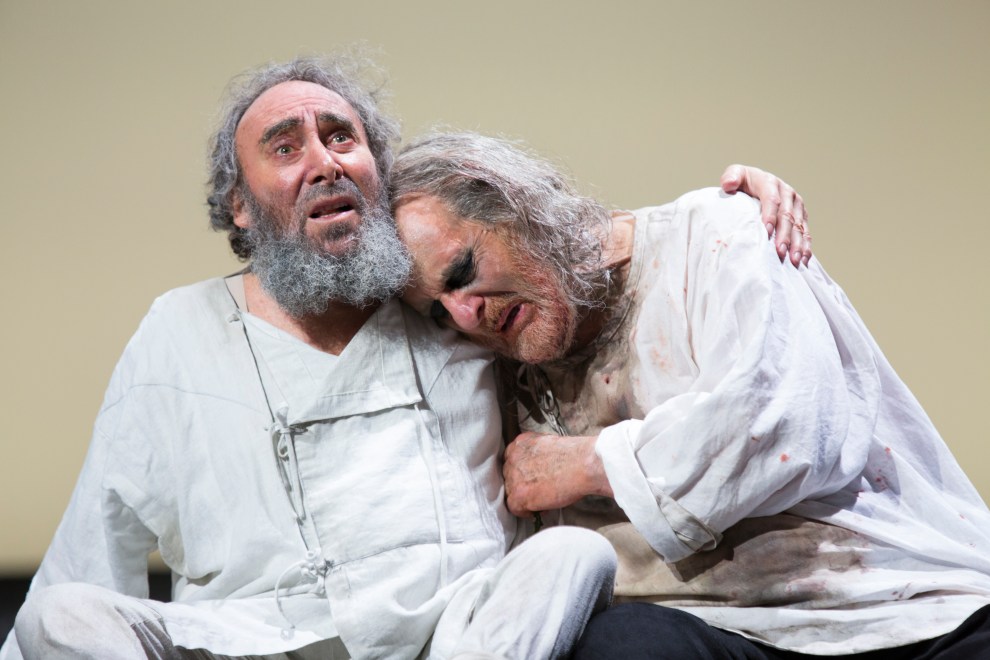
The picture shows Anthony Sher as King Lear, consoling David Troughton’s blinded Gloucester. Copyright Ellie Kurttz. Lear was on the main stage in Stratford on Avon. Ticket courtesy of the RSC.


Leave a comment

Filed under Culture, Poetry, The Arts

THE SHAKESPEARE BLOG – SOUTHWARK, CURE’S COLLEGE AND THE ORDER OF NOBLE POVERTY

St._Cross_Hospital,_Winchester_-_geograph.org.uk_-_638

I blogged last week on the founding in 1588 of the little Alms House run by Saviour’s Church, Cure’s College, on Maid Lane in Southwark, where the Rose, Globe and finally Hope theatres stood, by the Stewes and the river. Parish Gardens, that centre of theatre, brothels and bear-baiting, was nicknamed ‘The Bear College”. I also said that the draconian rules for those 16 local poor folk, men and women, laid down by that saddler to Queen Elizabeth, Thomas Cure, were a forewarning of the dreaded Workhouses to come, that Dickens so pilloried in novels like Oliver Twist. I’m certainly convinced that the shape of modern Capitalism and many of the woes we face today were born in Tudor London. In that privatisation of Church land called The Reformation, but most especially in the explosion of Private enterprise from the walled City, that turned the old English idea of Empire, lost in France, into an Empire of trade around the World. So the East India Company was founded in the same year the little wooden Globe theatre went up, 1599, and in 1605, I think, the Virginia Bay Companies too, that led the expansion in the Americas and the race, especially with the Dutch, for brave new worlds. The East India Company would of course define British power and Foreign Policy for Centuries, owning private armies and putting up their first little fort in Madras in 1607, the year Shakespeare’s brother Edmund died and was buried in Southwark. That same year there is a record of Hamlet being performed on board an East Indian ship, The Red Dragon, off the coast of Sierra Leone. It was formerly a warship called The Spirit of Malice and is mentioned in AL Rowse’s book on the astrologer Simon Foreman. The echoes of such a dynamic time are all over Shakespeare, of course in The Tempest, but also in Falstaff’s descriptions of himself in The Merry Wives of Windsor, in terms of Continents and Countries. Then there is that strange, almost unintelligible dedication on the cover of the sonnets about ‘well wishing adventurers’ setting forth. Those vital player’s patrons The Herbert brothers were of course major share holders in those City Companies, as the idea of sharers and private enterprise is also reflected in Shakespeare’s own theatrical Company, whose leading members had fingers in several little business pies in London, like groceries and sea-coal. In 1612 the first ‘Free Standing Lotterie’ was launched in the city too, to fund New World endeavours, and from common purses too, which all 13 original American colonies would soon take up. I’ve said before they were remarkably early origins then to that so-called ‘American Dream’ (and Shakespeare is filled with dreaming) born in London and the City. It was of course all about trade but also private banking and ownership, along with the massively lucrative beer trade, that in terms of private wealth remains true to this day.

Meanwhile, although Elizabethan ‘social security’ nets were remarkably fragile, they were there, in Parish organisation, although with the often hypocritical and allied hands of Church and State control. Take the unconsecrated graves of prostitutes and the poor at ‘Crossbones’ in Southwark. While there is that telling note in one of the St Saviour’s Records, of a payment ‘to send a woman out of the parish’, as Wards tried to deal with the growing issue of the Urban Poor in London and to fob it off on neighbouring parishes. In the meantime much of the condition South of the River grew into a true nightmare, with places like the Marshalsea Prison on Long Southwark, but also those Liberties themselves, areas of independent jurisdiction, that also spawned Crime, prostitution and slums like ‘The Rookeries’, where Daniel Defoe sets much of Moll Flanders. Despite all our worries then about Banking scandals today and the inequality of rules and playing fields, it was probably only the changing of the laws of debt in the 19th Century that saw true social reform. It is also true that the one old photo I have seen of Cure’s College, by the time it had developed into a stone structure by the early 19th Century, is very forbidding indeed.

Yet I got a fascinating insight into modern Alms Houses the other day when I helped a friend move rooms at the oldest Alms House in England, in Winchester, at The Hospital St. Cross and The Order of Noble Poverty. Of course the links with Winchester and Southwark were very strong indeed. It is very doubtful that poverty was ever considered especially noble in England, outside the beliefs and Orders of sections of the Church, but it is a charming and very historic place, rather like an Oxford College, and dominated by a huge Norman stone Church. It boasts the title of the oldest charitable institution in England. Incidentally scenes from the brilliant Wolf Hall, now running on the BBC, were shot here. It’s a pity I didn’t get to bump into Mark Rylance then and ask such a fantastic actor and former Artistic Director at the modern Globe why he believes the silly and impossible theory that Shakespeare was the Earl of Oxford. It just happens to be that the beneficiaries at St Cross today are all men, and refer to one another as ‘Brothers’, while at Cure’s College there were certainly men, women and children too. You do not have to be of any Religion, I believe, and Cure’s founding document specifically laid down that members had to be of a Protestant faith, though the Brothers today are required to attend Matins in the Church in their red robes. But in return they have charming rooms, peace and quiet, friendship and excellent and highly subsidised lunches too. They are not, as the poor of Cure’s College certainly were, required to work for their bed and board. I didn’t see around the whole place, like The 100’s Hall where a hundred locals were fed regularly, and my dog Rascal upset the ordered tranquility a little when we wandered into the Garden, but that and other Alms Houses in Winchester and around England are a testament to an ancient and noble tradition.

David Clement-Davies February 2nd 2015

For writers in the Sixteenth Century it was hard to survive, books and plays often supported by private donations. We seem to have returned to that time, in some ways, so please realise that the research on Edmund Shakespeare and Southwark represents two years of unpaid work.  If you enjoy these blogs then and can afford to support Phoenix Ark Press, please donate below.  Many thanks.

Donations

The photo shows the main Courtyard of St Cross,medieval but edged by an original Tudor balcony.

Leave a comment

Filed under Community, Culture, Education

THE SHAKESPEARE BLOG – THE MYSTERY AND MAGIC OF RESEARCH

Shakespeare-Testament

An American friend has just asked, in this very free form Shakespeare and London blog, what it is like doing the research itself, in the backrooms and the stacks of great libraries?  A worthy digression, I think, about real life in London, past and present, and the hunt for Edmund Shakespeare or his brother.  Although I first heard about Edmund’s tombstone in St Saviour’s church from a schoolteacher in a pub up in Clapham, and had already started a pretty bogus novel, perhaps that search really began in earnest when I heard a London lecture by Professor Alan Nelson from Berkley University, talking to a small audience in that church about the St Saviours Token Books. Then another to his theatre students down in the lecture hall at the modern Globe reconstruction, explaining how to use the main resources – the London Metropolitan and the National Archives. So talking of the detective work around wills especially, mostly held in the National Archives, among all those pipe rolls and government documents, but also giving that name of the place Edmund Shakespeare was in 1607, the Vine Tavern on Maid Lane in Southwark.   I should say that from start to finish in that search though I have found the academics mostly pretty uncooperative, and of course there is a competition that surrounds everything to do with Shakespeare.  Alan Nelson is doing his own biography of the bard for the 2016 anniversary, but I do think he might have been more forthcoming, as might others, especially James Shapiro’s UK publishers.  Perhaps anyone on the hunt for the bard succumbs to that twinge of paranoia or jealousy that infected that American couple, the Wallaces, who unearthed the Mountjoy Court case early last century and the Silver Street story, but came to believe the British Establishment were spying on them and trying to steal their work.  To add a semi psychic twinge to the Wallace’s peculiar talents, perhaps needed in the imagining of any past, they returned to Texas during the oil rush determined to strike black gold and did exactly that.

But so I set off, in my little Gold Peugeot, to the main centre of the work done, the London Metropolitan Archive in Clerkenwell.   Like every area in London proper, visiting that much changed part of the city of course has its own place in the jigsaw, because scrubby and little-streeted Clerkenwell, with its rough market and emergent cappuccino shops, its modern Turkish immigrants or its Roumanian dominated strip bar, was in Shakespeare’s day the Clerk’s Well, where clerks, scribes and limners settled and Dutch and Flemish immigrants probably ended up in brothels too. There were other major wells, like The Bridewell, Hanwell and so on. Those limners later morphed into the printers and booksellers who especially congregated around St Paul’s Cathedral and Paternoster Row, and modern St Paul’s, with Wren’s proud dome, as opposed to the wood steepled church, of course still looms up now and then among the constuctions.  The idea of wells though, in a City once famous for its clean and pure springs, as Peter Ackroyd says, became as redolent in my head as the 212 parish churches that defined both the development of London and the creation of Reformation records too, or as important as the river itself. So the topography of the place became vital, passing streets like Bowling Green Alley, among so many in London echoing that popular sport, once played out in open fields, as eagerly as archers practiced at Newington Butts, or falconers hunted on the Morefields .  Like visiting the still working pub on the corner of Cowross and Turnmill Streets, near to Smithfield market, which was once George Wilkin’s brothel tavern, where the young Mary Mountjoy stayed with her lover Stephen Bellot.  That would have been in a near rural district outside the now vanished City wall and Smithfield was both a market and a place of popular burnings. Then there is that original remnant of a wattle and daub Elizabethan tenement building, through the arch approaching the very ancient St Bartholemew’s Church, just down the road, that once also had a spittal, or hospital.

Where I was coming from became just as important too, living in Lambeth, in a little flat on Gilbert Road in Kennington, that just happened to have the name of another of Shakespeare’s brother’s – Gilbert. Richard was the other. Kennington, with it’s Dog House pub, probably on the site of one of the old dog houses that surrounded London, once on lands of The Black Prince and where Sir John Fastolf, who fought at Agincourt and that echo of Jack Falstaff, owned land as well as a tavern, the Boar’s Head, in Southwark. I got to know much more about the area in the light of the Shakespeare research. For instance that Lambeth was once the Lamb’s Bath on the river, or that the little market street ‘Lower Marsh’, like ‘Upper Ground’ in Paris Gardens, testified to the effective swamp land this was South of the unembanked river, haunt of cutpurses and gypsies. Hence on Maid Lane too the Globe theatre had been ‘forced out of a marish’ in 1599, or a marsh, as Ben Jonson records in his long poem The Exacration Against Vulcan. Of course the astrologer Simon Foreman also lived in Lambeth, marrying in St Mary’s, beside Lambeth Palace, now the modern Garden Museum. But right at the end of Gilbert Road, turning into Renfrew Road and running into Kennington Lane, the search also began for another lost Elizabethan theatre, the wooden playhouse in Newington Butts, where Shakespeare may have played. On Kennington Lane the names of some ugly Council Estates, like Othello and Brutus Court, testify to its presence, perhaps in the circle that is now a garden, although a mile from the river down Newington Causeway it proved too far out, which is why Henslowe cashed in by building The Rose on Maid Lane. The most likely source of any extant records or clues was at its local church too, St Mary’s Newington, there being nothing in the Metropolitan Archive, which still has a thin sliver of medieval curtain wall looking especially incongrous on Kennington Park Road. A vicar I had befriended told me that Giles Frazer had taken over there, the Cannon who resigned at St Paul’s over the Occupy London protests, but whether he had become too much of a celebrity, was too busy, or thinks Shakespeare and the players unimportant to the plight of the modern urban poor, he never got back to me. That modern poverty is of course much in evidence, especially around the Elephant and Castle, that rather swamps the lost area of Newington Butts.

The London Metropolitan Archive itself though is in an unremarkable little street in Clerkenwell north of the river, faced by a large deconsecrated church and a playground, once a plague burial ground, I think.  Through the glass door, once you’ve pressed the button, and have signed in with the usually polite but disinterested security guard, up you go, see-through plastic Metropolitan bag in hand, to deposit any closed bags in the locker room.  Much the same process and security as in the British Library, where I spent a great deal of time too, reading their copy of Frances Meres’s book, or learning more of Kit Marlowe.   The place is modern, efficient and helpful, and the sourcing is done on a row of computers, mostly, or via the shelved parish record catalogues. Your hand written order chits are then slipped into the order box, to await delivery in the glass sided and temperature regulated reading room beyond.  Pencils and sharpeners in hand you then await the thrilling delivery of those buff boxes, filled with vestry minutes, token books, wills, covenants, scraps of semi-legible medieval paper, hand drawings, or leases, to unfurl them on the reading tables, open delicate volumes on large v-shaped foam reading mounts, keep the tomes open with heavy lead book snakes, or fall fast asleep.  I admit I have never been very good with libraries, easily distracted, keen to flirt, hungry for discoveries that take a long time,  Yet when Shakespeare is in the frame, or that particular period, there is a very special thrill getting your hands on original Elizabethan paper.  As Alan Nelson pointed out of the Token Books, which are just like long restaurant menus, bound with breaking linen threads, all hand written lists of Southwark locals and purchases of Communion Tokens, paper far long-lasting than anything we would produce today, often with particular watermarks. Summoning up images of that first paper mill on the Thames that saw its founder knighted by the Queen, as the establishment have always knighted captains of industry. This was the very beginnings of the printed word though.

So what are you exactly holding there, as you search for that golden moment that never comes, the sight of an unknown record of Shakespeare, or his brother Edmund?  Well, the loose leafed vestry minutes from St Saviours, for instance, are often single or double folds of paper, scratched with fading black ink, often with the minute instincts of the accountant or secretary and hard to read. But so the thrill begins of seeing those words on the covers of the Token Books, that are already numinous places in your head – “Ye Liberty of the Clink, “Ye Libertie of Bankside, “Ye Liberty of Paris Gardens.” Then there is the variable spelling, especially of names, the accounting of pounds and pence, L an i, and the Elizabethan confusion with f, ff, and s.  At first too you have no idea who these hieroglyphs refer to at all, until, screwing up your eyes and your brain too, an english sentence suddenly pops out  and firms up in your  mind- “To the widowe Bradshawe”, “paid to the bishop to bringe water from the Thames in their cartes” –  “A forenoon toll of ye greate bell“, “Paid to the sexton for the burning of mens bones“.  Lives, love, commerce, the past, the church, begin to echo in your head, flicker like candle light, and just for a moment the jigsaw becomes clear, until it is lost again in a maze of broken pieces.  Depending too perhaps on whether or not you believe in ghosts, or trying to get to some harder truth, the conjunction of realities and falsehoods that makes any life, it can be both depressing and even frightening sometimes doing that lonely research.  Take for instance the year 1603, five years before Edmund Shakespeare’s little tragedy, when Queen Elizabeth I finally died, I think in March, after standing for hours on her feet.  As with the death of King James, meaningfully or not, plague hit London very hard that year, and its echo is held in the St Saviour’s Burial Register.  That, like some of the Token Books, is too fragile to be released into the eager hands in the Reading Room and so is on microfilm now. But look at that year patterned on a scrolling neon screen, a patient etherised upon a table, and you will get an astoundingly dark taste of that time.  I believe the average monthly mortality rates in the parish of Southwark were something like 80 deaths, nasty, short and brutal enough, but in May that “Suma Mensis” rises to something like 200, then around 350, to over five hundred by July. So the agonising litany unfolds, in a year that took the player and original Globe sharer Will Kemp too – “A man in the street”, “A servant dropped by the wall”, “A woman in ye Church yard” “A Gentleman”, “A boy”, “A girl” “A stranger”.This was Shakespeare’s real and very dangerous London and remember that Southwark, across the river and outside London wall, was only one Parish among those 212. By October the tally has climbed to over 850 dead and then, the next month, it suddenly dips again.  What lets you really touch it across the centuries though, gives the sense that that great church of St Saviours had become almost besieged by the dead, is the physical sigh of relief you can detect in that unknown vestryman’s hand, as below the list of the fallen a scrolling line trails off down the page.  The plague had finally broken, taking over 100,000 lives across London, and it also shows that although some believed it was a visitation by God, or the ‘foul miasma’s’ of the brothels, bear pits and theatres, these people must have known that it had a pathology.  You sigh and look out of the window at a winter night, or leaves coming on the trees, and wonder what it all signifies, or if it is a tale told by an idiot.

That’s the dark stuff though, compared with the fun of the hunt, and those moments of greater satisfaction.  The egg on the face moment of thinking I had found a reference to a Ben Jonson play in the ‘records’ of Cure’s College, the accumulating data of the centuries, the fascinating snippets about a death ‘in sui felo’, a suicide at the house at Bank End that was overturned in such a rowdy liberty because it would have meant a daughter did not inherit when her father drowned in the river, the approach to the local poor shown in a payment “to send a woman out of the Parish“, and the real thrill of linking the Vine Tavern where Edmund died, to the founding of that local fraternity at St Margaret’s Church on Long Southwark, in the reign of Henry VI, and its ownership by John Le Hunte, Edward Hunt Esquire’s ancestor.  There is another very remarkable thing you of course learn at the London Metropolitan Archive too, as you chat to the staff about the Guilds structures in London, the 12 great Livery Companies, or who might have fallen into what parish, and in what particular Ward, as a group of uneager schoolboys arrive to try something else with the computers, or a lone figures plods away at their own family history. Namely that before Henry VIII’s shattering Reformation itself there simply are no records, apart from a scrap of a document from the Magna Carta period referring to the rights of a Man.  In that sense Shakespeare’s or the Tudor age is a kind of beginning of modern time, in that crowding but still deeply rural and wooden London, and in the municipalization of us all. Nothing ever so certain as Death and Taxes! In the restructuring of the Church into parishes too and the very founding of Parish Registers of christenings, weddings and funerals, in the suring up of Sir Names, so often based on trades, once called The Mysteries, in the all-consuming account of daily expenditure, and in the move from the fable and the chronicle to the conception of modern history and sociology. Then of course there is that secularisation of theatre, or players, the explosion of printing, literature and poetry and of course the man of the moment and all time, Shakespeare, with his strange, eventful histories. A man who knew so well how both the records and people lie, or veil, but that the real history is the history of the human heart, mind and soul.

David Clement-Davies January 24th 2015   

For writers in the Sixteenth Century it was hard to survive, books and plays often supported by private donations. We seem to have returned to that time, in some ways, so please realise that the research on Edmund Shakespeare and Southwark represents two years of unpaid work.  If you enjoy these blogs then and can afford to support Phoenix Ark Press, please donate below.  Many thanks.

Donations

The image is a Wikipdia photgraph of Shakespeare’s Stratford will, written in the classic ‘secretary’ hand, not Shakespeare’s but a scrivener’s, but with his signature at the bottom.

Leave a comment

Filed under Community, Culture, London

THE SHAKESPEARE BLOG – THE STRANGE CASE OF EDMUND SHAKESPEARE AND MR JONSON!

220px-Benjamin_Jonson_by_Abraham_van_Blyenberch

One of the less succesful moments in the search through St Saviour’s records for Edmund Shakespeare, his immortal brother William and Southwark in general was when I stumbled on a payment in the London records “For Mr Jonson’s Book“. It came in an odd place though, namely the loose leaf records of Cure’s College, that little Southwark Alms house founded in 1588. You have to know the difficulty of reading those records, most especially deciphering variously spelled names, and gradually beginning to recognise them too, to understand why, as your eyes start to deteriorate or your pencil blunts in the London Metropolitan Archive, you can suddenly give into the tendency to convince yourself of a Eureka moment.

The first and real Eureka moment was when I had linked the lease of that tavern where Edmund Shakespeare very probably died in December 1607, The Vine on Maid Lane, directly to a local Southwark fraternity granted Livery back in 1460, The Brotherhood of Our Lady of Assumption, and given rights by the King at Westminster, Henry VI, to buy local land of up to Sixty Marks. That was a true window on the history of the entire area because it established the significance of St Margaret’s Church, in the middle of Long Southwark and right opposite the Tabard. Which linked lay church life to the growth of London and commerce in general, in a very louche area, famous for the Bishops of Winchester licensing those ‘Winchester Geese’, for bear and bull-baiting and later for its theatres too. Peter Avergne and John Le Hunte were two of those livery wearing church wardens who invested in both The Vine and The Axe on Maid Lane, in a riverside district of perhaps 300 inns by Shakespeare’s day. John Le Hunte is clearly the direct ancestor of Edward Hunt, Esquire, who by Elizabeth’s reign owned sizeable land in Southwark called ‘Hunt’s Rents’ and bequeathed the Vine tavern to his pregnant wife Mary, also in 1588. His will is up on line. From there many discoveries arose, from the appearance of ‘pleyers’ working for the church back in the 15th Century and performing around St Margaret’s Cross, to the story of the rebel Jack Cade. Who marched from Blackheath and sacked the City in the real beginning of the Wars of the Roses, and fought the Battle of London Bridge, meeting the Bishop of Winchester, William Waynflete, inside St Margaret’s. Cade and his men were staying just opposite at the White Hart Inn, a few doors up from the Tabard. The very catholic and originally Norman church of St Margarets was of course suppressed at the Reformation, and turned into a local compter prison. As the big church, St Mary’s Ovaries Priory, was renamed St Saviours and Bermondsey abbey was broken up too. The Tudor revolution had begun and Southwark was hit dramatically.

But there was a valid reason for my false Eureka moment over “Mr Jonson’s book”, which at the time I thought might be a payment for a lost play by Ben Jonson himself, perhaps the missing “Isle of Dogges”, because of the date of 1598, or possibly “Every Man in his Humour”. Though there are no extant records for the Globe theatre, and Phillip Henslowe’s account books remain the prime source for the period and the theatres, it was not so absurd to assume, in the ad hoc nature of early impresarios and payments from the bag in local churches too, that Henslowe’s hand had got in here somehow. After all Henslowe was both vestryman and warden of St Saviours, which he lived right next door to at the Bell, for several years with his son-in-law the great actor Edward Alleyn. Whose name appears with Henslowe’s on The Great Enqueste in James’s reign, when a scandal developed at the church over abuse of money for the poor. The other reason is those ancient papers for St Margaret’s, St Saviours, and Cures College too, are all bunched together in those buff boxes in the London Metropolitan archive.

Heart in mouth I turned to The Shakespeare Institute in Stratford and Professor Martin Wiggins, a Jonsonesque figure himself in his leathers and Doc Martins. Martin was encouraging at first, although it was tellingly the price of the payment, which I hadn’t written down properly, that raised the greatest question mark. He explained that plays of the period were worth £5 or £6, although Henslowe often gave advances of 20 shillings to writers, which is incidentally the same amount that was paid for Edmund Shakespeare’s funeral. True to any writer’s concern with money, fame and fortune though, as I sought for the book I was trying to write too, I rushed back to the archives only to discover that this payment for ‘Mr Jonson’s Book” was for a mere tuppence! On further eye-scrunching scrutiny of those often illegible papers, if on very good and thick Elizabethan paper, it turned out that this Mr Jonson was just a local scrivener, his little ‘book’ perhaps for copying something, or making an accounts book for the church, and my hopes were dashed.

Yet never be disheartened too easily in the search for such a fascinating period. This goodly scrivener became another of the local figures coming back to life along the river, characters dimly discernible through the veil of financial records, like the Sexton paid at a time of obvious plague “for the burning of men’s bones”, or one “Widow Bradshawe”, one of the local beneficiaries of a place at that alms house, Cure’s College, whose name appears repeatedly. With the likes of Henslowe himself, Ned Alleyn and lost Edmund Shakespeare, they help build a fascinating sociological history of Southwark and theatreland, much about London’s poor too, among whom the players moved constantly. As fascinating as the characters in the Token Books or Vestry Minutes, in trouble with local Constables for refusing to buy Communion Tokens, at various times of heightened religious tensions, or marked down for the number of women moving in with them. Or as the foul mouthed watermen and taverners along the river, among the Stewes, or the sudden occurence of new professions in the marriage and christening records of St Saviours; like shipwrights or a ‘Hansom man’, one of the first moving ‘taxis’, joined with the arrival in Southwark of printers and publishers called ‘men in books’. An odd tale for a blog, in an age when millions of words are spewed out onto the web every day, and so losing so much value, meaning and power. But I am still convinced that was an age as revolutionary to the world of thought, because of printing, reform and theatres, as the internet or the closing of the London Stationers office only as recently as 2005 is to the now.

David Clement-Davies January 22 2015

For writers in the Sixteenth Century it was hard to survive, books and plays often supported by private donations. We seem to have returned to that time, in some ways, so please realise that the research on Edmund Shakespeare and Southwark represents two years of unpaid work.  If you enjoy these blogs then and can afford to support Phoenix Ark Press, please donate below.  Many thanks.

Donations

The image is taken from Wikipedia and is a portrait of Ben Jonson.

4 Comments

Filed under Community, Culture, Education, London

THE SHAKESPEARE BLOG – SOUTHWARK, SHOES, SCANDALS AND SADDLERS

220px-Southwark_Cathedral_-_geograph.org.uk_-_1498322

One of the most famous of all Shakespeare’s soliloquies must be Henry V’s immortal “St Cripsin’s Day” speech, but few know its special significance to a Southwark audience, in particular at the Globe. Agincourt of course took place on October 25th 1415, the feast of Crispin Crispianus, brother Saints who would have had special significance to soldiers because they were the patron saints of cobblers and shoemakers. Of course Southwark, as well as being theatreland and crowded with taverners and watermen along the river and Long Southwarke, the great thoroughfare across the bridge, was, as an area of ‘the stink trades’, butchery, tanning and leather working, also a great centre for cobblers. Indeed, when Henry VIII called St Saviour’s ‘a verie great churche’ it was also at a time when he granted incorporation to the Guild of Leatherworkers and one Leonard Scragges as Warden. The associations with the leather trade would continue, particularly in the presence of one Thomas Cure, Warden of St Saviour’s, as Phillip Henslowe would become too, and saddler to Queen Elizabeth I herself.

The Cures became a prominent Southwark family and are mentioned several times in Al Rowse’s book on the astrologer Simon Foreman, who specifically referenced visits to the Globe to see Macbeth and The Tempest. There were two Thomas Cures, father and son, but one Cure attended Foreman’s wedding, further along the river in Lambeth, in the Church of St Mary’s Lambeth, which today is the Garden Museum. Elias Ashmole, William Tredescent and Captain Bligh were all buried there, but Foreman’s house was just across the road, all in the shadow of the beautiful Elizabethan building and seat of the archbishops of Canterbury, Lambeth Palace. There is a wonderful inscription on the wall outside St Mary’s regarding a bequest of £100 to be used for the education of two local boys, yearly, but which specifically forbids it to ‘Watermen, chimney sweeps and Catholiks’!

The social role and purpose of the church was one that would be specifically challenged in Southwark at St Saviours in the days when Henslowe was a Warden and also running his theatres and the Royal Barge House, along with being ‘Master of the Game’. Then a scandal erupted around their use of alms for the poor and the building of a huge new refectory, when the number of Vestrymen had risen to 80 strong. An act was even mooted in the parliament, though in the end the Wardens appeared to have reformed themselves. They were already running a local school and alms house though called Cure’s College, which appears constantly in the records I was searching through in my hunt for Edmund Shakespeare. It stood on Maid Lane too and by the 18th Century had become a forbidding stone institution around a central garden. It was founded though in 1588 in the Will of Thomas Cure, who died in the same year as Edward Hunt, that owner of the Vine Tavern on Maid Lane and direct descendent of John Le Hunte, one of the Brethren of that Brotherhood of Our Lady of Assumption at St Margaret’s Church on Long Southwarke, repressed at the Reformation. Cure’s bound will is one of the more remarkable documents in a collection I think so important I even approached the Liberal MP Simon Hughes to try and establish a special Southwark-Shakespeare collection, though to no avail.

There will be a further blog of the importance of Southwark to the Reformation battle itself, especially in a church that lay at the beginning of the Canterbury Road, where Becket had preached, and which later became highly prominent in Mary’s attempt to take England back to Catholicism too, because she staged the Marian heresy trials inside the church. But Thomas Cure was of a very Elizabethan religious stamp, veering towards that puritanism that would spread in London closer to James’s I’s reign, at least on the surface. His will establishes provision for 16 local poor, men and women, but also the rules under which the college functioned. So they had to kneel at dawn and dusk, on the ringing of the hand bell, and recite the Lord’s Prayer. They had to work for their upkeep too, and Cure laid down specific fines against brawling, swearing and fornicating. It all makes starker reading in the light of Southwark’s especially colourful reputation, that land of theatres, brothels and gamboling houses, but is absolutely the prototype for the hated Victorian Workhouse. Except in Shakespeare’s day it was a much humbler affair with the records full of little payments to buy a cloak or hose, stockings, for one of the boys or girls, to send for a Doctor, or to buy bread. I have wondered if Phillip Henslowe’s own hand is on those records, as he continued to fill his purse from his entertainments, but it gives a fascinating picture of local life and of the very thin social support networks they had.

David Clement-Davies 20 January 2015

For writers in the Sixteenth Century it was hard to survive, books and plays often supported by private donations. We seem to have returned to that time, in some ways, so please realise that the research on Edmund Shakespeare and Southwark represents two years of unpaid work.  If you enjoy these blogs then and can afford to support Phoenix Ark Press, please donate below.  Many thanks.

Donations

The image is a Wikipedia photo of Southwark Cathedral, renamed St Saviour’s at the Reformation but originally part of St Mary’s Overies priory. Thomas Cure was a Warden here as was the famous Phillip Henslowe and for a time his Son-in-Law the actor Edward Alleyn. Shakespeare’s youngest brother Edmund was buried inside the church on December 31st, 1607, at the age of 27.

Leave a comment

Filed under Community, Culture, London