Category Archives: Environment

MUSKINGHAM COUNTY FARM

Forgive us for saying it, but there seems something surreal and so tragically middle American about the scenes from Muskingham County Farm in Ohio. Terry Tompson shot himself, probably releasing his own animals, and so began a town lock down in Zanesville, and the shooting of 49 out of 56 ‘exotic’ creatures, including 18 tigers, lions, cheetahs and leopards. To see their bodies lying there in the mud, not denying some vital defence in responding to the immediate danger to people, is rather tragic. Somehow symbolic of how we have lost touch so incredibly badly.

There was something in that American ‘right’ to big pets, or to big guns, the official gun response too, that seems to us to have resulted in the whole thing. There is a clear personal tragedy there, or madness, but how did it go so unregulated, and was it impossible more animals might have been darted instead? Perhaps that is unfair, but the big voiced official response, ‘people above all else’, almost a cowboy response, may be what defines us, but is also not particularly inspiring either.

Talking of cowboys, how had Terry Tompson so stepped beyond the ‘normal’ himself? The man had been in prison, lost his wife, but what he was trying to do with those creatures in Ohio and who else was involved? It speaks of isolation and a failure to bridge the gulf between the wild and the human. But there is some great blandishment also involved and for us it relates to culture and especially the catch all, that catches nothing, in that Bureau of Alcohol, Tobacco, Firearms and Explosives, which had investigated him, that is so bleak too, really. It is that classic American dilemma as well, when faced with its own visceral, deeply instinctive sense of frontier still, the ‘right’ to the ‘wild’, in both defence and longing. But this was not wild Ohio, or man in harmony with his own biosphere, but the ‘exotic’ relocated with a sense of the big, wild west. So lions, leopards and tigers, endangered, and wildly out of their real habit, lie dead in the American mud, next to bears, monkeys and wolves. A monkey with Herpes is still on the loose! Human madness and sadness is as big as the potential nastiness in wild nature, except we think about it, and it is part of our own agony, both to be free and instinctive ourselves, and to understand and protect. “Tiger, Tiger, burning bright, in the forest of the night, what immortal hand or eye can frame thy fearful symmetry?‘ But of course, in Blake’s poem, the symmetry is all of nature’s, and most especially man’s.

Leave a comment

Filed under Environment, Uncategorized

9/11

A post dedicated to Dinah, in Texas, because we may be grumpy, but we don’t forget friends.

After so much re-examination and seeing the photos of survivors and the fallen at 9/11 in the Sunday Times Magazine, Phoenix Ark Press want to remember the people inside, and the lives touched and harmed in so many unseen ways. We pray some other moron doesn’t try and ‘commemorate’ today with more horror and fear. Sometimes war is necessary too, the fight against evil or for freedom, but nothing is an absolute and be careful where the rage is directed and how. One of the most moving things about the 7/7 attacks in London was just the silence of Londoners, in Parliament Square, on balconies across the city, just standing side by side, to resist together. The way the War on Terror has been operated, and used as a catch all too, to mask the real movements of money and power, has many deep flaws and generates much fear. It is the principles of freedom you stand by that truly matter, not the force you use or the rules you break, and even the Arab Spring suggests one man’s terrorist is often another man’s freedom fighter. Fear itself is one of the first things you have to fight inside yourself too, because it has a natural escalation and is corrosive.

Did the philospher Francis Fukayama make a grave mistake when he wrote his thesis on The End of History though, believing in the final triumph of the Nation State and Liberal Democracy? We seem to have been in shock ever since. The world, like history, never stops turning, but those liberal values are right and must be defended. With the proviso that we understand we are on a completely interconnected planet, man, animal and biospheres, and must all wake up to it. No freedoms without responsibilities, no rights without awareness, no power without connection, and as little as possible – ‘them’ and ‘us’. To commemorate 9/11 too then, with a full knowledge of how sad and terrible it was, some other events in History, on 11th September. If you look at those ‘Today in History’ websites it is interesting how many of them are American, and so of course see the world from that perspective. So many things have happened and are happening all the time, and actually, in a dating perspective, time zones have shifted too, especially with the arrival of The Gregorian calendar, so those dates, at least the further back you get, are not exactly right either, but it makes you think. Like that song from the Flaming Lips though, that Phoenix have blogged before, today of all days, perhaps we also need a love song for the human and the beauty of nature too. There’s a power and a burning love and light in all of us if we find the courage to reconnect, and do not swallow the dark, the loneliness and the hurt.

THE FLAMING LIPS
One, two, three, four
Do You Realize – that you have the most beautiful face
Do You Realize – we’re floating in space –
Do You Realize – that happiness makes you cry
Do You Realize – that everyone you know someday will die

And instead of saying all of your goodbyes – let them know
You realize that life goes fast
It’s hard to make the good things last
You realize the sun don’-go down
It’s just an illusion caused by the world spinning round

2010 Pastor Terry Jones announces that the Dove Outreach Center will not burn the Koran, ‘not now, not ever’
2010 The Medal of Honor is awarded for the first time since the Vietnam War; U.S. Army Staff Sergeant Salvatore Giunta in Afghanistan
2001 19 Islamist terrorists hijack four commercial jets, killing nearly 3,000 in New York, Virginia and Pennsylvania
1995 Soyuz TM-22, lands
1992 Hurricane Iniki hits Kauai Hawaii; 3 die and 8,000 injured
1991 14 die in a Continental Express commuter plane crash near Houston
1988 1/3 of population argues for Estonia autonomy
1988 Sports Aid – jogging to feed the world
1987 Shoot out at Jean-Bertrand Aristides’ church in Haiti, 12 die
1986 President Mubarak receives Israeli premier Peres
1986 U.S. performs nuclear test at Nevada Test Site
1986 Dow Jones Industrial Avg suffered biggest 1-day decline ever, plummeting 86.61 points to 1,792.89. 237.57 million shares traded
1983 U.S.S.R. performs nuclear test at Semipalitinsk, Eastern Kazakhstan U.S.S.R.
1980 Chile adopts its constitution
1973 Chile’s President, Salvador Allende, deposed in a military coup
1969 U.S.S.R. performs nuclear test at Semipalitinsk, Eastern Kazakhstan U.S.S.R.
1967 French president De Gaulle visits Poland
1967 Indian/Chinese border fights
1967 U.S. Surveyor 5 makes 1st chemical analysis of lunar material
1966 France performs nuclear test at Muruora Island
1965 Beatles’ “Help!,” album goes #1 and stays #1 for 9 weeks
1961 Bob Dylan’s 1st New York performance
1959 Congress passes a bill authorizing food stamps for poor Americans
1958 Great Britain performs atmospheric nuclear test at Christmas Island
1952 West German Chancellor Adenauer signs a reparation pact for Jews
1951 Stravinsky’s opera “Rake’s Progress,” premieres in Venice
1951 Florence Chadwick becomes 1st woman to swim English Channel from England to France. It takes 16 hours and 19 minutes
1946 1st mobile long-distance car-to-car telephone conversation
1944 Franklin D. Roosevelt and Churchill meet in Canada at 2nd Quebec Conference
1944 U.S. 5th pantzer division is 1st to enter nazi-Germany
1943 Allied arm forces conquerors Salerno
1943 Jewish ghettos of Minsk and Lida Belorussia liquidated
1943 Last German Q/pirate ship sinks near Easter Island
1943 U.S. and Australian troops join in Salamaua, New Guinea
1942 Transport nr 31 departs with French Jews to nazi-Germany
1941 Franklin D. Roosevelt orders any Axis ship found in American waters be shot on sight
1941 Charles Lindbergh, charges “British, Jewish and Roosevelt administration” are trying to get U.S. into WW II
1940 Hitler begins operation-Sealion (invasion England)
1939 Iraq and Saudi Arabia declare war on nazi-Germany
1930 Stomboli volcano (Sicily) throws 2-ton basaltic rocks 2 miles
1926 Spain leaves League of Nation due to Germany joining
1923 ZR-1 (biggest active dirigible) flies over New York’s tallest skyscraper, Woolworth Tower
1922 British mandate of Palestine begins
1919 U.S. Marines invade Honduras
1914 T Handy publishes “St. Louis Blues”
1909 Max Wolf rediscovers Halley’s comet
1900 President Kruger crosses border with Mozambique
1881 Triple landslides bury Elm, Switzerland
1831 Charles Darwin meets with Captain Fitzroy at Plymouth
1773 Benjamin Franklin writes “There never was a good war or bad peace”
1741 Queen Maria Theresa addresses Hungarian Parliament
1714 French and Spanish troops under duke of Berwick occupy Barcelona
1709 Battle at Malplaquet: England/Austria/Dutch Great Alliance beat France
1697 Battle at Zenta: Prince Eugen van Savoye beats Turkish superior power
1649 Massacre of Drogheda-Cromwell kills 3,000 royalists
1645 Thomas Fairfax’ New Model-army occupies Bristol
1557 Catholic and Lutheran theology debated in Worm
1297 Battle at Stirling Bridge, Scottish rebel Wm Wallace beats English
813 Charles the Great crowns Louis I emperor

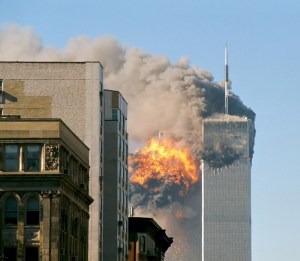
The image of the WTC is a public domain photo from Wikepedia

Leave a comment

Filed under Community, Culture, Environment, New York, Uncategorized

Making a Serious Splash

Pheeeeeew. Did you see Daryl Hannah being cuffed and arrested outside The WhiteHouse? Who wouldn’t be in love with her for Splash, or Priss in Blade Runner, but now I know she’s an environmental campaigner too, my heart’s quite gone! I’d better grow fins and swim the Pond.

It was only topped by the smile on the New Zealand scientist’s face, trying to save Orcas on a documentary, when they managed to release a Humpback from a tangled rope, and it powered away, snorting water and sunlight. Then watching her and others trying to refloat a pod of beached Pilot whales, and fighting back their tears. The evidence of pollution in the water, getting into the sealife chain was awful and depressing, but we are a very strange and sometimes rather moving species.

Leave a comment

Filed under Culture, Environment, Science

POLAR BEAR ATTACK – A BETTER STORY

In such strange and sad times the hits at Phoenix Ark, after a blog about a Polar Bear attack got almost as many as the Norwegian, Anders Breivik. Well, you can’t control what people want to read about. The tragic case of the 17 year old Horation Chapple on Svarlsbad was exceptional, and the Polar Bear in question was shot and killed by their guide, who was himself badly injured.

Last time we blogged it, we talked of the needed respect of and even fear of wild nature. So crowded in on now, on a planet of ever expanding populations, that faces great and sometimes seemingly impossible paradoxes between the human and the animal. In fact, after spending an imaginative two years with Polar Bears, writing Scream of the White Bear, the founder is well acquainted with those remarkable animals, used as a ‘Flag Ship’ species, to attract interest to their own plight, in what is really a problem of biospheres, on a World scale. Though, apart from the Polar Bears that he used to see in London Zoo as a boy, a real inspiration was the sad and neurotic pair in Central Park Zoo in New York, one of which recently died. They are the largest carnivores on earth, and with such keen senses of smell and such fearlessness too, extremely dangerous. Which is why the inhabitants of Churchill, in Canada, the ‘polar bear capital of the world’, face regular problems with them coming into town.

For those who like their animals in happier stories though, we pointed to the great polar bear in Phillip Pulman’s sparkling trilogy, that begins withNorthern Lights, also partly set on Svarlsbad. How the story, brilliantly woven between real and fictional worlds, plays with the ideas of almost Jungian archetypes, and in the flow between ‘male’ and ‘female’ energy, and the changing animas of childhood growth and creativity, the bear who loses his honour and his armour finds his strength restored, thanks to the courage and love of brave Lyra Silvertongue. The pact between the two of them is enchanting. They are the most wonderful stories, and we recommend them to anyone.

Leave a comment

Filed under Books, Childrens Books, Environment

‘STORM FORCE’ WITH THE PLASTIKI AND HOME TO SYDNEY!

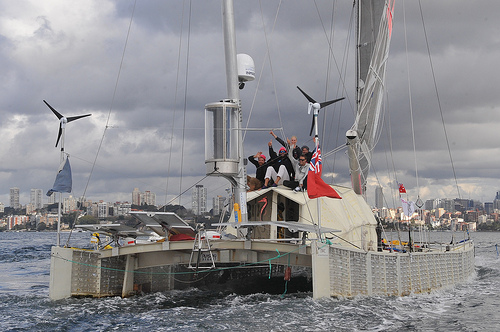
Documentary maker Max Jourdan’s fabulous diary from last year’s voyage of the environmental craft Plastiki, with excerpts from David de Rothschild and fellow crew members, sails on fearlessly and finally comes home:

Mid-June. Needlework (Max Jourdan)

4am again. Outside already. Average seas and drizzling rain running cold through briny hair. Chart littered with oceanic shelves, mounds and deep troughs named after French navigators. Just let me lie here on deck in the dark. No. I am awake, just resting a little. “Foresail’s ripping. Need to finish patching the other one before they’re all gone,” says Jo.

Inside. We sit opposite each other across the mess table. A roll of twine, bag of needles and strips of sailcloth. Eyes wide open and pupils dilated. We start to sew under the red glow of night lights. Pitching and rolling in our pod. Darkness all around. We could be in deep space or attending a Sunday patchwork class on LSD.

Patching is done. I take the helm. I could cycle across the Pacific faster than the Plastiki can sail. Maybe that’s why it’s taking me more than 2,000 miles of ocean crossing before deciding to try out the stationary bike bolted to the foredeck. We take turns on the bike. It’s a sit-down contraption that spans two cross beams. When you are in the saddle you are suspended over the big blue. I don’t know what this is doing to my fitness level, but the blind aggressive pace feels all wrong and out-of-place on this boat.

15 July. Storm force (Matthew Grey, expedition co-ordinator)

It’s 3.51,” Graham sing songs in his most mumsy voice. “Urghh, thspp,” is all I can muster. He’s sent grabbing for the corner of the doorway, as a huge wave whumps against the boat. I went to ‘bed’ two hours and 45 minutes ago.

Wet means wet-weather wear and judging by the sound of the waves breaking across the deck, I’m gonna need it. Slipping into a wet pair of dungarees at 4am is no one’s idea of fun. The pants are like a halfway house: they ease you uncomfortably from warm sleeping bag to violent seas and driving rain. The last piece of the puzzle is the life-vest.

Welcome to winter in the Southern Hemisphere.

Last night we had a ‘blowout’ on our headsail and with 35 knots of wind tonight we can’t risk destroying the second and only spare. Instead we’re flying our utilitarian orange storm gib. A handkerchief-sized piece of fabric is strung up where our big billowing powerhouse once was. It’s designed for the worst; when all other options are exhausted and the wind is pummeling us at 50 knots we would point the boat away from the waves and tuck our tail between our legs with just this little sail to guide us.

16 July. Samoa to New Caledonia (David de Rothschild)

The temperature inside the cabin has just reached a distracting and uncomfortable 39C! The situation seems oddly perverse; on one hand I am surrounded by a horizon that holds all the promise of reprieve from the sweltering heat, yet on the other, the 15 knots of breeze means we don’t have the option of dropping sails in order to give way for some underwater activities. I am firmly trapped within the confines of a 20ft by 60ft floating plastic solar oven.

If only I’d had the prior insight to design some form of swimming platform; what was I thinking to miss that particular detail? But, then again, hindsight is a luxury of the now. Which makes me ponder the notion: would I even be here on this mission in the first place had Leo Hendrick Baekeland realised that by presenting the world with the first fully synthetic plastic, Bakerlite, back in 1909, he would be ushering in the modern era of plastics.

I wonder if at any point during his research and development he anticipated that the very durability he most likely worked tirelessly to engineer and perfect was in fact going to become an Achilles heel for all things organic and natural, invading and conquering almost every ecosystem worldwide in one way or another.

Hindsight or not, what’s crazy about the issues of these plastic fingerprints that are tragically tarnishing our natural environments is that it doesn’t have to be this way! If the development and build phase of the Plastiki taught me one thing, it was that innovation can come from the most unexpected places.

Late July. Epilogue (Max Jourdan)

Our arrival in Sydney on 26 July wasn’t what we had expected – we’d arrived in the Tasman Sea 10 days before, but much too late in the year, so the ‘Plastiki’ spent the last week of its voyage under tow. Which was a bit of an anticlimax. Was the expedition a success? David always said it’s not about the expedition, it’s about the message, and he certainly worked hard getting the message across, blogging, tweeting, working the press – he even went live on ‘The Oprah Winfrey Show’ mid-voyage. And we certainly spent a huge amount on satellite communications. In essence, David was at the office for about 80 per cent of the voyage.

But the more communication we had with the outside world, the less unity there was among the crew. And it’s a pity that we weren’t able to visit the plastic ‘garbage patch’. So, for me personally, the voyage of the ‘Plastiki’ wasn’t quite the adventure it might have been.

But we were treated to a phenomenal reception in Sydney Harbour: helicopters, police craft, and a flotilla of little boats, not to mention a huge press reception. After that, the crew went their separate ways. And the ‘Plastiki’? If current plans come to fruition, she will sail on, sort of, travelling the world in a showcase as an oceanic exhibition piece. Her voyage is far from over.

Documentary maker and photographer Max Jourdan’s film of the voyage of the ‘Plastiki’ was transmitted on the National Geographic Channel on 22nd April, to celebrate Earth Day. ‘Plastiki: An Adventure to Save Our Oceans’ by David de Rothschild was published at the same time. Photograph courtesy of the Plastiki crew. A version of these blogs has appeared in The Independent. For more information on the expedition, go to the web-site http://www.theplastiki.com

Leave a comment

Filed under Books, Environment

SAILING INTO THE DOLDRUMS WITH THE PLASTIKI

Documentary maker Max Jourdan’s fabulous diary from last year’s voyage of the environmental craft Plastiki, with excerpts from David de Rothschild and fellow crew members, sails on fearlessly:

Late April. The Doldrums (Max Jourdan)

‘L’enfer, c’est les autres’ (‘Hell is other people’) purports the existentialist slogan. Inching our way along the seventh parallel under a blistering sun, I would tend to agree. The edge of ‘The Doldrums’. The ‘Plastiki’ is spinning around like a top going nowhere fast, even backwards at times. Some mornings you wake up with your entire soul in a minor key. Feeling like you just want to line the crew up on deck, make them beg for mercy and pop them all in the head with the flare pistol. Wham. 35 days at sea in a Tupperware box, like rancid cheese. What do you expect?

30 April. Christmas Island (David de Rothschild)

We arrived on Christmas Island yesterday, very early in the morning. We got a tow in (after overshooting the island) from one of the local ferry-boat handlers, who managed to pull us into the very shallow lagoon; getting in and out of these atolls can present real challenges. On shore we received a welcoming ceremony from the local community; there was an amazing dance from some local school kids to welcome us.

The first thing I did on land was eat some chocolate and drink a soda. We ate some local fare – coconut cakes and some coconut water. While we’re here we’re going to be meeting local environmental and agricultural groups, and visiting a number of bird sanctuaries and wildlife projects that have been funded by the New Zealand government. We will also be replenishing the hydroponic garden, maybe with some bananas. Community spirit here seems amazing; people are always smiling and very welcoming.

4 May. Leaving Christmas Island (David de Rothschild)

It’s been almost a week since we reached Christmas Island. Although it’s hard to tell really – we’ve all switched on to ‘Island Time’. It has been a very full schedule, lots of school talks and meetings. The boat maintenance consumes a lot of our days. Matt and Graham have been fixing the rudders which got a little damaged as we were towed into the dock. David T has been working on repairing the sail with Jo. We’ve also now replenished our kitchen stocks with some new food for the next leg of the journey.

We’re getting close to hitting the high seas again. We’ll be welcoming some new crew and fresh minds on board.

9 June. On Samoa (Jo Royle, skipper)

Mr T and I have been extremely busy since we got here; we’re trying to prepare the boat for another long leg towards Sydney, where we expect to see the worst weather we’ve seen on the voyage. I’ve serviced all the electrical gear. We’ve still managed to survive off 100 per cent renewable energy since we left San Francisco, which is incredible because we have lots of “Digital Dave [de Rothschild]” and “Digital Graham [Hill]” using our computers and communications.

After a few weeks with another female crew member, I will be back to being the only girl, which I’m a bit apprehensive about, as it’s always good to have another girl to giggle with. But I can’t moan too much; the guys are great. There are six of us living in this tiny cabin and we’ve been at sea for 60 days. To be honest, the most annoying habit is probably the boys showing me their spotty bums; they have very spotty bums from sitting down all the time and I don’t need to see that!

Western Samoa is actually environmentally leaps and bounds ahead of some English towns; we’ve got to catch up, otherwise it’s a bit hypocritical for us to go around the Pacific spreading this message. They already use biodegradable BioBags, as plastic bags were banned in 2006.

READ ON SOON…

Photograph of the boat’s navigation system courtesy of the Plastiki crew. For more information on the expedition and the message, go to the web-site http://www.theplastiki.com or by clicking

Leave a comment

Filed under Environment

CONTINUING VOYAGES OF THE PLASTIKI

Documentary maker Max Jourdan’s fabulous diary from the environmental craft Plastiki continues:

Early April. Dawn watch

Waking up for the 4am watch, feeling like the ship’s cat has peed in your mouth. You stumble around head bowed under a red glow looking for damp clothes in the cramped space. In the cabin you pass half-undressed members of the other watch. “Morning.” “Good night.”

Emerging into the strange night you venture to the deck’s edge and grab hold of a mast stay, flexing cold-metal with every movement of the ship. You fumble with layers and zips as you lean over the edge for a piss. Jo said, “Most sailors lost at sea are found with their tackle out.”You sit at the helm and steer the course: 150 degrees. “The Pacific covers an area larger than that of all of the Earth’s masses combined,” you read, and contemplate the curving horizon with rising emotion. There’s a full moon: mesmerising, huge, white, round – and dead ahead.

The hours flash by. You hand over the helm and stand up. Looking at the boat’s wake, you realise dawn is approaching. The ocean is iridescent purple, and lines of orange and blue edge the sky. The entire sky is humming, as light from the sun arcs through the atmosphere. Overwhelmed, you just want to scream, but the rest of the crew is asleep.

6 April. How to kill a tuna fish

1.4 billion hooks are deployed annually on long lines. Some of these can be as long as 75 miles, allowing a fishing vessel to gather 50 tons of fish in one haul. We are trawling one fluorescent, feathered, garish lure on the end of a line and rod. I’m the first to get to the rod after we become aware of the whine of reel. The rod is bent in half and it feels like I’m dragging an oil drum in the boat’s wake. “Make sure the line doesn’t snap,” someone advises. But I am confident in the gear. The lady at the Sausalito tackle store told me we needed 50 lbs test line. “There’s some big fish out there,” she had warned.

“Maybe we need something tougher, then,” I said.

“Let me tell you something…” she replied and paused.”Anything bigger you don’t want to be pulling up on your boat.”

I am inching monofilament back on to the reel. “I hope we haven’t caught a shark,” I think aloud. Finally it surfaces by the boat. Flashing silver and blue and yellow. “That’s the biggest tuna I’ve ever caught,” mumbles Olav who previously spent two-and-a-half months floating across the Pacific on a replica of the Kon-Tiki. “Must weigh nearly 25 kilos.”

The tuna flaps around the deck, spraying blood everywhere. Olav hits it with the bat and I plunge a knife into the back of its head to reach his spine. We don’t measure it, just start butchering it on deck. The flesh convulses powerfully in our hands and Olav and I look at each other. Conveniently the rest of the crew seem to have disappeared. We cut the whole fish up into steaks passing them through to the galley.

8 April. Notes from the ‘Plastiki’ tramp

23.3 degrees of latitude. Sounds exotic; so why is it so cold? Jo told me, “By day five you’ll be in a pair of shorts and T shirt.” I’ve woken up on deck wrapped in a wet, grey, wool blanket; the kind the Salvation Army hands out to homeless people in winter. Did I remember to brush my teeth last night? Mouth all dry. Hair stiff like salty rope. Glasses frosted with spray.

Trousers are torn and disintegrating. Maybe dragging them by a rope in the boat’s wake for a few hours and drying them in the sun was a mistake. But it’s better than wearing the smell of tuna blood. I’d like to see myself as a hobo riding the ‘Plastiki Pacific Slow Boat to Somewhere’; but really I’m the official ‘Plastiki’ tramp. Crawl through to my hutch. The cabin smells like six teenage, grubby, campers are living here. Five men. One woman. Poor Jo.

15 April. The middle of nowhere

I’m not out here on some jolly, organic, culinary cruise across the Pacific. I’ve got a job to do. So when Jo pops her head out of the cabin and looks out at the ocean and grey dawn with a ‘this-is-not-just-another-day-at-the-office’ expression I pick up the camera. Turn on, press record, frame, focus, re-frame. Jo’s blue eyes crystallise on the LCD screen. I can sense the thoughts formulating on her lips. “What’s up, Jo?” “We’re more than 1,000 miles from any landfall,” she says. Jo looks profoundly happy. “What does that mean, Jo?” “It means it would take someone quite a while to rescue us. It means we’re alone.” The announcement is electric.

This is precisely why I took this assignment on, I think. In my peripheral vision, I can sense some members of the crew don’t share our mutual delight.

19 April. Let them eat cake

24 days at sea and maybe 20 more to go before landfall on Christmas Island. There are some pressing concerns; water is being consumed too fast, toilet paper is running out, the furling system starboard side is broken and the foresail ripped. Running out of bread is a serious problem. Just look what happened to Marie Antoinette. I’m not saying this as a Frenchman, but because bread is part of the ritual of our daily lives; it provides sustenance, pleasure and even bonds people.

An ocean-crossing is all about being self-sufficient, from mending sails and water pumps to baking bread. Unfortunately, we’ve got only a solar oven (delusional dream of some wacky hippy baker). The wrapping and instructions displayed a perfectly roasted Thanksgiving turkey. It’s so hot out here you could fry eggs on the plastic deck, but I still haven’t got the temperature above 120C. “What bread can we bake with no oven and a miniature grill?” I ask Jo. We run through the naans, flatbreads, galettes, rotis and chapatis of our desires. Olav suggests the chunky Norwegian black rye bread of his youth. In the end we opt for pita.

READ ON SOON…

Photograph courtesy of the Plastiki crew. For more information on the expedition, go to the web-site http://www.theplastiki.com or by clicking

Leave a comment

Filed under Community, Environment

EARTH DAY, APRIL 22, WITH A LOT OF PLASTIKI BOTTLE!

When David de Rothschild sailed across the Pacific last year, the voyage became a model of the media-savvy eco-adventure. But what was life like aboard the ‘Plastiki’, inspired by Thor Heyerdahl’s trail-blazing expedition on the balsa wood raft ‘Kon-Tiki’, sixty-two years ago? On board the ‘Plastiki’, a 20ft by 60ft press office was strapped to 12,000 plastic bottles, as documentary maker and photographer Max Jourdan and his crew mates kept the ship’s blog.

Max’s film of the voyage of the ‘Plastiki’ will be transmitted on the National Geographic Channel on 22nd April to celebrate Earth Day. ‘Plastiki: An Adventure to Save Our Oceans’ by David de Rothschild will also be published at the same time, with an event at the Paragon Sports on Broadway in New York. Phoenix Ark Press are delighted to re-blog a version of an article that appeared in the Independent, and extracts from the diary will be blogged over the coming week.

A lot of bottle: Life on board the Plastiki by Max Jourdan

“Do you want to cross the Pacific on a boat made of plastic bottles?” I was asked a year-and-a-half ago. “Yes,” I replied, without hesitation. I figured it wasn’t a question that would come up again soon. The ‘Plastiki’ adventure began when David de Rothschild, the British adventurer and environmentalist, came across a United Nations report on the state of the world’s oceans, which pointed to the fact that our seas and their ecosystems are dying, suffocated by millions of tons of human waste, in particular, plastics. There was also the ‘discovery’ of huge gyres of plastic waste ‘the size of Texas’ trapped in oceanic vortices. Sailor and environmentalist Charles Moore had sailed through one of these Pacific ‘garbage patches’ in 1997 and brought back grim samples: a briny soup in which plastic nano-particles outnumbered plankton by a ratio of six to one.

Inspired by the famous ‘Kon-Tiki’ expedition, David decided to build a one-of-a-kind expedition vessel, incorporating that ubiquitous item of rubbish, the plastic bottle, and sail it across the Pacific to encourage the world to ‘beat waste’. He was keen to show that with more efficient design, and a smarter understanding of how we use materials, waste can be transformed into a valuable resource. The ‘Plastiki’ is the result of nearly four years of design, boat-building, hipster environmentalism and cutting-edge research into plastic polymers.

I started documenting the adventure for a National Geographic Channel film nearly two years ago, when the Plastiki was still just a bunch of wild sketches on a naval architect’s notepad and a pile of dirty recycled bottles in a San Francisco workshop. Work at the construction site was slow and disorganised. All of the plastic materials used to build the boat’s structure were untested and, to his credit, David insisted on a hull design that incorporated recycled plastic bottles in their original form. Whatever vessel was going to emerge from this zany endeavour would have to be strong enough to sustain months of battering and ultra-violet degradation under the punishing equatorial sun.

I went 100 miles out to sea for a weekend trial, with a crew I barely knew. Five men and one woman. Most of us hadn’t ever sailed before. David spent the entire time vomiting his guts out and we lost a few bottles from the hulls (which we retrieved); but skippers Jo Royle and Dave Thomson reckoned the ‘Plastiki’ was ready as she would ever be. The morning we set off in March last year, a hard-boiled sailor warned me I was mad to be taking part; the ‘Plastiki’ would never make it past the Golden Gate Bridge, let alone 8,398 miles across the Pacific.

Could we prove him wrong? One thing we did have to give up on was sailing to the infamous northern ‘garbage patch’; the ‘Plastiki’ couldn’t get us there. Despite its sci-fi appearance, the boat is more like a raft than a conventional sailing vessel. It can’t sail up wind, nor can it really battle against currents and weather systems. It can only go with the flow, in our case, from East to West following the Pacific currents and trade winds. The garbage gyre lies north of Hawaii and from our launch in San Francisco it was beyond our reach.

Cooped up for weeks on end in a sweaty plastic cabin the size of a tent or roasting under a fierce equatorial sun, I tended to forget what the mission was all about. Life boiled down to basics: sleeping, eating and helming around a 24-hour watch system or tending to nautical chores (and coping with the interminable noise of the ‘Plastiki’s’ 12,000 odd bottles dragging against the sea and the rest of the boat).

I was also distracted by my own self-centred emotional experience of life at sea and hypnotised by endlessly changing vistas of sky and ocean wilderness. But I wasn’t there to change the world; I was aboard to film a bunch of people trying to make it across the Pacific on a crazy plastic boat. And to blog and tweet just about every nautical mile of the way…

23 March. Leaving San Francisco (David de Rothschild, expedition leader)
So, we’ve made it, day two on board the ‘Plastiki’! Seems I got away with it on the first day but have started to feel sick again due to what seem to be massive swells surrounding the ‘Plastiki’, although the sun is out, which makes it really amazing to be out here. Spray seems to be hitting every part of the boat covering the decks, cabin and us with salt water.
We have a new crew member – a flying fish hanging out in the bottles. Olav [Thor Heyerdahl’s grandson] is trying desperately to prise it out for dinner. Max is talking to himself on the helm – which is entertaining the rest of us. Off to get a sleep before dinner, although with Olav cooking I might give it a miss; got a feeling it could be flying fish….

READ ON SOON….

Photograph courtesy of the Plastiki crew. For more information on the expedition, go to the web-site http://www.theplastiki.com or by clicking

Leave a comment

Filed under Books, Environment

A LETTER FROM JAPAN, ONCE IN A THOUSAND YEARS

Dear World,

Let me try to tell you something about what I feel now.

18 days have passed since the earthquake, and what we know every day is much worse than we have imagined! We all knew that the big earthquake would come in near future in Japan, especially this SANRIKU area (north-eastern district). However it was much bigger than we thought, something like once in a thousand years, the specalist said.


As you know, one of the biggest problems is the trouble at the atomic power plant at FUKUSHIMA. Because of that, we have to be careful for water, vegetables, and so on. And saving electric is very important to do now. On the other hand, we afraid another earthquake may come to Tokyo, or Tokai area.

There are so many things to worry about, but what we must think about first, is how to help the people who are in a big sadness, losing family, or house, and everything. To clean and make the town again, is also important to do. All Japanese are on the same ship. We do the things we can, even if it is small. March is the season for School graduation, and everything starts from April in Japan. Of course, I’m afraid of many things, but must be strong to start making up our country, I think.

Yukari

Yukari is the wife of a Japanese Diplomat. The photos are from her best friend in Arahama, where the Tsunami washed away most of the town. They were sent with the following message about her friend:Her father is a traditional fisherman , and one of the big bosses of that area. It means they had such a big house, where they could have wedding or funeral of the area there. It is said it will take at least one year to clean the town. But she says even in this situation, all the family were saved, and just keep going on.

If words can bring a blessing, then we are listening and with you too.

Leave a comment

Filed under Environment

Seeing with Samson and Delilah

I think it was Dr Johnson who said ‘nobody but a fool ever wrote for anything but money’. A chance quip doesn’t make the philosophy of a man, but perhaps that makes everyone at Phoenix Ark, and the 17 million daily word-processing WordPressers too, fools! Perhaps they should see it in ‘holy fool’ terms, like Dostoyevsky’s Idiot, or what Jung said of how we lose the wonder of being alive by not just leaning forward in a train and expressing what a beautiful day it is. In fact, whether lay person or professional author, the key is connection, and even having one engaged response to what you do can be hugely rewarding. It also gives you a chance to express without any wider intention, or need, and perhaps see in a different way.

Seeing, and the story of Samson and Delilah were and are a central theme in the unpublished Scream of the White Bear. A story about belief, the word, and the blinding loss of the redemptive feminine to the male psyche, inside and out. It was wonderful then to see Warwick Thornton’s spare little masterpiece Samson and Delilah. Set among Australian aboriginals, and a teenage love story, it is brutal and ultimately beautiful, stressing above all how so many lives are not lived in words at all, especially at a particular age, and in different cultures. The ‘religious’ themes, the supporting metaphor of story, are only glanced at, with mourning and the tradition of hair cutting reflecting Samson’s loss of power, and a rape and a haze of petrol sniffing, blocked opportunities and a poverty of connection, there to reflect the biblical blinding, the loss of hope.

This Samson is just a kid, trying to find a way, love too, and decidedly unheroic, except for his first tilt at a girl. His Delilah, who he loses sight of in his loss of power, is the heroine who turns everything around. Thornton is aboriginal, and says he hardly learnt to write at all, and the script is virtually non-existent. Instead we have a very raw reality, and the final redemption, the final understanding of what love might really be made of, is one of the most eloquent things I’ve seen. Though raising money was no problem, Thornton did not want the vast ‘circus’ of big budget film making and it is the integrity of the story, its truth, that inspires and wins the day. Perhaps where the heroine suddenly gets a gun from to hunt Kangaroo, in a story that is also partly about brutal economics, is glossed over, but it’s great, and hard to put into words. Thornton is also passionate and moving about the lack of chances and support given to kids, by whites and aboriginals alike. DCD

For the website just click

Leave a comment

Filed under Culture, Education, Environment