Category Archives: The Arts

SHAKESPEARE, SCHOLARSHIP, SOUTHWARK AND THE OXFORD SIDESHOW

All cough in ink, all think what other people think,” Yeats

It is not the acceptance of the absolutes of ‘worthy’ scholarship or ‘establishment’ theory, even if Prince Charles did put his face on the Shakespeare Birthplace website in reply to Anonymous, upholding the very merry Shakespeare industry and RSC land, that makes an ‘attack’ on the Oxford authorship theory for Will Shakespeare important, but because it is an irritating sideshow. In fact, the supposed authority of the scholars on a Stratford Shakespeare can be just as irritating, since documentary evidence is so thin, and truths lost to the veils of time. Half of the reason for scholarly tentativeness seems to be you might get your head bitten off, but in terms of the supposed authority of established truth, of course Shakespeare has been reinvented and rediscovered for four hundred years. As history is a dialogue between past and present. So he has been co-opted as protestant path finder, a staunch monarchist, pure revolutionary, the voice of Brit propaganda, or simply the God of the word.

Perhaps that’s why it is important to resist received authority too, especially when setting out to make discoveries. When trying to present ideas on Edmund Shakespeare to one major publisher, and also bringing up the three signatures in the Catholic English college in Rome, the only comment was ‘they would say that, wouldn’t they?’ Because the Reformation itself still carries such deep echoes. But if a person’s ‘faith’ or lack of it can be a private and intimate thing, or should be, there is much evidence for Shakespeare’s involvement with prominent Catholics, as a society mutated from ‘Catholic’ to ‘Protestant’. So the ‘truth’ carries deep felt echoes and controversies, but is also defended so hotly because there is gold in them there hills. Though it is circumstantial, the residence in his last days of Edmund Shakespeare, Will’s youngest brother, living at The Vine in Southwark, ties into the London Hunt family’s involvement, under Henry VI, and the likes of Peter Averne, with the very Catholic Brotherhood of Our Lady of Assumption in Southwark. Perhaps the overriding point though is that Southwark itself is such a fascinating area and an absolute fault line for London politics and the Reformation too. It does irritate too, much as facts are a guide, when the new voice of American literalism swings onto the scene, if it loses Peter Ackroyd’s sense of the intrinsic mysteries of identity, creativity but above all a shifting English language.

St Margeret’s Church, where the Brotherhood began, was thrown down by Henry VIII and turned into a prison, and its parishoner’s transferred to the large St Saviours, previously St Mary’s Ovaries, now Southwark Cathedral. But at that Cathedral, five minutes walk away, there Becket had preached, there too Bloody Mary staged heresy trials against Protestants, and nearby at St Thomas’ ‘hospital’ they produced the first English language bible, in the form of the Vulgate. It lay on the Canterbury Road, real and metaphorical, running down towards the continent. It was filled with Protestant Dutch, many involved in the tavern-brewing business that swallowed up the district, but also notable for many years for Catholic dissenters, especially under the Jacobites. The Bishops of Winchester there were at the heart of Henry’s divorce and ensuing Reformation battles, but also excerised their power and protection in the liberties, until the Puritans and the Civil War closed them down in London, and the theatres too. So exactly the place, with it taverns, brothels and theatres, used but complained about by the City of London across the water, or local ‘respectable’ folk, to encourage the stews of free thought and creativity. A place to be wary of too. Evidence suggests Will did not live there all the time, in that ‘Domus et Aliorum’, also living in St Helen’s, at the Bishop’s Gate, Silver Street or Stratford, but he may have lived and worked there for ten years and more, and the place has been underestimated in its significance. Go back to the source, though the ‘source’ of Shakespeare’s mind and art is another thing, the different ‘countries’ he journeyed to, as is what we are really talking about when we talk of his ‘identity’. It was Bulgakov who wrote the life of Mr Moliere, Shakespeare’s only comparative rival in Paris, but doubting the easy validity of documentary biography, believed an artist had to inhabit an artist to get close. To do that with a mind like Shakespeare’s, through the currents of his time, can be a slightly dangerous exercise and you might do better just to enjoy the work!

Arguments can be followed in Shakespeare’s Brother, posted experimentally above.

PA PRESS

Leave a comment

Filed under Culture, Education, London, The Arts

THE SHAKESPEARE DEBATE, SOUTHWARK, FISHY THEORIES AND JOHN DONNE

THE BAIT, by John Donne

COME live with me, and be my love,
And we will some new pleasures prove
Of golden sands, and crystal brooks,
With silken lines and silver hooks.

There will the river whisp’ring run
Warm’d by thy eyes, more than the sun ;
And there th’ enamour’d fish will stay,
Begging themselves they may betray.

When thou wilt swim in that live bath,
Each fish, which every channel hath,
Will amorously to thee swim,
Gladder to catch thee, than thou him.

If thou, to be so seen, be’st loth,
By sun or moon, thou dark’nest both,
And if myself have leave to see,
I need not their light, having thee.

Let others freeze with angling reeds,
And cut their legs with shells and weeds,
Or treacherously poor fish beset,
With strangling snare, or windowy net.

Let coarse bold hands from slimy nest
The bedded fish in banks out-wrest ;
Or curious traitors, sleeve-silk flies,
Bewitch poor fishes’ wand’ring eyes.

For thee, thou need’st no such deceit,
For thou thyself art thine own bait :
That fish, that is not catch’d thereby,
Alas ! is wiser far than I.

It is just a pet theory here, but might be fun in talks about Shakespeare or Southwark. John Donne, soldier, poet, father of 12, and preacher, must have been a constant Southwark visitor and his daughter Constance married the actor manager Edward Alleyn, who lived with his father-in-law Philip Henslowe there, and became a warden at St Saviours. In trying to fictionally imagine London and Southwark of the time though, first in a film script, that Charles Dance promised to comment on and never did, though SKY thought it good (!), then a novel about Edmund Shakespeare, William’s unkown youngest brother, Donne’s poem The Bait suddenly sang of the area. It was part of that little poetic contest between Marvel and Marlowe, The Passionate Shepherd, but there is one line that sounds with brothel tenements and taverns in Southwark, and that is ‘windowy nets’, quite apart from the running river that speaks of the Thames. Then there are those sleeve-silk flies, factually accurate, but perhaps also redolent of an area swarming with Walsingham’s spies, in Elizabethan cuffs, or others betraying themsleves, or each other.

It was of course London’s most thriving tavern, brothel and theatre district, and Elizabethan or Henretian brothels, there for centuries, were also called the “stewes”. The medieval word seems to have dropped out of usuage during the Reformation, as it became better known as Bankside, but there has also been debate about the derivation of that term. Whether it stemmed from the Scandinavian for a stove, or the medieval ‘”stewes’, or Pike and carp fish ponds, that still existed in Southwark. The obvious link is the second, for many fishy reasons, and of course London bridge was a great centre for those fisherwomen, hawking their catch out of Billingsgate, with their pretty or lewd songs. If you are trying to imagine what the Shakespeare’s saw there at the time, in the face of the sturdy, power seeking City of London across the water, Fishmongers Hall stood right opposite St Saviours, now Southwark Cathedral. The Thames too, only beginning to touch the days of mass Urban pollution, long before the silted or darkened waters of Dickens, was a broad river many fished. Wand Mills had also grown up right along its banks to feed the new, and often Dutch, hop brewing trade in London, that spread down into Surrey and Kent. There, just a little food for Elizabethan thought and reality.

DCD

PA PRESS

Leave a comment

Filed under London, Poetry, The Arts

SCIENTISTS DISCOVER THE ‘GOD’ PARTICLE!

Have they been reading The Godhead Game, or have they really discovered the Godhead Particle?! With all the thrill at CERN yesterday, discovering proof of the Higgs Boson, weary eyed scientists, reminding us of the astonishment of everything, are all cordially invited to read the new ‘thriller of the century’, about the Mayan end of the world, this year, 2012. The clock is ticking! Many of its themes are science ‘versus’ faith, or some kind of spirit, and a stranger understanding of ‘reality’ and each other, so if the ‘God Damn’ particle was misnamed, as one scientist said irritably, perhaps it is all about language. But to get the language right, this admittedly is a shameless plug. The Godhead Game by David Clement-Davies, available from Amazon.com or Click here

We could not find a picture of said particle, or is it wave or particle? But instead, and in the spirit of enquiry, adventure and a good read, we offer this:

Leave a comment

Filed under Publishing, Science, The Arts, Thrillers

PHOENIX ARK PRESS INVITE DEREK JACOBI TO TEA!

Did we tell you the one about meeting the actress who played the poisoner who Livia employed in I Claudius, in a chemist in the Oval, complimenting her on her talent and the wonderful series, then deciding not to buy any medicine that day! From the frayed temper in reply to a blog about another I Claudian, Derek Jacobi, and the Earl of Oxford theory today, perhaps emotions run deep. We do want to stress then undying admiration for real writers, poets, and actors, especially Derek Jacobi, so point out that disagreeing with his thoughts on Shakespeare’s identity, in his programme about Richard II, has nothing to do with our appreciation of his huge talents as an actor. So we invite him to tea, to dispute the Oxford theory, or even better to hear about research here into the story of Edmund Shakespeare in Southwark. No poison will be even contemplated.

Leave a comment

Filed under Education, Language, Non Fiction, Poetry, The Arts

SHAKESPEARE’S BROTHER AND JAMES SHAPIRO

It was the US academic, and very nice guy, even if he would not help with an agent, who said that any work on Edmund Shakespeare was a ‘good idea’. So it was gloomy to take it to Faber and Faber and discover James Shapiro is doing another book on the year 1608 there, after his very valuable and enjoyable 1599. Sorry to correct editors though, but there is a great deal that was and is completely new in writing about Edmund Shakespeare and Southwark, in Shakespeare’s Brother.

Firstly is the precise discovery of where Edmund was living in Southwark and probably died in 1607, The Vine, who owned it and what it was. It was based on initial information in a lecture by Berkeley Professor Alan Nelson on the Token Books at Southwark Cathedral, but then original research into deeds and the ownership of The Vine by the Hunt family. That family also played a part with a fascinating local Catholic fraternity called The Brotherhood of Our Lady of Assumption, linked to the leatherworking Guild that played a large role at the all important church of St Mary Ovaries, later St Saviours, now Southwark Cathedral, where Edmund Shakespeare is buried.

There are jewels of information in those Token Books, that read like an Elizabethan Address Book, as there are in birth and death records, new to the Reformation, proving how long Philip Henslowe, who became a warden, lived in Southwark, precisely where, and the residence there of his son in law Edward Alleyn and his family. There are a great many things about other players living in Southwark at the time too. But following the trail of that Brotherhood of Our Lady there are also unknown facts, as far as we are aware, about ‘pleyers’ in the district and at the Church of St Margarets, that was thrown down during the Reformation, well over a hundred years before Shakespeare’s troupe, especially performing on St Margaret’s and St Lucy’s days. But in that Reformation earthquake also specific evidence of how The Bishops of Winchester were running and licencing brothels, and how so much of the history of Bankside was about the tavern and then coming brewing industry, and the battle for money and wealth in the great capital.

Much of the writing on Shakespeare nowadays comes from the US, perhaps because of the forming of a consciousness at a particular time, or a US need for roots, especially in Southwark, with the likes of John Harvard being born there (if he was). Also because of those religious echoes that still sound so loudly in America. But much as American academics can be very brilliant, and well funded, there seems also the danger of American literalism in work on Shakespeare that does miss some point about the mysterious well springs of language and inspiration itself. Read the story with us, as it happens, and perhaps James Shapiro can tell if it is of further importance or value.

Phoenix Ark Press

Leave a comment

Filed under America and the UK, Education, The Arts

ANDREW LLOYD WEBER AND THE PRE RAPHAELITES

Talking of Earls or Lords of anything, how awful it was to see Lord Andrew Lloyd Webber on the Pre-Raphaelites. Much as we have a sneaking love of any musical, and putting on a show here and now, but usually written by Sondheim, Rogers and Hammerstein or Bernstein, Sir Andrew’s attempt to step into the spotlight of serious art historian was just a gawping embarrassment. Trying to adopt the tonal stride of Jeremy Paxman, with a bit of grave World War I throw away history chucked in, to twang the thrumming heart-strings, he led us into a wonderland of sentiment and mawkishness, only worthy of some of the worst blogs at Phoenix Ark Press, in the wounds of love or art! Look, was the subtext, at the lovely Pre-Raphaelite works on my sitting room wall, I now own for my private Nation, as I cool it up playing Rock n Roll on my antique piana, and I will share with you how jolly succesful and rich I am, one of you, though not quite, and what an amazingly sensitive person too.

If there is any lone justification for abolishing the House of Lords, or reforming it radically, it is and was the donning by Lord Webber of the blessed Ermine, the Lord Archer of the minim and octave, and now in danger of becoming the Liberace of his own success. So comes another Simon Cowell style TV stitch up, with Superstar. Jesus Christ! As the money triumph of the ever running musical, in our age of countrywide coach tours to the Mama Mia show, did so much harm to the life blood of real theatre. Ah, perhaps it was just TV and the Global ‘culture’ franchise. For those who absolutely loathe the pompous self aggrandisement of Victorian architecture, Webber can defy anyone to hate Keble college, but we hope it falls on his head.

To be a little kinder, he may have many real talents, may have edged saying something interesting about the Arts and Craft movement, but so much of the Pre Raphaelites were not only a side-show, but the mythification of days of yore, in a Tennyson style love of the antique, but turning so much real art to Victorian kitsch and the island of fey. Yes it has beauty, yes at times it carries the visionary, but the programme was not about that, it was about Sir Andrew Lloyds-Bank’s lovely things, and his desire to be taken to the heart of a Nation, as cultural hero, in preparation for more of his TV stuff. Hence his suddenly ‘noticing’ the Superstar crucifixion on the front of the Lady of Shallot’s barge. The mirror cracked, from side to side! The stage show way he was tutored to speak with gravitas to camera was only as obvious as that naughty schoolboy way he tried to hold the eye, and failed, in a very slight attack on Damien Hurst and his sell-out jewelled skull. Well, if you are going to attack, do so, for the love of God, and do it well, but don’t be naughty about it, Sir Andrew. We forgive you, compassionately, but abolish the House of Lords immediately, its full of Pre-Raphaelite ‘style’, and bring back Brian Sewell!

1 Comment

Filed under Culture, Education, The Arts

A GAME OF SECRETS, A HUNT FOR SKULLS, A BATTLE OF SPIES

In responding to searches on Phoenix Ark’s website, we have noted interest in the article on Drue Heinz and the CIA. The story of Allen Dulles features prominently in the new thriller The Godhead Game by David Clement-Davies, A Game of Secrets, A Hunt for Skulls, A Battle of Spies, available as an eBook via Amazon.com, but here is some of the factual research that helped to inform the story. Drue Heinz was one of Manhattan’s grandest dames for many years and a massive supporter of the arts, but sadly not Phoenix Ark Press. On the other hand, we have never asked!

FROM THE PHOENIX ARK FILES:

It turned up in a World War II visitor’s book, from an aristocratic home, on a hill in Switzerland, with sweeping views to Mont Blanc. There a glamorous American heiress, and a Swiss Baron, banker, and notable art collector, lived out the war in grand style, and with a considerable taste for adventure. Among their more permanent guests was the painter Balthus. They were also intimately connected with a celebrated spy – Allen Dulles – first Civilian Director of the CIA. The hostess of the house would help Dulles retrieve the Ciano diaries from Mussolini’s favourite daughter, Edda. As part of an American East Coast elite, she was at least an informal agent for the OSS, forerunner to the CIA, the Office of Strategic Services. As for Dulles, still said to be a romantic hero at the Agency, and a committed lady’s man, the be-spectacled, swashbuckling, but famously discrete lawyer had crossed into Switzerland, via Lisbon and Spain, as the borders slammed shut on the eve of Operation Torch, the allied invasion of North Africa. He was armed with a banker’s draft for a million dollars, and a virtually free hand, as Berne OSS station chief. That he cherished, and fully exploited, culminating in his work over Operation Sunrise, for German surrender in Northern Italy. His all important Swiss escapade is touched on, fictionalised, but largely avoided, in the film The Good Shepherd, starring Matt Damon. Dulles certainly believed in something that seems to have gone into decline, operatives fully enagaged on the ground, and culturally educated and well informed, rather than doing much second hand, perhaps nowadays down the net. He once famously said that all you really need in life is ‘a little bit of courage’.

Dulles had worked for the State Department, became a lawyer with Cromwell and Sullivan, and was a member of Yale’s infamous Skull and Bones Society, initiate to Presidents and security gurus, alike. In Switzerland he set about building a spy network that saw his intelligence gathering reach Roosevelt’s own desk. Since he had turned Lenin from the American Legation door in Switzerland, in 1918, he would never make the same mistake again, and worked with many. He also contacted every American living there, to ask for help, in what he described to Washington as a ‘somewhat distorted world’. It was the kind of world where agents still wore red carnations, or proffered a pack of Camel cigarettes, rather than Gauloise, to establish their allegiance to Free France, or Vichy. One that saw the British and Americans in touch with Admiral Canaris, employer and lover of Mata Hari, as head of the Abwehr, German Military Intelligence. Until Canaris fell, after the attempt to assassinate Hitler, and the Abwehr were abolished. Canaris was effectively replaced by Walter Schellenberg, who mounted two machine guns on his desk in Berlin, and later settled in Switzerland to write The Labyrinth. One of Allen Dulles’s greatest coups though was securing the help of the heroic Fritz Kolbe, who the British had turned away from ‘the shop’, and whose reports were validated in London by none other than Kim Philby, already working for the Soviets. Actually Dulles was too acute to sign his name in a visitor’s book, although his daughter Joan, and troubled wife Clover Todd, both appear in 1944. As does a patient of the psychologist Carl Jung, who, though he never came to the house, Dulles also consulted in Germany, and had his own OSS code number. There too came Dulles’s station replacement in Berne, Robert P. Joyce, and General Barnwell Legge, American Legation secretary. Legge was heavily criticized in a recent military controversy on the internet, for his involvement in preventing downed American airmen escape, under threat of Court Martial, probably because Dulles did not want their Swiss operation compromised. Also for failing to correct conditions at the scandalous camp at Wilmeroose, although one subordinate called him a caring man.

In a very ‘Special Relationship’, British Intelligence were at the house too, many times. In the person of George Younghusband, military number two at the British Legation, and the Colditz escapee Pat Reid, famous for his escape-themed board game, and for so successfully telling The Colditz Story, after the war. Reid never wrote about his time in Switzerland though. More specifically, on the British front, there is Henry Cartright, head of MI9 in Switzerland. MI9 dealt with escape routes out of Switzerland, although the role of MI6 has been little written about, in terms of the use and significance of information that debriefed escapees must have provided to intelligence networks, for attacks on Germany. Cartwright was a world War I escapee himself, whose best seller on the subject was avid Nazi reading in WWII, for obvious reasons. That house was watched closely by the Swiss Police too, reported for high antics, and for harbouring ‘a nest of spies’. Its owners were friends with the head of the Berne police though, and so probably protected, in the semi neutral atmosphere of smoke and mirrors diplomacy. One affected in Switzerland by the changing winds of war.

Soon after the war though, they received a grateful card from the British Legation, commending the couple not only for hospitality, but for their invaluable help to British and American escapees. It makes a family visitor’s book a very important historical document, as are unseen papers on Hitler and Edda Mussolini. Perhaps significantly, they received no such commendations from US Services, since spying rarely stops. The question still remains though as to how much their Brit guests were aware of the depth of their American connections, because the house’s true significance is testified to by a meeting in 1945, still a mystery, that involved a visit by colonels at the heart of SHAEF, The Supreme Headquarters of the Allied Expeditionary Force, and ETOUSA, American Theatre of Operations, during Operation Overlord. They had helped covertly in a war that would see Nazi scientists smuggled to America too, in the battle for the A-Bomb, under Dulles’s Operation Paperclip, and herald the triumph of American world hegemony, in more ways than simple military victory. If information is power, cash rich America certainly won the covert war, because America soon had vast reserves of European files transferred to Washington. Incidentally, some 6000 secret papers relating to Switzerland, and designated Safehaven, remain closed.

There is one rather surprising name in the visitor’s book too though, on an evening in 1943 – Drue Mackenzie Robertson. She is actually Drue Heinz, future wife of the Baked Bean and Ketchup Multi-Millionaire, Henry J Heinz. She was a doyenne of New York Society for many years – writing letters to the New Yorker in 1944, so she may have been back in the States by then – but also became a celebrated patron of the literary arts. One the flapping Phoenix Ark could certainly do with a little help from – for our love of stories, real and fictional! She is publisher of The Paris Review, established the Drue Heinz Literature Prize, and her foundation endows the Drue Heinz lecture series in Pittsburg. At the Carnegie Museum of Art, her foundation also funds exhibitions at the Heinz Architectural Centre, and supports The Lincoln Centre Review. Having endowed a chair of American Literature at St John’s College, Oxford, and involved with Hertford College too, Drue Heinz has long been at the very epicentre of American Arts and Culture, but also influential in the UK. In 2002 she was made an Honorary Fellow of The Royal Society of Literature.

Born Doreen Mary English, Mrs Heinz clearly had a taste for theatrics earlier on, and as an actress, earned a small part in the movie Uneasy Terms, in 1948. It is all a long time ago, and many lives have passed in-between, so distance affords both mystery, and admiration, for a now grand old literary lady. But what of such tantalising ‘skull and bones’ in her cupboard, and was Drue Heinz really part of the OSS too, America’s Office of Strategic Services, or only linked by association? The term spy became a very moveable feast during the war, but it is an open secret that some of the most fertile areas of unwritten intelligence history are neutral territories, and Switzerland is no exception. Drue Heinz was there that night in Switzerland, 67 years ago, in 1943, and her signature is on the visitor’s page too, below her second husband, Dale Wilford Maher. As a graduate of the US Cavalry School and military attaché, Maher is a dead ringer for a spy, and signs himself ‘Master of the Five by Five”. That entry rather bemused this excited researcher, until, last year, one of the obvious links sprang fully armed from the pages of history, to validate a remarkable story, worthy of a movie, or a very stylish spy novel. ‘Five by Five’ was official Nato parlance for the best quality wireless transmissions, namely ‘reading you loud and clear’.

These people based at the American Legation then, and guests at a private home, were sending back radio reports, as Dulles himself began nightly transmissions from Switzerland, which in a coming technological age changed the cloak and dagger style of British dominated spying. It was the dawn of a new era, and they specialised in American style code words, like ‘Fatboy’ for Herman Goering. Stationed in Berne, in his beautiful flat in the Herengasse, Dulles’s own rather charming code name was Mr Burns, so you might take another glance at the satirical cartoon The Simpsons. To underline the personal touch, that Dulles would stamp all over the CIA, he called the technique for an operative communicating with a plane overhead by radio, ‘J-E Operations’. It came from the initials of Dulles’s daughter Joan, and his sister Eleanor. Despite British fears, Dulles’s work never compromised the greatest British coup though, in his supposedly ‘gung ho’ and open door approach. A coup embodied in the Enigma project, and Ultra transmissions, concealing the fact Britain had cracked and could read all German messages at the start of the war. British archives, although still closed, reveal a wireless transmitor was installed in their own Swiss legation in 1943.

Dulles, whose obsession would soon become the Soviet threat, and who encouraged later assassination programmes, out of the no-holes-barred tactics learnt in defeating the Nazis, notably had shares in the American Fruit Company, and has a rather more suspect role after his heroic war effort. Allied propaganda was one of his specialities in Switzerland, and as a master of dis-information, he was to be involved in a Mind Control programme, and Operation Mockingbird – perhaps he liked Harper Lee – the CIA’s attempt to directly influence the American media. Another visitor to that house would be Captain Tracy Barnes, a so-called ‘Jedburgh Agent’, and code named ‘Trick’, who would later turn up in the Cuban ‘Bay of Pigs’ debacle. It was of course Cuban bedeviled Kennedy who said of the CIA that he would like to scatter the organisation ‘to the four winds’. But what of Drue Heinz, whose Wikepedia profile is rather thin? Tantalizingly, that evening Drue Heinz signed herself in appealingly Mata Hari vein, for such a sparkling Manhattan hostess-to-be – “Queenie – the Striptease Queen!” The intense passions and fortunes of war, and such heady Swiss excitement, may have been too much for some. Dale Maher died in 1948, and his forwarding address on the internet is simply listed as ‘The State Department’. Drue Mackenzie Robertson married Henry J. Heinz II in 1953, becoming his third wife, and so perhaps beginning her powerful and passionate role in fiction and the arts. A passion fully shared by Phoenix Ark Press, although admittedly with a sometimes sceptical eye on other literary powers that be.

If you enjoyed this article, which is exclusive and under copyright, you can donate to building a little writer’s publisher:

Phoenix Ark Press errors: If anything is factually wrong in any articles on the Blog, please write to us direct, and we will enadeavour to check and correct.

Leave a comment

Filed under America and the UK, Education, Non Fiction, The Arts, Thrillers

CORIOLANUS AND RALPH FIENNES

The Ralph Fiennes directed Coriolanus, that stars him too, looks promising, in contrast to the high production but low truth value Roland Emerich movie Anonymous, asking “Was Shakespeare a fraud?“, and peddling the tedious Edward Devere, Earl of Oxford theory about authorship. In interview Fiennes talked about how as relevant Shakespeare is today as he ever was, despite any difficulty with language, and, as a footnote, a project here on Shakespeare and Southwark has noticed how the Fiennes family name, though not a theatrical family then, turns up in Southwark Cathedral, 400 years back. It was of course his brother who played Will himself in lovely Shakespeare in Love. But without seeing the film, we wonder how true the film stays to a fascinating play. Coriolanus is not only the high patrician, who scorns the ‘democratic‘ voices of the mob, or the hopes of Republican Rome, but the essential soldier, whose life and power is undermined by the matronly Roman virtues of his mother Volumnia, when he is banished. In that it is much about male identity. The Nazis initially banned the play, then changed their mind and put it on the school curriculum! No doubt they completely misunderstood Shakespeare’s purpose, in the act of the play, and the journeys towards comedy or tragedy, in human beings over reaching themselves. But it is a work that asks two vital questions too, in Gaius Martius’ Coriolanus’ journey away from all-powerful Rome – “There is a world elsewhere” he cries, but also “as if a Man were author of himself“. It is a question about individual freedom and human identity so essential to Shakespeare, but one he repeatedly asks in seeking the almost Godlike power of his own writing, that it makes it a much neglected work.

Coriolanus is released on January 20th

Leave a comment

Filed under The Arts

THE JURY

The BBC produced the best drama in ten years with The Shadow Line but perhaps drama departments across the board are raising the bar, because ITV’s The Jury is both very good and clever. It is a soap opera of jurors, but it is brave to do a week of programmes, to commit us all to the drama, but its intrinsic seriousness too. The connections are constantly intriguing, and remind you of the shadow of a world without such a system. It was also inspired to cast Julie Walters as the defence barrister. The expectation of comedy is constantly redirected towards a raised eyebrow at the ironies of everyone’s lives and compromises and her skill as an actress reminds you that so much is about belief and authority.

Leave a comment

Filed under Culture, The Arts

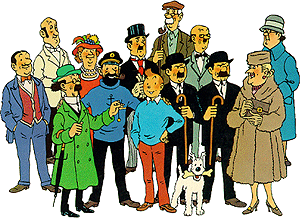
TINTIN AND THE FAILURE OF MOTION CAPTURE?

PRESS RELEASE: Phoenix Ark Press adopts Tintin as Mascot:

They argued it hotly on The Review Show recently, rather condemning Stephen Spielberg’s Motion Capture techniques for the new Tintin, the only possible literary mascot for Phoenix Ark Press! Particularly because Motion Capture deprives the actors of facial emotion. Many kids love it, which is its own vindication, and yet, although classic strip cartoons were in a sense a kind of precursor to movies themselves, they are also far more than that, as are Graphic Novels. Who could forget just one box from Tintin in Tibet, the moment Tintin has his dream and wakes with an explosive sneeze of ‘CHANG‘?

So much is happening, just in that one picture, it might be a movie in itself. The point is that in those marvellous, original and heroic books lies so much more than can be contained in a speedy narrative adventure. The art in enjoying them is not the speed either, it is the slowness, what your imagination has to create and interpret between the gaps, the very point of books, and the joy that you and kids can paw over them for hours and hours on end, rediscovering things all the time. Just study who is looking at who in the picture above.

Some of the female commentators especially said that Tintin never turned them on, like this movie, because it is so lacking in emotion. In fact, the process for a child is learning emotion and complexity through the drawings, and the Tintin series is filled with emotions, from Chang’s rescue, a book that was pennded during a nervous breakdown, and the Yeti’s heartbreak at the loss of the human he protected, to Captain Haddock’s passionate rages, guilts and embarrassments, to the horror of Raskacapak, and the anger of the Gypsy at Marlinspike, in The Castafiore Emerald, that might put you on the side of Dale Farm. Although it is true Tintin never gets a girlfriend. They are also filled with an understudied theme in literature, the role of animals, while they capture some eternal truth about the real world, which is why in King Ottaker’s Sceptre the adventure is spliced between children rooting around on a Third World rubbish tip, at the start and end of a story of regime change. As for the politically correct, that could be complicated, especially during Nazi occupation which Herge admitted part swept him up. But perhaps Tintin in Tibet was a kind of moral redemption for him, after his flirtation with Jungian analysis, while Herge was not only a person of his time, which still allowed the Robinsons Golliwog, he was also an artist who grew all the time, and was constantly on the side of the underdog – with Snowy at his side, of course, pawing over all the marvels. Which brings us to the true story of finding a real Snowy at Battersea Dogs Home recently, but not having signed up early enough to take him home. Woof woof!

The cartoons are from public domain Wikepedia images of Tintin.

Leave a comment

Filed under Childrens Books, Culture, The Arts