Category Archives: America and the UK

A MEMORIAL TO ERIC YORK

I’ve mentioned the story elsewhere, but it this is a photo of Eric York, who died in the Grand Canyon in 2007, of Pneumonic Plague. I never met Eric, but I saw how colleagues, friends and his girlfriend were so shocked by his death, and especially perhaps the cause. I had walked down into that extraorindary ‘hole in the ground’ with one of the last people to speak with him, a teacher at the school where I was doing a writer’s in residence programme. When we learnt a Ranger had died that night, from colleagues at the ranger’s station in the Canyon, the mood was understandably sombre. Eveyone was speculating. It was extraordinary though to learn the next day that Eric had died of a strain of the Black Death, from skinning a mountain lion carcass.

Apparently plague exists in cats and rats, especially at certain heights around the Canyon, and they die of it too in Colorado, although ‘Zoonotic Transfer’ into the human population is very rare in America. Eric had passed away in his cabin, around Halloween, and parents at the school were especially and understandably worried. Anyone who had come into contact with Eric was put on antibiotics, as the top virologist from Washington flew down with his team, to allay fears. It was a surreal and nervy time, very unhappy in other ways too, with the authorities both trying to supress rumours, and put people’s minds at rest. It seemed to take a very long time to get into the National Press. I wanted to do a book on Eric, and the life of the Rangers, a rather special breed of American, with any number of stories of Canyon life, and the often rather crazy and unprepared tourists who visit too, but sadly it was not to be. One day I hope to go back, because it is a place that touches and inspires many of the themes in my own books. DCD

Leave a comment

Filed under America and the UK, Science, The Phoenix Story

A KENNINGTON WALKABOUT

I just crossed the path of Jenny Agutter in the Tesco’s in Kennington and commended her for being a cultural icon. She was kind enough to take the compliment graciously. I’m not sure about Logan’s Run, but for adolescent boys her role and swim in Walkabout was, er, a seminal moment. It’s one of those great, tender films, reminiscent of Sunshine, that we blogged about before, and the tragedy of misunderstood languages. So the young aborigine’s mating dance becomes only a source of fear and then ultiamte tragedy for him. Maybe we should warn those trying to engage in any kind of ‘transatlantic relationships’ between the UK and America!

Leave a comment

Filed under America and the UK

An Agent and Scream of the White Bear

I have rather turned the spotlight on Abrams, or myself, but have never actually spoken up about that agent in New York, Ginger Clark. A tough, fiesty, fat little New Yorker, who I rather liked, when she jumped on me way back when, when I was trying to tour in America again. Already in such hard circumstances, because of the oddness and absolutisms of an ex, but also a senior editor at my own American publisher. One who would not even prioritise a drink, after a two year relationship, either as a somewhat responsible human being, or an ambassador for their firm to a novelist in a Foreign country and city, now starting to hum Sting’s – “Englishman in New York” turning quickly into “I’m an alien, I’m an illegal alien!”. So, by Ginger Clark, I was wined and dined in the best Chinese restaurant, and virtually handed an agent a deal that was almost already made, on a large plate, as I was pushed further and further back from people I had been so close to and needed.

It was my mistake not to tell Ginger about what had happened personally, for a very long time. But that was part of the secrecy that developed, actually in respect of a partner’s fears, and almost obsessive privacies too. But why exactly is it that Ginger abandoned me in the middle of a crisis, and so made it all far worse? Perhaps she disliked the swear words coming down the phone from London, as Abrams threatened and cancelled promised conference calls. I must say that I laughed out loud when she rather sneered at my talk of how hard writing had become, in her Gangs of New york voice – ‘Wot did she do ta ya, steal your laptop or turn off yer electricity?!”

But then agents usually are not writers, and would not understand why something that is most ‘animated’ in imagination and in storytelling, is directly related to the feminine ‘anima’, as Jung calls it. I had lost that externally, and inside myself too, and it was a crisis I was not ready for, at a very particular time in life. It made me rather think New Yorkers are vey mad indeed though when Ginger could so dismiss human grief, lost love, but simultaneously talk about her enormous pain at the death of her Chincilla! A bit like that editor Susan Van Metre had seen fit to discuss my private life with at another publisher, sending a Round Robin right across the publishing world, when her relationship ended. Perhaps she was right to do so, because people have very different ways of coping. So Ginger dumped me, though I thought writers were supposed to dump agents, at the worst possible moment, and before I could actually take the very good advice she had given, which I was about to. I watched in horror as the names of twenty publishers came down the wire, she had lined up to take Scream of the White Bear to around the world. A life fell apart in many ways, and sometimes the fall can be very far indeed. I do not think though she would have done it if the book was any good, which I think it nearly is now.

I was so strung out though, and so believed in the goodness of the people at Abrams, that I genuinely believed Abrams had consciously engineered it, to try and snap me out of a cycle. I am afraid my own fantasy driven hopes and idealisms were very mistaken indeed. Ginger Clark, I think, actually lied to me on the phone, and I say this because of the catch in her voice and perhaps I am wrong, about what was actually said between my editor and agent. It is a disaster when you give yourself completely up to other people.

As it became a very literal disaster trying to rewrite a novel, not away from all that entirely, but straight into the face of it. But then my fantasy books have always been extremely autobiographical, in trying to relate experience in nature, to human experience too, and take readers on a journey worth going on. My tragedy is that big books like FireBringer and The Sight have also been related to personal challenges, and been a way of finding my road through them again and to triumph. There could be no triumph, no wonderful resolution in Scream of the White Bear, because the source of hope, joy, light and life was right in front of me, but had already been stripped away. So came the most terrifying darkness, most specifically because I had been called evil by someone I loved, and tried to write about real evil again in a book, as I have done before. It was also claimed quite bogusly I was a difficult author, when the truth is, when a real dialogue is going on as it should, I have always been flexible and very easy to work with. But that is a vital trust between writer and editor, neither should ever forget.

In the politics of this story I ask just one very loud question. I argued with Abrams that in editorial all I have ever really needed, and it is true, is support and positivity, that electric connection that ends with the reader, and is sometimes so hard to find nowadays, because I am enormously committed, and know that I can get books and stories right. That is why the wall they put up, and the threats they issued, became so monumentally destructive. But editors make much of their ‘ownership’ of authors when they pay the money, but some quickly abandon that ownership and a real and almost sacred responsibility, if it does not suite their own ambitions inside a firm. I became a very big fool indeed for love, and not very nice at times, but I am not a fool and know that publishers are businesses, and books must succeed on their merits, although plenty succeed that have no merit. But the real question is this, if I were Shakespeare, JK Rowling or just Jo Bloggs, what real duty do editors, not to mention agents, actually show to writers, the very source of it all, especially when they have actually contracted them? I did find it shocking that Ginger Clark could so grandly inform me that trust would be destroyed if I dared to mention contracts, like the book they held for four years, and when they were not only threatening my real good name, but my entire livelihood and career. That duty internally though was distorted by the politics of a personal situation they could have resolved but refused to, or one person refused to, because they were trying to keep a secret from a CEO, I think, and because of the power struggles at work behind the scenes. Otherwise it is just raw arrogance about who is the important link in the chain in art and publishing – not writers but editors. The truth of who I really am though, why the wound of love became so harmful, or of the value of my novels was absolutely irrelevant in the end. If the human is lost in all the business then it is not worth having anything to do with at all. David Clement-Davies

1 Comment

Filed under America and the UK, Culture, Publishing, The Phoenix Story

PHOENIX ARK PRESS RELEASE

Scream of the White Bear by David Clement-Davies, the book that helped cause a horror story in New York, the complete disrespect of fundamental artistic, human and contractual principals there, and led to the birth of Phoenix Ark Press too, will also be published by this August, at the latest. Since David, with the help of the US Author’s Guild, took back his eRights from Abrams on two other novels, who when challenged to sue him backed down within a day, but also got his eRights from Dutton in America, he will go on fighting for his work and voice, for a far more transparent and human artistic world, and for the work of others too. Dear reader, you are all invited to join the Phoenix story and an adventure where fact became stranger than fiction.

1 Comment

Filed under America and the UK, Books, Childrens Books, Culture, Phoenix Catalogue, Publishing, Young Adult

PHOENIX ARK PRESS RELEASE

Phoenix Ark are delighted to announce that the sequel to The Sight, Fell by David Clement-Davies, will be published digitally this June. Fell is at the very heart of what happened in America to a real writer, and sadly what some readers have described as its ‘beauty’ was in marked contrast to the ensuing battle, and some very unbeautiful behaviour and politics. But that is over, and the founder may be struggling like so many writers to get financial backing, but at least he has complete say back in his own novels. The call for an independent publishing Ombudsman in the UK and America remains, to protect authors and editors too, but in many ways this is a great achievement, and one in the eye against a publishing machine that too often walks over talent, commitment and truly original voices.

1 Comment

Filed under America and the UK, Childrens Books, Publishing

LIGHT BREAKS WHERE NO SUN SHINES

The previous post needs almost instant up-dating because, with a little support from The Author’s Guild of America, Phoenix are thrilled to share the fact that Abrams in New York have just given back the eRights to both Fell and The Telling Pool. It means that Phoenix Ark Press can now also publish, to Kindle and Ipad, a special joint edition of The Sight and Fell, by David Clement-Davies, novels that should sit naturally together, and which were once separated by publishers.

It feels like the end of a terrible road, and although losing someone you love is probably the only thing that really matters in a human life, a tiny victory for one author to get a reputed and powerful publisher to truly respect an author’s work again, at some fundamental level. David Clement-Davies now has the say back in his own creations, the expression of years of hard and highly committed work, and this little Phoenix might fly after all.

Leave a comment

Filed under America and the UK, Books, Childrens Books, The Phoenix Story

THE 3RD PHOENIX ARK CULTURAL ESSAY

THE LAW OF HUMAN RIGHTS: POINTING A VALUABLE FINGER by Murray Shanks

On Saturday the UN Security Council unanimously adopted Resolution 1970/2011, which among other things referred the situation in Libya since 15 February, the day of the first protests in Benghazi, to the Prosecutor of the International Criminal Court, the ICC. This reference enables the Prosecutor to start an investigation into that situation, and gives the International Criminal Court jurisdiction in relation to “grave crimes against humanity” committed in Libya after 15 February. Thus Gaddafi and others in the regime are exposed to possible prosecution before an international court for their treatment of innocent civilians during the current uprising. Were it not for the specific UN Security Council Resolution the ICC would not have any jurisdiction over him, because Libya is not a party to the Rome Statute, which is the treaty setting up the ICC, and the general jurisdiction of the court requires the relevant state to be such a party. It is a supreme irony of the situation that three of the permanent members of the Security Council who voted for the reference are themselves not parties to the Rome Statute, namely the Russian Federation, the People’s Republic of China and the United States of America. As with so many international treaties the US has not felt able to join in the Rome Statute, basically because it does not trust foreigners to exercise any jurisdiction over its citizens or affairs.

The Rome Statute, which established a permanent international criminal court for the first time, was adopted by 120 states on 17 July 1998 and came into force on 1 July 2002, after it had been ratified by 60 of them, and it is now fully functioning in the Hague, though it can only deal with crimes committed after the latter date. The international community had aspired to set up the ICC for decades and it represented the culmination of years of work agreeing on the court’s terms of reference and how it was going to be organised. Before the establishment of the permanent court various ad hoc international tribunals had been set up by the UN in 1990s to bring to justice those guilty of grave crimes arising out the terrible events in former Yugoslavia, Rwanda and other parts of the world.

Although it is hard to criticise the principle of international criminal tribunals (and now the ICC) being established to deal with such crimes, inevitably questions arise as to whether the whole exercise can be justified, given the practical difficulties and expense. On a visit to Cambodia in December with Prospero World I had an opportunity to see an example of a UN established court dealing with the appalling crimes against humanity committed there during the 1970s, which gave me further food for thought on this topic.

The extraordinarily named “Extraordinary Chambers in the Courts of Cambodia for the Prosecution of Crimes Committed during the Period of Democratic Kampuchea” was established under a 2003 treaty between the UN and Cambodia. It is a hybrid court containing Cambodian and international judges funded by the UN set up specifically to try the surviving Khmer Rouge leaders. The court is housed in a group of buildings (including a holding prison for those who have been indicted) located at the end of a strange finger of territory that is part of the city of Phnom Penh. It is in this finger because the treaty required the court to be sited within the city of Phnom Penh while the most convenient place for it was just outside the existing city limits, and so that particular dilemma was solved by the expedient of extending those city limits.

I took a taxi through the seemingly endless suburbs of Phnom Penh into that finger of territory to visit the court with Sinet Chan, one of the girls rescued from an abusive orphanage in Battanbang in 2006 by the remarkable Australian woman, Tara Winkler. Sinet was a very bright girl who has been sent to a good high school in Phnom Penh by Winkler and she is keen to become a lawyer one day. The day of our visit was World Human Rights Day and a national holiday in Cambodia so ironically only the UN appointed international staff were working at the court. We were met by a judge of the court, Rowan Downing, who spent two hours showing us round and explaining its workings. Judge Downing is an Australian steeped in the common sense of the English common law, but experienced too in the ways of international courts and the French system of criminal justice (on which the Cambodian is based).

We were shown the two court rooms, the vast public gallery, the judges’ retiring room, the holding cells below the court, and the court offices. The whole thing is a vast undertaking: the court operates in three languages (Khmer, English and French) so everything has to be simultaneously translated; it has the most extensive and sophisticated electronic communications system in a court that I have seen; there are hundreds of thousands of documents to deal with; up to seven judges at a time hear applications and trials; the French system involves the judges being responsible for the whole investigative and trial process so there are pre-trial, trial and appeal chambers; and the court’s statute entitles injured third parties to be heard and to seek compensation (and thousands have sought to do so).

So far only one trial has been completed: that of Kaing Guek Eav (alias “Duch”), the infamous Chairman of the S-21 interrogation unit in Phnom Penh. In July 2010 the trial chamber produced a 275 page judgment finding Duch guilty of crimes against humanity and grave breaches of the Geneva Conventions and sentenced him to 35 years imprisonment. Although he co-operated throughout the process and effectively accepted his guilt he is now appealing and seeking to resile from that position. He therefore continues to be held at the court prison rather than in a regular Cambodian jail.

The next (and possibly last) trial scheduled involves four senior Khmer Rouge party members, including Pol Pot’s “Citizen no 2”. The trial proper will start around April 2011, so the pre-trial chamber in which Judge Downing sits is busy with many issues that are arising before the cases are ready for trial. These four defendants (three men, one woman) are now old and infirm, a feature which adds to the logistical nightmare of holding the trials, not least because of the frequent need for rest breaks. The holding cells below the court room not only contain television links to the court room, but beds for them to rest on during breaks and a stair lift to get them upstairs to court.

Sinet’s reaction on seeing those holding cells was very telling; she was amazed to think that Duch had actually been there and that he had been held in such relative comfort. And she was sure when Judge Downing told us about the necessity for security arrangements in the courtroom to protect Duch from people wanting to take revenge and kill him that she would be among those who wanted to do just that. The good judge patiently reminded her that even Duch and his comrades were entitled to protection by the law and to a fair trial, before they could be considered guilty and worthy of punishment.

Whatever her private thoughts about that message were, I found it re-assuring to see that Sinet, who was born more than 10 years after the defeat of Pol Pot, cared so much about how her people had suffered at the hands of Duch and his comrades. It made the whole cumbersome and expensive process seem worthwhile. As we travelled in silence back to town and I tried to find my way around that 275 page judgement I could sense her sitting beside me wide-eyed at it all and perhaps determined to have her own better and sweeter revenge for her people’s suffering. MURRAY SHANKS February 22nd 2011

Return to Cultural Essays

Murray is a circuit judge who sits in the Snaresbrook Crown Court in East London, hearing rather more mundane criminal cases than those which concern the ICC. The photo is of human victims from ‘the Killing Fields’ in Phnom Penh. An earlier version of this essay appeared as a blog on the Prospero World website and to visit it and see all the fund reaising work they do click

Leave a comment

Filed under America and the UK

THE FIRST PHOENIX ARK ‘CULTURAL ESSAY’

‘OPULENCE’ – a cultural ‘short story’, by Philip Mount

Some time ago I was asked to write a piece of work regarding ‘Opulence’. I don’t really know what I wrote, or in fact if it really looks directly at opulence. I’m not really sure which of the below has any ‘truth’ in it. Which is truth – thought, memory or history? If any of it. Some of the people are, or were.

It is what it is

Living in New York offers the privilege of being a part of a wealthy family. A commune of one and a half million, in Manhattan alone. Of the many advantages to a large family, one is being privy to, and sharing, the collective turn of phrase. I left the city in 2006 – at this time the phrase on many a New Yorkers lips was: ‘Suck it up’.
One of my favourites was ‘This is not my movie’, or variations of: ‘This is turning into a bad movie’ or, ‘Thisisnotmymovie’ (in monotone, under breath). Of course there are the New York Staples: ‘…the f***?!’, shortened from ‘What the f***?!’ ‘Fergedaboutit, what are you gona do?’ There are more, many.

So, in my brief visit there, in early 2008, whilst delivering a new piece of artwork to collector Darren, and wife Margarete, and in the company of my young friend, Mary the Dancer, we decided we should celebrate with a drink and a bite. Dipping into fondue, whilst sitting around an elegant kitchen table, in their newly decorated minimalist Soho loft, I was pleased to be witness to the phrase of the moment, delivered to me from my young friend, Mary. Darren scans the artwork from a distance… ‘And have you titled this one, Philip?’
‘Ammiratore Vicis…Which, loosely translated, is the vicarious admirer… The painting is most happy when seen. It likes to be seen. Doesn’t hide away, it’s not introspective – it looks out, comes out – it’s bigger than the canvas. It demands you look at it and then sees itself through your eyes.’

The eyes of the table move off me and look toward the painting, hanging above the fireplace, a few painful moments pass and, much to my relief, heads begin to nod a little in collective agreement…Mary comes to my rescue; ‘Yip, I guess… It is what it is.’ ‘It is what it is,’ agrees Darren.

The next morning I’m walking with my young friend, Mary the Dancer, back to the apartment on W19th; I’ve asked her if she’ll let me photograph and sketch her. As we cross our street South to North, through the jammed up traffic, a driver leans on her horn for a nerve breaking amount of time.‘…the f***?!’ hollers Mary, ‘Y’know, people have a greater sense of entitlement in New York more than anywhere else in the world. It drives me crazy.’

IT IS WHAT IT IS? by Philip Mount – Later that day I’m on my way to an apartment in ‘Nolita’. I pick up some perfect roses on the way to Mulberry Street and duck into Fanelli’s tavern on Prince Street for a quick sharpener. I see Bill, the NYU film professor, in his usual seat at the bar.
His head cranes a hypermobile 180.‘Hey there… take a seat!’ he beckons, patting the bar next to him. I ask him what movies he’s seen lately and what he thinks of it all – ‘Coen Brothers – Thieves, totally derivative. Kevin Costner – guy still can’t act. Diving Bell Butterfly – artists becoming filmmakers – what are you gona do? Favourite film of the year – without question – Ratatouille! Y’know who I bumped into the other day…? That actor… English guy… worked with Sean Penn…’
‘Gary Oldman?’ I try.
‘Naaah… Tim Roth! So we’re at the bar talking and I say ‘Is Roth your real name?’ He tells me – Nah! It’s Smith – he changed it to Roth out of respect, something to do with his father, who knows, maybe he liberated a camp back in the war…’

Equity of fear

The motivation for Louis XIV to build Versaille, and to such Majestic splendour, was possibly brought about from an equity of absolute fear. The fund from which his inspiration sprang most likely derived from a glamorous party, hosted by Nicolas Fouquet (then finance minister), at his proud residence – the chateaux at Vaux-le-Vicomte.
In 1661, then green-eyed Louis claimed the finance minister had built this estate through embezzling from the crown. Louis confiscated Fouquet’s property and took into employment the talents used by Fouquet – the architects of his stolen dream; Louis Le Vau, André Le Nôtre (landscape), and decorator and painter Charles Le Brun, to build Versailles.

Don Trump

He was my first thought, as I walked into Darren’s loft. His new development , Tower Soho – 460 million dollars, 45 floors – is clearly visible from the north windows of the apartment. A couple of weeks before I arrived, Margarete heard a bang, an explosion, she called it – ‘well, after what happened… you hear a bang and think God no!’, but it wasn’t a bomb, or an airplane, it was a construction worker falling to his death, hitting the ground with such force that Margarete could hear his finality 4 blocks away. Some of the gaudy creations of Trump may put Midas at a loss for things to do. There is probably some other psychological or god-worship intention behind his wish to alchemize. Compromise comes when there are two elements in conflict. Doesn’t it? Following this logic, is Versailles compromised? And many other Grand Palaces I can think of.

I’m often lightly charmed at the amount of serious landed-gentry millionaires I know that ‘don’t know where the next pint of milk is coming from’ or announce they’re heading off to Barbados or Monaco in the ‘in-season’, but will walk around in worn out shoes, telling of how ‘vehy pooer’ they are at present. This false poverty serves the upper classes and their peers well – they have little need to show wealth, though this binary living may compromise their residences, their context.


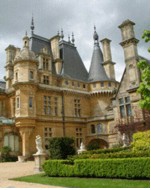
So I looked to Waddesdon Manor. The Rothschilds, upon building it, were neither established nor noble, nor were they new money. Their Manor at Waddesdon, transformed a hill top into uncompromised and sheer sumptuousness. Opulence. In it’s pure form. A very rare thing. With no other intention, from what I can feel, no compromise or conflict, it simply is what it is.

Philip Mount – February 2011

Return to Cultural Essays

Philip is profiled with his web link below. The second Phoenix Cultural essay will be another perfect addition to ‘The Storyeller’s Publisher’ and entitled ‘The Child’s Eye’ by Donald Sturrock, music impresario, and the hugely lauded biographer of Roald Dahl.

1 Comment

Filed under America and the UK, The Arts

SEEING WELL

In presentations and school visits, when I’ve read out excerpts from my books, I’ve sometimes told listeners I didn’t remember actually writing that bit, often coded with a Stephen Fry style joke – ‘well now, that’s rather good though!’ It’s been strangely emotional this week though, laying out Fire Bringer and The Sight to go to eBooks, on Kindle and Ipad. Firstly because it really is the end of an era, and the end of having any truck with big, conventional publishers. That’s strange, after 12 years fighting to be a writer. Secondly though because it put me back in touch with my own characters, characters loved by many readers, like Rannoch, Crak, Rurl, Larka and Fell. They came back, like old friends, and with a sense that in taking back my erights I have taken back some power in my own storytelling, snatched away by the very people who should have protected it. It reminded me too that writer’s lives are not that lonely after all, largely because they go on long emotional journeys, with others actually living inside their heads and imaginations, like true friends. Sebastian Faulks is doing a UK TV series soon on how we often know the characters in fiction far more than we do each other, friends, family and lovers too, and I can’t wait.

I wish someone I loved in New York, as I say in a new afterword, and at my own publisher too, had understood how books like The Sight were so close to my own emotional ‘coal face’ though, and my philosophical struggles. Because then they might have seen me more clearly, without projecting so badly, and The Sight is precisely about projection and labels, and their danger. I wish too they had read the sequel to The Sight, Fell, because it is also a love letter, and in a sense the full expression of what was happening in America. That book is all about the redemptive power of balanced love, to bring the mind out of darkness, fear, negativity or despair. What is still eerie though is that in all that writing about seeing properly, and being seen, there is so much in all my books about eyes. The fact that Scream of the White Bear has such an astounding ‘coincidence’ in it to real life though, involving eyesight, and actually events that happened around me, might make even the most ‘rationally’ and sceptically minded stop to ask if it is not powerful proof of precognition. Proof of the very ‘powers’ of The Sight I am talking about, which is really the visionary understanding of the mind and consciousness, true imagination, beyond what we see in the every day. It is not ‘God’, though the language of spirit may be vitally important, it is about levels of language, understanding, maturity and consciousness. Many people believe, with all those New Age ‘Aquarian’ and Mayan prophecies, Mankind has to wake up to its real power, and so real responsibility too, and so increasingly do I. Perhaps there is another stage of consciousness and awareness we need to reach, and one so abused in quick, side-driven, morally sententious but privately ruthless New York.

I was chatting to an American last night though, who when I started to talk about it, shrugged as if it was par for the course. ‘New York, they cover you in warmth on the surface,’ he said, ‘then stab you in the back, but they don’t mean to. It’s an accident.’ Perhaps that ‘not meaning to’ is vital, because it is really is about a lack of awareness, a boxed-in disconnection, a sense of ‘rights’ without wider responsibility, and a failure to see what is at the other end of all that aggression, those labels, that high-minded and morally superior front, at the cost of real hearts, real lives, and real careers. At the cost of the human. It really isn’t enough any more to excuse it as an accident though, and there may be some motor driving it on in the ‘bright, lights, big city’ machine of NYC, but it is certainly not limited to there. Indeed, the greatest surprise was to find it so close to home, with so-called ‘friends’ in London too, like the author of ‘Hew, Screw and Glue’, who so disrespected everything by working with my ex, desperate to hop on a bandwagon. Still, there are other friends, other journeys, and they are coming back, with the return of a say in my own books. Perhaps Fell needs a sequel, but there are certainly exciting adventures to come. DCD

Leave a comment

Filed under America and the UK, Publishing

DRUE HEINZ, AND THE LITTLE LITERARY MYSTERY OF A WARTIME STRIPTEASE

FROM THE PHOENIX ARK FILES:

It turned up in a World War II visitor’s book, from an aristocratic home, on a hill in Switzerland, with sweeping views to Mont Blanc. There a glamorous American heiress, and a Swiss Baron, banker, and notable art collector, lived out the war in grand style, and with a considerable taste for adventure. Among their more permanent guests was the painter Balthus. They were also intimately connected with a celebrated spy – Allen Dulles – first Civilian Director of the CIA. The hostess of the house would help Dulles retrieve the Ciano diaries from Mussolini’s favourite daughter, Edda. As part of an American East Coast elite, she was at least an informal agent for the OSS, forerunner to the CIA, the Office of Strategic Services. As for Dulles, still said to be a romantic hero at the Agency, and a committed lady’s man, the be-spectacled, swashbuckling, but famously discrete lawyer had crossed into Switzerland, via Lisbon and Spain, as the borders slammed shut on the eve of Operation Torch, the allied invasion of North Africa. He was armed with a banker’s draft for a million dollars, and a virtually free hand, as Berne OSS station chief. That he cherished, and fully exploited, culminating in his work over Operation Sunrise, for German surrender in Northern Italy. His all important Swiss escapade is touched on, fictionalised, but largely avoided, in the film The Good Shepherd, starring Matt Damon. Dulles certainly believed in something that seems to have gone into decline, operatives fully enagaged on the ground, and culturally educated and well informed, rather than doing much second hand, perhaps nowadays down the net. He once famously said that all you really need in life is ‘a little bit of courage’.

Dulles had worked for the State Department, became a lawyer with Cromwell and Sullivan, and was a member of Yale’s infamous Skull and Bones Society, initiate to Presidents and security gurus, alike. In Switzerland he set about building a spy network that saw his intelligence gathering reach Roosevelt’s own desk. Since he had turned Lenin from the American Legation door in Switzerland, in 1918, he would never make the same mistake again, and worked with many. He also contacted every American living there, to ask for help, in what he described to Washington as a ‘somewhat distorted world’. It was the kind of world where agents still wore red carnations, or proffered a pack of Camel cigarettes, rather than Gauloise, to establish their allegiance to Free France, or Vichy. One that saw the British and Americans in touch with Admiral Canaris, employer and lover of Mata Hari, as head of the Abwehr, German Military Intelligence. Until Canaris fell, after the attempt to assassinate Hitler, and the Abwehr were abolished. Canaris was effectively replaced by Walter Schellenberg, who mounted two machine guns on his desk in Berlin, and later settled in Switzerland to write The Labyrinth. One of Allen Dulles’s greatest coups though was securing the help of the heroic Fritz Kolbe, who the British had turned away from ‘the shop’, and whose reports were validated in London by none other than Kim Philby, already working for the Soviets. Actually Dulles was too acute to sign his name in a visitor’s book, although his daughter Joan, and troubled wife Clover Todd, both appear in 1944. As does a patient of the psychologist Carl Jung, who, though he never came to the house, Dulles also consulted in Germany, and had his own OSS code number. There too came Dulles’s station replacement in Berne, Robert P. Joyce, and General Barnwell Legge, American Legation secretary. Legge was heavily criticized in a recent military controversy on the internet, for his involvement in preventing downed American airmen escape, under threat of Court Martial, probably because Dulles did not want their Swiss operation compromised. Also for failing to correct conditions at the scandalous camp at Wilmeroose, although one subordinate called him a caring man.

In a very ‘Special Relationship’, British Intelligence were at the house too, many times. In the person of George Younghusband, military number two at the British Legation, and the Colditz escapee Pat Reid, famous for his escape-themed board game, and for so successfully telling The Colditz Story, after the war. Reid never wrote about his time in Switzerland though. More specifically, on the British front, there is Henry Cartright, head of MI9 in Switzerland. MI9 dealt with escape routes out of Switzerland, although the role of MI6 has been little written about, in terms of the use and significance of information that debriefed escapees must have provided to intelligence networks, for attacks on Germany. Cartwright was a world War I escapee himself, whose best seller on the subject was avid Nazi reading in WWII, for obvious reasons. That house was watched closely by the Swiss Police too, reported for high antics, and for harbouring ‘a nest of spies’. Its owners were friends with the head of the Berne police though, and so probably protected, in the semi neutral atmosphere of smoke and mirrors diplomacy. One affected in Switzerland by the changing winds of war.

Soon after the war though, they received a grateful card from the British Legation, commending the couple not only for hospitality, but for their invaluable help to British and American escapees. It makes a family visitor’s book a very important historical document, as are unseen papers on Hitler and Edda Mussolini. Perhaps significantly, they received no such commendations from US Services, since spying rarely stops. The question still remains though as to how much their Brit guests were aware of the depth of their American connections, because the house’s true significance is testified to by a meeting in 1945, still a mystery, that involved a visit by colonels at the heart of SHAEF, The Supreme Headquarters of the Allied Expeditionary Force, and ETOUSA, American Theatre of Operations, during Operation Overlord. They had helped covertly in a war that would see Nazi scientists smuggled to America too, in the battle for the A-Bomb, under Dulles’s Operation Paperclip, and herald the triumph of American world hegemony, in more ways than simple military victory. If information is power, cash rich America certainly won the covert war, because America soon had vast reserves of European files transferred to Washington. Incidentally, some 6000 secret papers relating to Switzerland, and designated Safehaven, remain closed.

There is one rather surprising name in the visitor’s book too though, on an evening in 1943 – Drue Mackenzie Robertson. She is actually Drue Heinz, future wife of the Baked Bean and Ketchup Multi-Millionaire, Henry J Heinz. She was a doyenne of New York Society for many years – writing letters to the New Yorker in 1944, so she may have been back in the States by then – but also became a celebrated patron of the literary arts. One the flapping Phoenix Ark could certainly do with a little help from – for our love of stories, real and fictional! She is publisher of The Paris Review, established the Drue Heinz Literature Prize, and her foundation endows the Drue Heinz lecture series in Pittsburg. At the Carnegie Museum of Art, her foundation also funds exhibitions at the Heinz Architectural Centre, and supports The Lincoln Centre Review. Having endowed a chair of American Literature at St John’s College, Oxford, and involved with Hertford College too, Drue Heinz has long been at the very epicentre of American Arts and Culture, but also influential in the UK. In 2002 she was made an Honorary Fellow of The Royal Society of Literature.

Born Doreen Mary English, Mrs Heinz clearly had a taste for theatrics earlier on, and as an actress, earned a small part in the movie Uneasy Terms, in 1948. It is all a long time ago, and many lives have passed in-between, so distance affords both mystery, and admiration, for a now grand old literary lady. But what of such tantalising ‘skull and bones’ in her cupboard, and was Drue Heinz really part of the OSS too, America’s Office of Strategic Services, or only linked by association? The term spy became a very moveable feast during the war, but it is an open secret that some of the most fertile areas of unwritten intelligence history are neutral territories, and Switzerland is no exception. Drue Heinz was there that night in Switzerland, 67 years ago, in 1943, and her signature is on the visitor’s page too, below her second husband, Dale Wilford Maher. As a graduate of the US Cavalry School and military attaché, Maher is a dead ringer for a spy, and signs himself ‘Master of the Five by Five”. That entry rather bemused this excited researcher, until, last year, one of the obvious links sprang fully armed from the pages of history, to validate a remarkable story, worthy of a movie, or a very stylish spy novel. ‘Five by Five’ was official Nato parlance for the best quality wireless transmissions, namely ‘reading you loud and clear’.

These people based at the American Legation then, and guests at a private home, were sending back radio reports, as Dulles himself began nightly transmissions from Switzerland, which in a coming technological age changed the cloak and dagger style of British dominated spying. It was the dawn of a new era, and they specialised in American style code words, like ‘Fatboy’ for Herman Goering. Stationed in Berne, in his beautiful flat in the Herengasse, Dulles’s own rather charming code name was Mr Burns, so you might take another glance at the satirical cartoon The Simpsons. To underline the personal touch, that Dulles would stamp all over the CIA, he called the technique for an operative communicating with a plane overhead by radio, ‘J-E Operations’. It came from the initials of Dulles’s daughter Joan, and his sister Eleanor. Despite British fears, Dulles’s work never compromised the greatest British coup though, in his supposedly ‘gung ho’ and open door approach. A coup embodied in the Enigma project, and Ultra transmissions, concealing the fact Britain had cracked and could read all German messages at the start of the war. British archives, although still closed, reveal a wireless transmitor was installed in their own Swiss legation in 1943.

Dulles, whose obsession would soon become the Soviet threat, and who encouraged later assassination programmes, out of the no-holes-barred tactics learnt in defeating the Nazis, notably had shares in the American Fruit Company, and has a rather more suspect role after his heroic war effort. Allied propaganda was one of his specialities in Switzerland, and as a master of dis-information, he was to be involved in a Mind Control programme, and Operation Mockingbird – perhaps he liked Harper Lee – the CIA’s attempt to directly influence the American media. Another visitor to that house would be Captain Tracy Barnes, a so-called ‘Jedburgh Agent’, and code named ‘Trick’, who would later turn up in the Cuban ‘Bay of Pigs’ debacle. It was of course Cuban bedeviled Kennedy who said of the CIA that he would like to scatter the organisation ‘to the four winds’. But what of Drue Heinz, whose Wikepedia profile is rather thin? Tantalizingly, that evening Drue Heinz signed herself in appealingly Mata Hari vein, for such a sparkling Manhattan hostess-to-be – “Queenie – the Striptease Queen!” The intense passions and fortunes of war, and such heady Swiss excitement, may have been too much for some. Dale Maher died in 1948, and his forwarding address on the internet is simply listed as ‘The State Department’. Drue Mackenzie Robertson married Henry J. Heinz II in 1953, becoming his third wife, and so perhaps beginning her powerful and passionate role in fiction and the arts. A passion fully shared by Phoenix Ark Press, although admittedly with a sometimes sceptical eye on other literary powers that be.

If you enjoyed this article, which is exclusive and under copyright, you can donate to building a little writer’s publisher:

Phoenix Ark Press errors: If anything is factually wrong in any articles on the Blog, please write to us direct, and we will enadeavour to check and correct.

1 Comment

Filed under America and the UK, Publishing, The Arts