Category Archives: Community

CONTINUING VOYAGES OF THE PLASTIKI

Documentary maker Max Jourdan’s fabulous diary from the environmental craft Plastiki continues:

Early April. Dawn watch

Waking up for the 4am watch, feeling like the ship’s cat has peed in your mouth. You stumble around head bowed under a red glow looking for damp clothes in the cramped space. In the cabin you pass half-undressed members of the other watch. “Morning.” “Good night.”

Emerging into the strange night you venture to the deck’s edge and grab hold of a mast stay, flexing cold-metal with every movement of the ship. You fumble with layers and zips as you lean over the edge for a piss. Jo said, “Most sailors lost at sea are found with their tackle out.”You sit at the helm and steer the course: 150 degrees. “The Pacific covers an area larger than that of all of the Earth’s masses combined,” you read, and contemplate the curving horizon with rising emotion. There’s a full moon: mesmerising, huge, white, round – and dead ahead.

The hours flash by. You hand over the helm and stand up. Looking at the boat’s wake, you realise dawn is approaching. The ocean is iridescent purple, and lines of orange and blue edge the sky. The entire sky is humming, as light from the sun arcs through the atmosphere. Overwhelmed, you just want to scream, but the rest of the crew is asleep.

6 April. How to kill a tuna fish

1.4 billion hooks are deployed annually on long lines. Some of these can be as long as 75 miles, allowing a fishing vessel to gather 50 tons of fish in one haul. We are trawling one fluorescent, feathered, garish lure on the end of a line and rod. I’m the first to get to the rod after we become aware of the whine of reel. The rod is bent in half and it feels like I’m dragging an oil drum in the boat’s wake. “Make sure the line doesn’t snap,” someone advises. But I am confident in the gear. The lady at the Sausalito tackle store told me we needed 50 lbs test line. “There’s some big fish out there,” she had warned.

“Maybe we need something tougher, then,” I said.

“Let me tell you something…” she replied and paused.”Anything bigger you don’t want to be pulling up on your boat.”

I am inching monofilament back on to the reel. “I hope we haven’t caught a shark,” I think aloud. Finally it surfaces by the boat. Flashing silver and blue and yellow. “That’s the biggest tuna I’ve ever caught,” mumbles Olav who previously spent two-and-a-half months floating across the Pacific on a replica of the Kon-Tiki. “Must weigh nearly 25 kilos.”

The tuna flaps around the deck, spraying blood everywhere. Olav hits it with the bat and I plunge a knife into the back of its head to reach his spine. We don’t measure it, just start butchering it on deck. The flesh convulses powerfully in our hands and Olav and I look at each other. Conveniently the rest of the crew seem to have disappeared. We cut the whole fish up into steaks passing them through to the galley.

8 April. Notes from the ‘Plastiki’ tramp

23.3 degrees of latitude. Sounds exotic; so why is it so cold? Jo told me, “By day five you’ll be in a pair of shorts and T shirt.” I’ve woken up on deck wrapped in a wet, grey, wool blanket; the kind the Salvation Army hands out to homeless people in winter. Did I remember to brush my teeth last night? Mouth all dry. Hair stiff like salty rope. Glasses frosted with spray.

Trousers are torn and disintegrating. Maybe dragging them by a rope in the boat’s wake for a few hours and drying them in the sun was a mistake. But it’s better than wearing the smell of tuna blood. I’d like to see myself as a hobo riding the ‘Plastiki Pacific Slow Boat to Somewhere’; but really I’m the official ‘Plastiki’ tramp. Crawl through to my hutch. The cabin smells like six teenage, grubby, campers are living here. Five men. One woman. Poor Jo.

15 April. The middle of nowhere

I’m not out here on some jolly, organic, culinary cruise across the Pacific. I’ve got a job to do. So when Jo pops her head out of the cabin and looks out at the ocean and grey dawn with a ‘this-is-not-just-another-day-at-the-office’ expression I pick up the camera. Turn on, press record, frame, focus, re-frame. Jo’s blue eyes crystallise on the LCD screen. I can sense the thoughts formulating on her lips. “What’s up, Jo?” “We’re more than 1,000 miles from any landfall,” she says. Jo looks profoundly happy. “What does that mean, Jo?” “It means it would take someone quite a while to rescue us. It means we’re alone.” The announcement is electric.

This is precisely why I took this assignment on, I think. In my peripheral vision, I can sense some members of the crew don’t share our mutual delight.

19 April. Let them eat cake

24 days at sea and maybe 20 more to go before landfall on Christmas Island. There are some pressing concerns; water is being consumed too fast, toilet paper is running out, the furling system starboard side is broken and the foresail ripped. Running out of bread is a serious problem. Just look what happened to Marie Antoinette. I’m not saying this as a Frenchman, but because bread is part of the ritual of our daily lives; it provides sustenance, pleasure and even bonds people.

An ocean-crossing is all about being self-sufficient, from mending sails and water pumps to baking bread. Unfortunately, we’ve got only a solar oven (delusional dream of some wacky hippy baker). The wrapping and instructions displayed a perfectly roasted Thanksgiving turkey. It’s so hot out here you could fry eggs on the plastic deck, but I still haven’t got the temperature above 120C. “What bread can we bake with no oven and a miniature grill?” I ask Jo. We run through the naans, flatbreads, galettes, rotis and chapatis of our desires. Olav suggests the chunky Norwegian black rye bread of his youth. In the end we opt for pita.

READ ON SOON…

Photograph courtesy of the Plastiki crew. For more information on the expedition, go to the web-site http://www.theplastiki.com or by clicking
Leave a comment

Filed under Community, Environment

THE 7TH PHOENIX ARK CULTURAL ESSAY

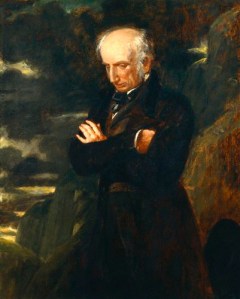
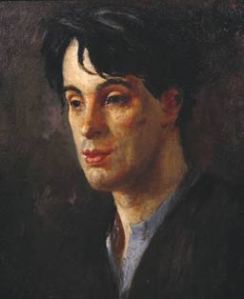
THE TWO WILLIAMS by Anthony Gardner

Recent travels have brought to mind two poets. Several weeks ago I was in Ireland, and thought inevitably of Yeats, whose poetry illuminated my own upbringing there. A fortnight later I visited Wordsworth country, which I’ve come to know only in the past few years. What, I found myself wondering, would each of these great writers have made of the other’s milieu, had Wordsworth not died fifteen years before Yeats was born? And what would they make of their domains today?

My Irish visit focussed on County Laois – not a region strongly associated with Yeats. But the Georgian mansion in which I stayed (now beautifully and painstakingly restored , as a hotel) was instantly evocative of his ‘Upon a House Shaken by the Land Agitation’, celebrating the virtues of gracious living:

‘…the sweet laughing eagle thoughts that grow
Where wings have memories of wings, and all
That comes of the best knit to the best…’

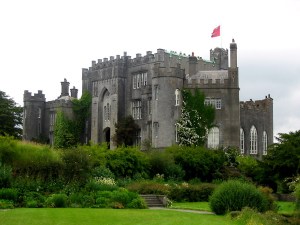
Many such houses were burned to the ground in the 1920s, and those that survived in the area have had widely different fates. Birr Castle remains the home of the Earl of Rosse, though its grounds and Victorian observatory are open to the public; Stradbally Hall is the setting for Ireland’s leading music festival, the Electric Picnic; Leap Castle (the country’s most haunted) is being restored single-handed, by a professional tin-whistle player, Sean Ryan.

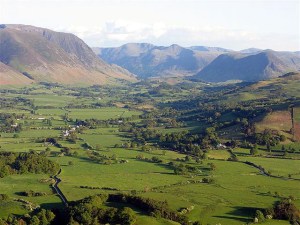
In the Lake District, I visited the village of Lorton, four miles from Cockermouth (the town in which Wordsworth spent his early childhood). Lorton’s most famous inhabitant is an ancient yew tree, to which Wordsworth devoted a short poem, including the lines

‘This solitary tree! A living thing
Produced too slowly ever to decay;
Of form and aspect too magnificent
To be destroyed.’

This has proved over-optimistic: the tree is only half the size it once was; but it is still an impressive sight, and the fact that Wordsworth made the pilgrimage to see it brings a small thrill.

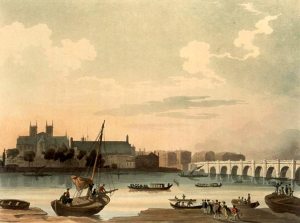
Wordsworth did not, to my knowledge, ever visit Ireland, nor Yeats the Lake District; the one place they had in common was London. The fact that Wordsworth, the great poet of nature, should have written the most famous of all poems in praise of the capital – ‘Upon Westminster Bridge’ – has always intrigued me. It is curious too (though in keeping with the tradition of the Irish artist in exile) that Yeats’s most famous poem, ‘The Lake Isle of Innisfree’, was inspired by a shop window in the Strand:

‘I will arise and go now, for always night and day
I hear lake waters lapping with low sounds by the shore.
When standing on the roadway, or on the pavements grey,
I hear it in the deep earth’s core.’

Wordsworth might have found in this an echo of his own ‘Lines Composed a Few Miles Above Tintern Abbey’, with its gratitude for memories of nature ‘’mid the din/Of towns and cities’. But I doubt that he would have thought much of Yeats’s lake and ‘bee-loud glade’: it’s far too tame, a world away from the grandeur of the Cumbrian scenery ,which formed his own sensibility with its ‘huge and mighty Forms’. The waterfalls and seascapes which characterise Yeats’s early West of Ireland poems would have left him equally unimpressed, for all the delight of fairies dancing

‘Where the wave of moonlight glosses
The dim grey sands with light…’

Yeats’s Celtic Twilight is a soft, dreamy thing which the harsh winds that blow with ‘strange utterance’ through Wordsworth’s ‘The Prelude’ might rip away in a moment.

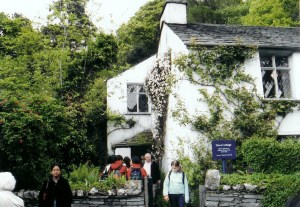
Let us turn the tables, though, and imagine Yeats visiting Wordsworth at Dove Cottage. He would certainly have approved of the domestic set-up – Mary and Dorothy Wordsworth, indulging William as he himself was indulged by his young wife Georgie. But the building itself? Surely not in keeping with Yeats’s notion of the poet’s role in society: for him the Duke of Urbino’s court or Lady Gregory’s Coole Park were where a great artist belonged, at once creating beauty and finding inspiration in beautiful things. Even the much larger Rydal Mount, to which Wordsworth moved in 1813, would hardly fit the bill.
Perhaps Wordsworth takes him across the fells to visit the family’s old home in Cockermouth. Now owned by the National Trust, it ranks second only to Cockermouth Castle in the town. ‘That’s more like it,’ thinks Yeats; but Wordsworth has a bitter tale to tell about the aftermath of his father’s death, and the failure of John Wordsworth’s employer, a landowner on a grand scale, to repay an enormous sum owing to the family. No wonder he doesn’t share his guest’s enthusiasm for the splendid dwellings of the rich.

He might approve, though, of the home Yeats creates for himself in later life. Thoor Ballylee in County Galway is a ruin restored

‘With old mill boards and sea-green slates,
And smithy work from the Gort forge…’

but even after refurbishment it’s pretty uncomfortable. To Yeats its greatest importance is as a symbol from which he draws inspiration for ‘The Tower’ and other great late poems. Wordsworth is stirred by ruins, too, from those of Tintern Abbey, to the ruined cottage which symbolises a peasant family’s suffering in the eponymous poem.

Can we picture the two men working side by side as Wordsworth did with Coleridge? Not easily. For one thing, Wordsworth likes to walk while he is composing, while for Yeats writing is ‘sedentary toil’. But from time to time he climbs to the top of the tower and looks about him. How different Galway in the 1920s is from the gentle countryside of his youth!

In the final part of ‘Mediations in Time of Civil War’ he sees phantoms of hatred sweeping across the sky in a ‘rage-driven, rage-tormented and rage-hungry troop’.

Perhaps Wordsworth accompanies him up onto the roof after dinner and they confront the tumult like a pair of King Lears, the wind blowing their white hair into halos. But I suspect not: Wordsworth has seen enough of bloody civil strife during the French Revolution – for him such things are best considered in the light of a new day, as in ‘Resolution and Independence’:

‘There was a roaring in the wind all night;
The rain came heavily and fell in floods;
But now the sun is rising calm and bright;
The birds are singing in the distant woods…’

For today’s visitor to the Lake District, these lines recall the terrible floods which assailed Cockermouth and Workington last winter. I think Wordsworth would be impressed by how his birthplace has picked itself up again, and reassured that the stoicism of the local people still endures – though saddened by the way in which traditional agriculture has been eclipsed by tourism.

As for Yeats’s homeland, it is significant that when Ireland was forced to accept the EU’s financial support a few months ago, the Irish Times quoted his ‘September 1913’ in its leader:

‘Was it for this…
…………that all the blood was shed,
For this Edward Fitzgerald died,
And Robert Emmet and Wolfe Tone,
All that delirium of the brave?’

Only Yeats at his most magnificently scathing could do justice to the ignominy brought upon his country and the spectacle of picturesque landscapes lost to thousands of unfinished houses.

It is possible that the two great poets would not have got on at all. Wordsworth was not known for his kindness to younger writers, and made a poor impression on Keats when the latter came to pay his respects. Yeats counted Wordsworth among his early heroes, but was more critical of him in middle age:

He strikes me as always destroying his poetic experience, which was of course of incomparable value, by his reflective power. His intellect was commonplace and unfortunately he had been taught to respect nothing else.

Nevertheless, roaming the countryside together, I think they would have found shared sympathies – for example, their concern for ordinary people, such as the shepherd deserted by his son in Wordsworth’s ‘Michael’, or the old pauper in Yeats’s ‘Adam’s Curse’ breaking stones ‘in all kinds of weather’. Indeed, if I had to choose the poem by Yeats that brought him closest to Wordsworth, it would be his description of his ideal reader, ‘The Fisherman’:

….his sun-freckled face,
And grey Connemara cloth,
Climbing up to a place
Where stone is dark under froth,
And the down-turn of his wrist
When the flies drop in the stream;
A man who does not exist,
A man who is but a dream…’

Return to Cultural Essays

Anthony Gardner April 2011. The public domain photos are Wordsworth by Robert Haydon, Yeats by Augustus John, Birr Castle, The Lorton Valley, Westminster Bridge and Hall, painted in 1808, a year after Wordsworth declared ‘Earth hath not anything to show more fair’ and Dove Cottage today. Anthony is profiled below and his novel ‘The Rivers of Heaven’ is published by Starhaven.

1 Comment

Filed under Community, Poetry, The Arts

ANSWERING A LETTER FROM A READER

‘Hello. I am a big fan of your stories. I especially loved Fell, and the scene with the salmon.
I was wondering though… This is the first time I’ve been to this site, and excuse me for saying that I am a little confused as to what is going on. I have never heard of Phoenix Ark, and would like to know when it started, and by whom. I think it’s a great idea to focus on writers and sharing the stories they work so hard on. I am very interested in it (being a hopeful writer myself). I hope that you succeed in letting your voices be heard, and that everything works out. When Scream of White Bears comes out in Canada, I’ll be anxious to read it.

Helene

Dear Helene,

many thanks for writing. Phoenix Ark was founded by David Clement-Davies, mid last year, in response to the awful publishing climate, and the politics inside many big publishers too, to talk straight to readers, and allow writers’ voices, even beyond their works, to be heard, shared, and to hope that writers and artists are really respected and protected too. The problem we faced and face is the very difficult financial climate, and so raising the necessary investment, not only to survive, but to really get books published properly, David Clement-Davies’s, and others. It was blogged that in fact we can only afford to get Scream of the White Bear, and probably other books, out electronically, to Kindle and elsewhere, though if investors came in, that could and would change. The founder, while trying to make a living himself, and come out of an awful and unneccessary battle in New York, is still looking for the right people though. We hope you like all there is on the website though, cover designs, cultural essays, personal blogs, articles, and a free story, and great to hear from you.

Very best,

Phoenix Ark Press

Leave a comment

Filed under Books, Community, Publishing

SLOW INSTALMENTS!

Many apologies for taking so long with Dragon In the Post, below, but many discoveries are being made. Not to compare you, dear reader, with a fish from the Foundless Sea, but they say if you’re not hooked by the first three chapters, a tale isn’t worth the telling. Well, I’m hooked, and want to know what happens, which I don’t know yet, if you see what I mean, so more to come. A very big thank you too, to some special people. To Dinah, in Texas, to Tiffany Bertrand, to Bill, who gave us our very first Donation, to Barb, who generously overpaid us, to Marcin Dabrowski, for working so hard for the love of what he does, and very genuinely, to anyone who has written to the Blog, whether encouragingly, or scolding an excess of anger, or personal revelation. That warmth, generosity and care, the pure inspiration of some of your letters, has literally kept the founder going, when he might have given up on the story a long time back. A thumbs up to WordPress too, despite not always answering queries, for believing in the First Amendment, and creating such a brilliant and adaptable creative tool. We’re very far from there yet, but not even the Black Warlock will stop us now!

Leave a comment

Filed under America and the UK, Community, The Phoenix Story

THE LOST AMERICAN?

What is the American voice? Is it something calling out of Last of the Mohicans? Some spirit drifting between those great cities, and the giant open spaces, the high wheat plains of modern America? A little idea formed today, perhaps out of my own troubles, and need to connect again, that there’s some urgent debate to be had about what it really is to be American, in 2010.

You cannot define a country by an individual, turn an individual into a cliché of a Nation. Yet Britain and America are clearly ‘divided by that common langauge’, and often don’t seem to understand each other. PJ O’Rourke said yesterday that the Republican backlash is because to be dictated to by any government is not ‘the American Way’. I wonder what he would have thought of a writer being dictated to by his own American publisher. When I travelled though, and toured in schools, or at signings, met such warm people, there was often a sense of Americans being lost. Of unique lives becoming swallowed in the vastness, the shiny, commercially demotic pace of it all, and almost some innocence or immaturity, needing to reach out and find its parent.

Was it reaching out, when the Twin Towers fell, in the modern confusion about what is real, and what a sequence out of Godzilla, or some monstrous global fantasy? Or in the signs that came up on the internet, ‘Sorry World’, during doubtful elections, no longer so filled with doubt? Or is there some far deeper lack? Something essentially cultural, something being missed in the American Soul, in its widest sense, and equally perhaps around the World. Perhaps we are all and always a little lost, in the face of existence, and the human condition. I do not think many Europeans understand the definitions of the Republican-Democratic divide though, and with that emphasis on the Bill of Rights, and Founding Fathers, as if a country is still fighting the American Revolution.

That is what flutters in those military banners, over so many homes, what stiffens the back in School-Time allegiances to the Flag, something we do not especially understand here, fearing a kind of cultural brainwashing. So often the tendency becomes not One World, if such a thing is possible, but ‘Us’ and ‘Them’, as it did at my own American publisher, and coming out of a Second War tradition, for me, isolationism is a great country’s worst instinct, Roosevelt its greatest voice. It’s flip side is that, while being so caught between the highest, most innocent idealisms, and real hardball, Americans believe the propaganda that says ‘try to make the World American’, and it will all be ok. ‘Job Done’. ‘Mission Accomplished’. Mission Impossible, perhaps?

The idiot always says ‘we bailed you guys out’, yet the cynic would do well to read the sadness and cultural mishaps of Graham Greene’s The Quiet American. America is a land of aggressive freedoms, energy, law, business, often hugely appealing to guilty Europeans, and has defined the modern world, in part because its driving spirit has been made by immigration from right across the world too. Or is that confusing America with New York, a land unto itself? Perhaps it was the sadness of so many of those Europeans, their quest for real freedom, that caused a kind of instant forgetting, the quickest desire to ‘move on’, and close a door fast on what is complicated, or even a truly original voice in the world. It’s why, for all our supposed ‘rights’, History taught in schools as ‘Social Studies’ in America, is the wrong approach. History is not there just to justify a present social model, but like literature, something independent, that contains the jewels of freedom and higher truth, beyond instant culture. In writing there, certainly storytelling, there is a tendency to encourage ‘World Building’ too, like a disconnected computer game, that does not breath in the real significance of cultural or imaginative archetypes, with enough depth. History is not just there to prove ‘we’ve never had it so good’, but an emotional, intellectual and imaginative in-breathing of the vast sweep of Man and Civilisations, out of which America was ultimately born too. That is real cultural depth.

So we look at America, often longingly, or out of a necessity of world capitalism, yet wonder why there were riots in New York, at the release of the newest PlayStation, and sense there’s an older, subtler consciousness in Europe, that needs to be heard in really linking global cultures, without fear or favour. We are shocked when we hear only 97% of Americans have passports, yet, in a shrinking world, know that how we travel is also how we can lose cultures to sameness. Is it geography, history, politics, or the stereotypes we carry in our own heads? That I carry, too much out of the pages of books: A Connecticut Yankee in King Arthur’s Court. Atticus Finch. Captain Ahab. Lee Scorsby. Colman Silk. Now I also carry the real people I got so close to in New York, and who did such unnecessary harm. But, even in a novel, a character only lives within the culture he or she can encompass, and really understand, or from which he or she is ultimately alienated. DCD

Leave a comment

Filed under America and the UK, Books, Community, Publishing