Category Archives: Language

THE DA VINCI CODE PROVED TRUE!

Perhaps it’s the wonderful end of obsessions with sex as original sin, women as evil, or the proof of Dan Brown’s Da Vinci Code fictions. Perhaps Catholic priests will now be allowed to live happily married lives. It was no Biblical story that forced in the idea, for instance, that Mary herself was conceived by Immaculate Conception, but the decrees of Church councils.

Karen King, a Harvard professor of Divinity, has just discovered a snippet of ancient parchment with words to the effect “and Jesus said, my wife…..who may become my disciple.” The Da Vinci Code may be a dreadful read, in literary terms, but it is also a very clever page turner. It builds on rather astonishing ideas about Da Vinci then, Jesus being married to Mary Magdalene, and out of books like The Holy Blood and The Holy Grail. We still think The Godhead Game should be seen as a Da Vinci Code of Mayan World End ideas, this year, but that’s special pleading! In the meantime, what a blessing for debate, life and different kinds of sacred love, even if Christians did get so upset about a film they misunderstood, The Last Temptation of Christ. Ghandi used to renew his marriage vows every day.

PA PRESS

1 Comment

Filed under Culture, Education, Language

THE EARL OF OXFORD SHAKESPEARE “THEORY”

TO WILLIAM RAY

Dear William,

I’ve posted your response in EDMUND SHAKESPEARE, THE EARL OF OXFORD, FALSTAFF AND THE HOLLOW CROWN comments. Please understand though, despite admiring a spirit in your article, I do think “THY TEST IS EVER HAM” and that what ensues from trying to prove what you think self-evident is hugely distortive of so much other evidence, and pointless arguing with too, because the holes in it are so enormous. Despite some arguments about the datings of both The Tempest and Winter’s Tale, there is no doubt they were written well after Oxford’s death in 1604. Are you seriously arguing those were not by the “Shakespeare” of the cannon?

That, and so many other things, including work on Edmund Shakespeare and Southwark here, just make it rather silly, I’m afraid, though everyone is tantalised by possibilities, and leaves some space for them too, like those Latin signatures in the visitors book in The English College in Rome. Sure, Sacred Cows get handed down the generations, hence constant re-inventings and re-interpretations of Shakespeare, as history itself is dialogue between past and present, or assumptions over-write very valuable arguments about who anyone really is, even what consciousness is, especially with such an artist. That’s the difficult nature of any biography supposedly telling it as it was. I would argue Shakespeare far more complex than the “sweet” or “gentle” image, though as a man in life I think he was, but as an artist during the business of writing, he was indeed Everyman, hero, villain, or real human being, as Bloom argues he “invented the Human”. It is why it is so essential not to invade or judge artists during the process of their work, because then they are engaged in archetypal processes that summon everyone’s consciousness and experience.

But reinterpretation itself is natural, as we all rediscover the world from birth to grave, especially from an age only coming into official records. Is it wrong to observe that you argue it so strongly because Shakespeare’s spirit and plays support your or Emerson’s observations about the nasty world, or what might have happened in some regard to Oxford, but that Will can still be what the evidence proves, the boy then man from Stratford? I also strongly suggest any search demands not highly speculative textual clues at all, but only a hunt in archival records for missing letters, facts and a potential confusion of dates. There any real proof would lie, and it is not there at the moment, very clearly highlighted by, though not dependent on, Oxford’s death in 1604. Just a year after Elizabeth had died and James ascended, who, with his interest in witchcraft, Macbeth seems written to profoundly appeal to. While King Lear very possibly writes a brother, Edmund, certainly the strife of families, in years that saw John Shakespeare die in Stratford, then Mary Arden, all over its pages. Edmund Shakespeare, a player, died in Southwark in 1607 and his burial at 20 shillings suggests the payment by his now succesful playwright sibling. I’ve stared and stared at the original documents and records. Then there is Charles Nichols on Shakespeare’s time on Silver Street, also after 1604, and his appearance in court in the Bellot Mountjoy case, that has a theatrical milieu written all over it too. I kindly suggest you admire Oxford for who he was, but give up the rest as a bad lot, though it’s been stimulating, and would be more so if there were real evidence.

best wishes, DCD

1 Comment

Filed under Culture, Education, Language

MITT ROMNEY AND KISS MY ARSE

Despite an addendum to the blog on the Romney Olympics remark, below, the reported comment of Romney’s Press Secretary “Kiss my arse” might be very humorous, until you remember that it was the such language to a Forbes Magazine reporter, from an Enron executive, that revealed the kind of arrogance that covered up the true darkness in Enron, and the biggest Corporate fraud in US history.

There is no suggestion here Romney is the bad businessman, like the Enron folk, but how can a serious Presidential candidate allow his people such an attitude and such comments? Bush displayed a notable arrogance or contempt towards the Press, and most politicians have a love-hate relationship with the Media, but at least Bush had ‘earned’ a Presidency. Romney’s camp clearly believe they have the right to rule and when anyone assumes that perhaps you know what you can expect.

Leave a comment

Filed under Culture, Language

SHAKESPEARE’S BOOKES AND THE TEMPEST

The Edmund Shakespeare Blog

The end of Charles’s Nicholls’ The Lodger is very good on Shakespeare’s supposed swan song, The Tempest, when Prospero drowns his ‘bookes’ and breaks his staff. As both he and Peter Ackroyd point out, it was not his actual writing end, before his death in 1616, (the Earl of Oxford had died in 1604) and so instead Nicholls quotes Theseus’s lines from another little-read collaboration – The Two Noble Kinsmen

“O you heavenly charmers
What things you make of us! For what we lack
We laugh; for what we have are sorry; still
Are children in some kind. Let us be thankful
For that which is, and with you leave dispute
That are above our question. Let’s go off
And bear us like the time.”

Appropriate words for Phoenix Ark Press, perhaps! As Nicholls says, that does not mean that The Tempest was not his greatest swan song, but then, as so much in Shakespeare is about the art and artifice of theatre itself, and generative language too, Prospero is much about the magical engagement of the poet magician’s own psyche, meeting the intractable threat of real life and politics. The appeal beyond fragile art too, not half so real or true as when fact and fiction meet.

There were about 15 permanent theatres in London at the time, and the remains of The Curtain were uncovered in work on the London Olympics. But in the story of William and many other players, like his youngest and virtually unknown brother Edmund Shakespeare, that astonishing flowering of poetry and theatre in London and Southwark was soon to be swept away by the Puritans, and Civil War, or find its channels in other more aristocratic rivers. Closed winter theatres, like the one Shakespeare and The Globe sharers were developing in Blackfriars, brought more expensive seats, the introduction of candlelight, one day to become ‘the limelight’, and so changed the shape of playwriting too, into formal acts. Theatre also moved towards London’s ‘West End’ – the City was pushing that way – with theatre’s like Beeston’s Cockpit, and developing Drury Lane.

But by the 1640’s The Swan theatre in Paris Gardens in Southwark, built by Francis Langley, was described as hanging down its head “like a dying Swan.” The Globe, that had burnt down in 1613 and was rebuilt, had gone by 1642. Later reformers would associate the site with a Baptist meeting-house, but if, for the morally minded, the ‘sinful miasmas’ of the theatres had been happily expelled, what really drove the development of the area now was the hugely lucrative brewing business, as individual ‘taps’ were driven out, and everything went through the guts of kings, beggars and London Citizens alike. So those ‘player’s fictive worlds were vanishing under their entertaining feet!

If Shakespeare, during the Reformation, did turn away from Marlowe’s darker revolts and investigations, that fiery playwright spy, to the purposeful prosperity of secular theatre and sought futures, perhaps he also echoed Dr John Dee’s turning from alchemy and the occult too. It seems that in writing about London, a skillful fiction writer like Peter Ackroyd, who wrote a novel about John Dee, has himself touched the potential darkness of that imagining. Shakepseare’s astonishing alchemies are of the heart, most interested in working effects on an audience, so he is always concerned with real love, and the effect of the play in engaging with life. Summoning too though those mythic ‘Gods’ of a classical imagination and belief, powerfully real forces inside such a psyche, before any pseudo ‘science’ of psychology had been invented, but knowing in The Tempest, and the flow and tide of time, that everything dissolves in the end, except the play itself:

“Our revels now are ended. These our actors,
As I foretold you, were all spirits and
Are melted into air, into thin air;
And, like the baseless fabric of this vision,
The cloud-capp’d towers, the gorgeous palaces,
The solemn temples, the great globe itself,
Yea, all which it inherit, shall dissolve,
And, like this insubstantial pageant faded,
Leave not a rack behind. We are such stuff
As dreams are made on, and our little life
Is rounded with a sleep.”

Leave a comment

Filed under Culture, Education, Language, London

EDMUND SHAKESPEARE AND ALAN NELSON

The Edmund Shakespeare Blog

William Ray described Alan Nelson as a somewhat rude Shakespeare critic, or words to that effect. That impression also emerged in a spat that took place between him and Katherine Duncan Jones on the Net, or his Socrates site. I first contacted the Berkeley University theatre historian about a novel I had started on Edmund Shakespeare, when a teacher in a Clapham pub told me about the tomb stone in the centre of Southwark Cathedral. It must be said, a late eighteenth or early nineteenth century addition to the sculptured dead there. Professor Nelson was working on listing the names in the Southwark Cathedral Token Books with a colleague, Professor Ingram, and certainly deserves the credit for naming the place Edmund Shakespeare turns up in Southwark, The Vine, at a little lecture to his students at The Globe Theatre. I hope I would have eventually uncovered it alone, but along with the difficulty of deciphering names and Elizabethan writing, you have to let a period into your blood, before you wake up to who and what, and interesting connections, that can suddenly vanish again, like wood smoke.

I was rather less impressed with a desire to ‘protect moral copyright’ in that work, since Edmund’s presence in the Token Books was already up on the net, and there is no copyright, moral or otherwise, in fact. To be fair, Alan Nelson quickly announced that at a first talk to the friends of Southwark Cathedral and how the name just might have been a forgery of John Payne Collier’s. He does not think so, though I am less certain about the name attached to The Vine, than Edmund’s certain burial record in Southwark Cathedral in 1607. I was also less impressed when I invited him to lunch in London, to discuss the whole subject, even perhaps seeking support from Berkley University, but never even got an answer.

As James Shapiro, doing 1608 for Faber and Faber, was not exactly hugely supportive of an Edmund Shakespeare project, although he said it was important. Well, our American cousins are as capable of being as protective of ‘new’ information about Shakespeare as anyone, not least because of waspish voices everywhere, in an increasingly competitive publishing world, and that there is gold in them there Shakespeare hills, or academic kudos. Except here, because frustration means we are giving work done for free! I hope it is of interest and value.

I also hope the scholars can be a little more open to work from those who are not the supposed ‘authorities’. I think writers’ and players’ instincts are very real authorities, but you must also have respect for what is actually said in the records. Alan Nelson made that point about the record of Will Kemp’s death, and the relaying of mistakes into the ‘mainstream’, picked up as ‘truth’. Go back to the source then, but do not get too fustion either about the nature of historical imagination and insight needed, nor the certain reliability of records or indeed scholarship. Much American interest in Southwark now, with Sam Wanamaker’s Globe, does seem to come straight out of the American search for its own roots, from an age of New World Discoveries, but I for one am rather dubious about the supposed name of John Harvard highlighted by an arrow in the Southwark burial records. Perhaps I am going blind!

As I have said though, I think the direct link of The Vine, in a group of Southwark buildings in the Token Books called Hunt’s Rents, to John Le Hunte, and The Brotherhood of Our Lady of Assumption, is a new and extremely important window into the vitally under studied area. As far as I know, no one else has revealed that but a scholar will have to tell me if I am wrong. Following the records of St Margaret’s Church there, which became one of the Compter Prisons, it is wonderful to find records of ‘pleyers‘ in the church, a hundred and fifty years before the new permanent Theatres. It ties that playing tradition to everyday and church life, to the great festivals and to the mystery plays, that were effectively banned under the Reformation. So theatre became essentially secular and political, in an intense and dangerous London environment. But as Ackroyd says, a Roman gladiator’s trident has been found in Southwark, and there was a very long tradition of ‘entertainments’ there.

So the dirge being sung for Henry VIII, at his death, by priests in St Saviours, now the Cathedral, was interrupted by the rowdy sound of players in the Southwark streets. Ah, time and history stop for no man, as was written over London Bridge. That band of ‘low life’ scum that William Ray tries to refer to then, or a great tradition of player troupes in England, that Shakespeare joined and fed from, however much he and Hamlet may have redirected the vision of theatre, or not, as the case may be. But it is of course Hamlet, and Hamlet’s reaction to the players’, with their vital reports, their window into truth, the play being the thing to catch the conscience of the king, and everyone else, that is one of the most obvious signs of Will Shakespeare’s living engagement with the playhouses. As that ‘magestical roof, fretted with golden fire’, gives a new resonance to an actor’s consciousness, standing physically on stage, referring to the props and artifice of the wooden O. The echo chambers to his art and his metaphysics. But it works throughout the plays, as Shakespeare engages in a dialogue about his own art, and what is truth and what show. What ‘History’ is too.

If you try and read my handwriting, in my large notebook, out of six months work at the London Metropolitan Archive, you might think mine an example of sloppy, mispelt Elizabethan writing, before spelling codified, like so much else! I have not got that with me, but it will come out in time. The picture you can begin to build up of Southwark, what was there, who living there, and how that assists Shakespeare scholarship, is one that should be shared, and shared by people on each other’s ‘side’, not trying to be the harbingers of the only truth around. Shakespeare scholarship does stand on the cusp of recorded ‘history’, perhaps a new consciousness of English or British history, suddenly being dramatised so powerfully by Shakespeare, not least because it was the beginning of parish records themselves.

DCD

Phoenix Ark Press

1 Comment

Filed under America and the UK, Education, Language, London

ED MILLIBAND MUST DROP THE TONY BLAIR STYLE!

The use of the thumb, the repeated use of the interviewer’s name, ‘Kirsty’, the intense reasonableness of it all, the ‘I’m the honest guy’, so smacks of Tony Blair, Ed Milliband must drop it immediately. Even his voice now sounds like Tony, not to mention the ‘I have to say to you’ words. Fight on, but read Brecht on studying style and The Resistable Rise of Arturo Ui, then find your own voice.

Leave a comment

Filed under Language

PHOENIX ARK PRESS INVITE DEREK JACOBI TO TEA!

Did we tell you the one about meeting the actress who played the poisoner who Livia employed in I Claudius, in a chemist in the Oval, complimenting her on her talent and the wonderful series, then deciding not to buy any medicine that day! From the frayed temper in reply to a blog about another I Claudian, Derek Jacobi, and the Earl of Oxford theory today, perhaps emotions run deep. We do want to stress then undying admiration for real writers, poets, and actors, especially Derek Jacobi, so point out that disagreeing with his thoughts on Shakespeare’s identity, in his programme about Richard II, has nothing to do with our appreciation of his huge talents as an actor. So we invite him to tea, to dispute the Oxford theory, or even better to hear about research here into the story of Edmund Shakespeare in Southwark. No poison will be even contemplated.

Leave a comment

Filed under Education, Language, Non Fiction, Poetry, The Arts

THE PHOENIX ARK CULTURAL ESSAY – THE LOVELY END OF THE WORLD!

2012 AND THE TWO LANGUAGES?

Just to prove here we are all vaguely nuts, the next Phoenix Ark Cultural essay is on 2012 itself and the much muted Mayan ‘Prophecy’. Much as there is a delight in boyish Professor Brian Cox being so much to the fore at the moment, and all the wonders of Science too – closing your eyes a second to the horror of those Chemical cataclysms like the First World War – it was slightly irritating to hear him say on the Jonathan Ross Show the other day, who like Madonna is of course simply divine, darling, that the end of that calendar is just garbage. Not of course because it is the End of the World, although for someone, somewhere, it always is, and for another a new beginning too. But because of the general interest in it, and the idea it represents some end or change, in the dawn of a new age for Human Consciousness. The Mayans believed in cycles of being, and strange new worlds, until The Spanish and West discovered their old world, or the rival Aztecs, and got away with pretending to be Gods, in their nasty hunt for gold and Christian servitude, in its formalised understanding of it. Well, human consciousness is a very nice idea, as Ghandi said of Western Civilisation, especially new dawns of it, while we need good narrative stories. Tell it to Assad in Syria, by close accounts just the crony of a family regime who have no interest in a political solution, and whose ‘Intelligence Services’ deny the very meaning of language in their horror and stupidity. But in the horrors we have witnessed in the last decade, especially out of unreformed Islam, is there not something more enlightening to be said on the language of God, religions, or at least the Spirit, that might be more helpful than Richard Dawkins going on and on about how Religion is just a virus? Even for Rushdie to write the Satanic Verses, or Phillip Pullman to so astoundingly go to the heart of fantasy and science, but with his final communion still being in some ‘republic of heaven’ demands a certain appreciation of the language, although perhaps a rule of thumb might be when anyone overtalks Science, talk Spirit or imagination, and when they overtalk God, talk Science.

The Mayan end date for jolly old us relates to a Stella, a carved stone, that has the start of what is called one of their Long Counts on it, ending in 2012. Actually the Mayans had various calendars, that worked in complex cycles, and relate both to their astrological and religious years. They were also able to count, and therefore supposedly conceive, in terms of vast periods of time, backwards and forwards, at least their controlling Priests or Royal initiates were, which is supposedly more sophisticated and true than the Christian West’s Six Days Creation, or Archbishop Usher setting the start date of the Earth as Sunday, 23 October 4004 BC. The Mayans knew a little something then, 1200 years before the language, discovery and awareness of modern Science, a word coined in the Eighteenth century, tipped the scales into our realisation of the elements, the fossil record, dinosaurs, Darwin’s rather upsetting Natural Selection, although Evolution is an intrinsic concept in Ovid’s Metamorphoses, and seismic geological activity on Earth. That accumulated knowledge allowing us to contemplate staggering Deep Time, with understandable vulnerability at being so tiny, and now has us peering out into the furthest reaches of spacetime too. Freeing us from the crosses of Sin, guilt and ignorance, perhaps, but at times leaving us just as lost in the void, or unnconnected with one another. So of course did the Babylonians, Egyptians and Greeks know things, looking up and out, and round about. But that is one up for the Mayans, even if, in the 1066 and All That vein of history, human sacrifice is a BAD IDEA.

When you think about it is also a Christian idea, in that very troubling story that reaches back to Abraham and Isaac, in any search for any loving God the Father, and in the eucharistic practice of ‘God Swallowing’, that goes back to very primitive societies. Perhaps drinking the wine and breaking the bread in memory is a gentler way of talking about the feast of life and good fellowship, if you do not want to argue the magic of transubstantiation, but if the Mayans intuited the Gods of their Underworld from the huge underground wells and chasms of Mexico, they also seem to have intuited a bloody great asteroid that may have wiped out the Dinosaurs, and ended their particular lizardy stint on the planet. Now those Underground pools are being threatened by building rods from holiday homes, so there’s one down for Science, or its oversuccesful children.Not wanting to be arcane, but still wanting to resist the contempt some scientists launch at the spiritual and cultural history of tricky, brilliant Mankind, and its journey out of what it could not know, because you can only inhabit the language and knowledge you have – or perhaps, if you like books like The Tao of Physics, always sensed somewhere, like waking up – it is delightful to see scientists like Cox, with Darah O’brien at his side, on telly and looking up, live, at the night sky and the marvellous stars and sharing it with the rest of us. Though we seem so driven by the TV or Internet, and the eye cannot easily resist a moving object, perhaps we wouldn’t need to be instructed on it, if we stopped watching TV and looked up in the night in person instead. Good too to see Brian Cox on the very celebrity driven Royal Society Lecture attacking ‘mumbo jumbo’ in talking about how certain theories in Quantum Mechanics are overused or misquoted. His example was the likelihood of electrons suddenly jumping out of their ‘box’, though not impossible, being billions and billions to one, so in fact we are stuck with various kinds of reality, even if at certain levels matter exhibits a simultaneous wave and particle form. Yet at the same time he said to Mr Ross that ‘that everything can happen in the Universe will happen’ , obviously stressing the possible, and the number of tilts we have at Parallel Universes nowadays would please the Buddha in his supposed love of numbers, or suspicion at the ‘10,000 things’. But if it is a fundamental Law that electrons cannot occupy the same space, so any movement affects any other on ‘the other side’ of the Universe, can Scientists not speak up and say what that might mean to human action, or even thought, and whether we should look again at ideas like Koestler’s psi functions of the mind, kinds of telepathy, Jung’s notion of a connected Universal Unconscious, or some really very wacky theories indeed like, dare we say, Holistic Relativity. When Doctors rightly talk of quacks, fakes and manipulators, though who was the quack in the 17th Century, they also frown at the fully acknowledged effectiveness of sugar pills and placebos, and now seem to acknowledge the vitally important interrelation between the mind and the human immune system.

Science’s liberating power from superstition and Religion, or bizarre moralities, in showing us how the world really works is vital to what we are now, and yet, what about those who feel a kind of impoverishment at the all dominating and often extremely arrogant language of scientists, many who just learn it as a given, and could never themselves have cracked the weird counter intuitions of Relativity? It is good to be ‘rational’ but sometimes not too rational, and while we are animals as well, Coleridge believed there was no great thought without feeling. It was of course that marvellous scientist and wild haired man, Einstein, who said that “The most beautiful thing we can experience is the mysterious. It is the source of all true art and all science. He to whom this emotion is a stranger, who can no longer pause to wonder and stand rapt in awe, is as good as dead: his eyes are closed” and on professor Cox’s part he is trying to share the wrapt awe, like a new religion. Although quotes are just that, out of context from the difficult or extraordinary labour or journey, Einstein also said that you can either see “everything as a miracle or nothing as“, because he understood the double-edged sword of language and probably the need to encompass full, even ancient meanings, not close them down, or banish.

So, being a tad brilliant, like mathematical Wittgenstein stressing language itself is a tool, and not the thing itself, Einstein knew how we are also contained within communicating, reaching languages, if we don’t grunt too much. Science is a language too though, or direction for one, sometimes easily provable, and vital in that methodology to prove and reprove, but very often guided by ‘quantum’ or visionary leaps into the unknown, that are quite as bizarre as imagining God or Gods. In Newton’s and Einstein’s cases couched in the specific language of reaching for ‘God’, like some magnificent seeing out, or seeing in. In saying “God does not play dice with the Universe“, with the confidence of some creating God, he grasped the power and ambition to know absolutes. As mathematics is a language, perhaps aspiring to the language of music, but as ‘religion’ and spirituality were or are a valid language too, if well used, especially in the long emergence of human emotional identity. As Arthur C Clarke said though “To any primitive society any advanced technology will appear as magic’, and 400 hundred years ago, and in places today, they would have burnt you for Witchcraft, for coming up with the science of now, which is exactly why Rome had to be pitched off its infallibility ledge. But on the other hand, perhaps anyone nowadays who travels in time back to that very reaching towards other, the constant push to truth or a whole, is publicly ‘burnt’ for being ridiculous. That is not to encourage David Ike believing the Royal Family are all lizards. Perhaps the very success of Harry Potter though is that bright sparks know we don’t always have to start from scratch and, like muggles, reinvent the wheel.

Yet the very history of Science has seen those absolute steadily pushed from their perches, or at least rearranged, which is not quite the same as encouraging ‘magical thinking’. First Newton’s clockwork vision of the heavens and Gravity, then in the grasping of light, relativity and spacetime, and now the suggestion that a quark may have arrived at one end of the CERN Large Hadron collider faster than the speed of light, which according to Einstein is impossible. To which, by the way, we would dearly love an invite, so we can share some glimpsable meanings with the rest of the laymen in the office, or get out of the box of our heads, where we ‘see’ things too. Meanwhile the gurus of abstract physics chatter with excitement at the muted discovery of the so-called ‘God Particle’ – the Higgs Boson Field. So what is the point, or the wave, of this article? Perhaps it is simply to remind about language, and its connecting vibration of metaphors and multiple meanings too. Perhaps to say too that without art, poetry, music, spirit, the vastly powerful tradition of mythological storytelling, even mumbo jumbo, we are not what we should be, and are reduced to particles and units that can drive us all mad. Like the scientist in William Boyd’s stunning Brazzeville Beach, having a nervous breakdown, as his lover goes off to Africa to discover the brutality of cannibalistic chimpanzees, and the corrupt need for cuddly Flagship species to bring in those popular research grants, as he tries to get his head around the Mandelbrot Set. It is a very beautiful play like Tom Stoppard’s Arcadia, which out of so much cleverness really starts to dance to the music of time, that suggests the aching mystery of how genius is always ahead of its time and can appear completely out-of-place.

But that spiritual and emotional tradition is a langauge absolutely vital to human beings, and a parallel language, that should walk boldly side-by-side the language and purpose of Science. Two super languages trying to be one, and not so much at war, perhaps. They meet, they interconnect, they fight, and hopefully they vie to illuminate, but we for one, if such a thing is possible, do not want to live in a Universe that does not have the language of the human heart, of blessings, love, of the spirit, even sacred and profane, and the extraordinary mystery that still lies on the edge of spacetime, inside and outside the box of beginnings and endings, that it is even possible we have to evolve out of Ovidian nature in order to even comprehend fully. How do you become the thing itself, to understand yourself, or as Yeats put it, “How can we tell the dancer from the dance?” Then you have to be careful how you use that language, and what it transmits to the hearer, because perhaps someone very ill in hospital might not want to hear that the Universe is composed of so much Dark Matter, it can be far too frightening, but their spirit or heart wants to hear that they are going straight to Heaven instead. We are certainly convinced the only Hell is one we make for ourselves or each other, here on earth, inside or out, so fear not dreary death. Scientists are now the high priests, but sometimes they might be less smug about it, or reduce it to silly electrical experiments, that had Jonathan Ross’s hair literally standing on end. We did that in mid school science classes, but if the old madmen and Alchemists did talk garbage, like the Mayans, as well as helping to discover the elements in their cooking pots, Mendeleev also cracked the Periodic table in a dream. Go up to Linton in Devon, with a poet like Shelley in your heart, long before they harnessed the water and streams to create the early hydro-electric dams, and you will sense those immortal intuitions that produced the likes of Mary Shelley’s Frankenstein. Or sit on a Tripod over the Delphic Oracle and contemplate the real vapours that brought psychedelic visions to the Sybles, as they dealt in a reaching abstract language of Gods, that also counted the clock and marked the seasons. But then, yet again, Cox talked of high psychics being real because it was ‘beautiful’, as Crick and Watson said they cracked the structure of the Double Helix because it was beautiful, or New York super scientists speak of the Symmetry theory of particle physics. So perhaps the struggling spirit of a poet like Keats did have something right in his “Beauty is Truth, Truth beauty, that is all ye know on Earth and all ye need to know.”

Or take the mutative and enormously fertile language of Shakespeare, where, out of the ‘dialectic’, to touch a pun, of changing Chaucerian, you can hear the origins of English itself being translated into a new awareness, and a genius was born who might find it impossible to come today, in all our linguistic systematization, that certainly produces accuracy and precision, but can also create profound human impoverishment and separation. In comparison Shakespeare had the most connective imagination of all because there was not split between gods, art and science. Perhaps Scientists need to tell us to keep believing in the phenomenally extraordinary too, but like Bottom in Midsummer Night’s Dream, we love to be translated, and flourish in finding new languages to translate us, and new cultures to be cross fertilised on too. But Shakespeare still has so much to teach about the creative power or the tragic agony of the whole or divided Self. Richard Dawkins may sometimes be inspiring on Unweaving Rainbows, but he ain’t Shakespeare, and for Newton, Einstein, Hubble, so many, it was and is a far, far bigger and more fascinating and, as Einstein said, mysterious journey, born in both Art and Science, than celebrity tricks, and usually wrong to patronize different kinds of searchers through the ordinary miracle of everything.

So, at this end, with Two Languages in the kitbag, and trying to remember a child’s wonder at looking up and reaching out with confidence into the stars, Phoenix Ark are making the Mayans some kind of Flagship Species and thoroughly looking forward to the End of the World – around the December Solstice, although it would be, wouldn’t it, because they liked solstices – and hope you are too.

PHOENIX ARK PRESS

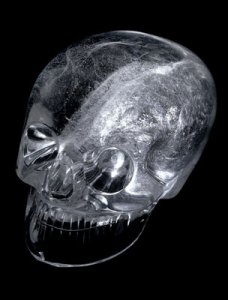
The picture shows the Crystal Skull in the Wellcome Trust gallery at the British Museum, one of several such skulls in London, the Smithsonian in Washington and the Musee de Quay Branly in Paris. It was bought from Tiffany and Co in New York in the 19th Century by the French collector Eugene Boban and is connected to the writings of the English ‘explorer’ Frederick Mitchell Hedges, who sued The Daily Mail in the 1920’s for libel when they accused him of being a fraud, and lost. The British Museum have tested it and far from being pre-Columbian, metal tool wheel scorings prove it is 19th Century, although original pre-columbian skulls exist. It would have been the centre of a world plot in ‘The God Game’, for all to enjoy, if the forces had massed, or perhaps George Lucas had not got there first, in the rather overblown and silly Indianna Jones and The Crystal Skulls, much as Spielburg is a god.

Leave a comment

Filed under Culture, Education, Fantasy, Language