Category Archives: The Arts

CHARLIE WILSON AND THE ZEN MASTER

I saw Charlie Wilson’s War the other day, with that great actor who played Truman Capote, Philip Seymour Hoffman. He was very moving talking about his new film recently, and especially about love. With the risk that we just have to take each time of getting hurt, even if in five or ten years time people may not even like us, let alone love us. But the story in this film is of the almost privately begun covert war in Afghanistan, between the US and the Soviets, and is quite extraordinary. Charlie Wilson pushed the military precurements budget from $1 million to $1 billion. Afghanistan was one of the reasons for the collapse of the Soviet Empire.

Yet, of course, half the film’s point was the civil war that then began, the arrival of the ‘crazies’ in Kabul, who the Taliban were originally the heroes against, in bringing some kind of order, and the perhaps inevitable betrayal of various idealisms. It was tragic when you saw Wilson arguing hopelessly for a $1 million to rebuild a school, only to be told no one was interested in schools. So the budget was about the military industrial complex, and the judgeable victories of war waged in high places, but the history of the world has been others suffering the damage of international conflicts. No more American bashing, yet there is great truth in the observation that the US is a country of real and high idealisms, even innocences, that at times can be atrociously blinkered and superficial, masking the true hardball. As Wilson said “These things happened and they were glorious…and then we fucked up the peace.

I loved the CIA man played by Hoffman though, perfectly open about wanting to kill some Soviets and do his job, yet strangely humane. He tells the story of the Zen Master who, when an Afghan boy was given a horse, and the villagers asked him if he agreed it was wonderful fortune, answered ”We’ll see’. The boy promptly fell off the horse and broke his leg, and when the Zen Master was asked if he thought it was terrible, answered ‘we’ll see’. Then war came and half the young men went off to fight and got killed. Except the boy with the horse and the broken leg. Life’s that all over, and so’s love, so as for Afghanistan now, or the everyday, perhaps the only response is always ‘we’ll see!

Leave a comment

Filed under Culture, Education, The Arts

WILLIAM SLEATOR AND NOT BEING ALONE

Perhaps there’s some merit in blogging my own story, if it shows writers and artists that they are not always so alone. A friend sent me a New York Times link today to the obituary of William Sleator, who has died at 66. I haven’t read his stories, but they dealt in the realms of Young Adult fantasy too. They sound rather wonderful, and on the side of the difficult adolescent psyche, dealing with good and evil, and fighting the forces of the mind and imagination. But Sleator clearly had his private demons, his battle with addiction, his alcholism.

It is very obvious territory for the artist, and perhaps it is the threat of public shame that always becomes the worst. Full Nelsons, Half Nelsons, the personal cruicifixion between high idealism and the ‘real world’. Above all the difficult attempt for ‘Children’s Authors’ to make that wonderful journey, again and again, through the dark and the life denying, as we step from the naturally whole psyche of the child, through the difficult realms of growth, to the most fully adult and human. My father found it very hard to deal with my Grandfather’s alcholism, but it is always the secret and the hidden that is both the driver and the danger too, when it takes control. How balanced I was again in America, for a time, how free of the psychic weight of the past, but how the absolutes and opposites that my own stories have argued against, and the fears of others, meant I was probably always heading for the most monumental crash in New York City. There we are, it happened, but it might not if they and I had remembered we’re all human, and I had not become so disconnected.

I learnt that Sleator was blogged recently by an Abrams employee and wondered if they got him too. DCD

Leave a comment

Filed under Books, Culture, The Arts, The Phoenix Story

HARRY POTTER PREMIER

The Harry Potter premier in London’s Trafalgar Square yesterday was extraordinary. As if Britain had suddenly become Hogwart’s and little Wizards everywhere been morphed into Royalty. Tears, thrills, waving crowds. Phoenix’s founder has to confess to a twinge of jealousy, even Schadenfreude at it all. He remembers his agent when Fire Bringer came out, telling him to check out ‘the competition’, with the arrival of JK Rowling’s first book. So, as the thrill of seeing his own work in the shops turned to horror as Harry Potter books turned into piles like New York sky scrapers, in one way he has lived in that shadow more than most. At school presentations, especially in America, he would ask what kids thought of the books, and then do a very good impression of Septimus Snape, snarling at ‘PPPPOTTER.HARRY POTTER!‘ The truth is though he, like everyone else, adored the series, though also being a little grumpy in the Bloomsbury premier of the first movie. He also defended the books, especially in Christian America, against the absurd charge of being evil.

Yet Children’s authors, in fact all authors, have lived in the shadow of the Potter Phenomenon, and carefully orchestrated phenomenon it has been. Brilliantly stage-managed, and channelled towards movies and merchandising with an enormous degree of talent. But the reason for that is certainly not stage management alone. It was always said, and we believe quite rightly, that the books began as a word of mouth phenomenon in schools. Their power is their extraordinary narrative energy, their remarkable reinvention, drawing on all the great myths, their humour and joy, but their inclusive, highly sensitive values as well, in defence of the young, of imagination, and of the magic of life. Fully in tune with the inescapable opposites of Good and Evil, and perhaps above all filled with a great deal of love.

Sober writers, ‘great minds’, serious intellectuals wondered why children and adults were hunched on tubes reading not The Brother’s Karamazov, Crime and Punishment, War and Peace, or even Pride and Prejudice, but happy to pick up those colourful volumes. The truth is not only the essential child within, and the vital dialogue between adulthood and childhood that makes the world, but also makes ‘children’s literature’, so wrongly dismissed sometimes, as the very gateway to genius and imagination. There are many other books to be read and written, and now the hype tells us its all over. Of course it isn’t, because the books will always be there, and JK Rowling, fearsome in defence of her own copyright, has started her own online book world. We wonder if she will turn that to supporting other writers and stories, in a defence of reading itself, but can only smile approvingly at all she has achieved. ‘Harry Potter is dead – Long live Harry Potter!.’

Leave a comment

Filed under Childrens Books, London, New York, Publishing, The Arts

SPACE FLIGHT FOR TOTS

As part of the POLLIPIGGLEPUGGAR collection Phoenix Ark Press are delighted to publish another poem for parents and young children by David Clement-Davies. Please read it with and to your kids, because if a Standard newspaper survey about reading in London is right, then one in three parents don’t feel confident enough to read aloud to their children, and it is a tragedy for all of us.

SPACE FLIGHT FOR TOTS

Space flight for Tots,”
Said Professor Wot-Nots
“Is a question both grave and dark.
The problem you see
Isn’t Gravity
But the lack of some primal spark.
It seems mad to me
If you’re only just three
To rocket, straight up through the air.
The jolt would be cruel,
Not to mention the fuel,
That would surely ignite your hair.”
“But I’ve done the sums,”
Cried Professor Nun-Drums
“And I know I can conquer this race
To make Astro-Sports,
Of the Sevens to Noughts,
Then hurtle them out into space!”
“What ROT”, snapped Wot-Nots
“There isn’t a tot,
That could master your method of flight.”
Nun-Drums shook his head,
At what ‘Nots had said,
Then he cooed, like an owl in the night:
“First suck on your thumb,
As your lips start to hum,
Then sit with your knees in a ball
And jump up and down,
In your warmest night gown,
As you start to ascend the wall.
The problem’s not wings,
But the strength of the springs,
And the positive slant of the bed,
To provide a position
For natural ignition,
As you bounce up to Pluto instead!”
I see,” said Wat-Nots,
As he looked at those cots,
And wondered where all the kids were.
Then Wat’s scratched his head
And turned lobster red,
As he saw what he now should infer;
The Num-Drumic Proof
Were those holes in the roof,
And the way that the beds were all bent!
With Nun-Drums – ecstatic
As he gazed through the attic
Straight up at the twinkling sky
For there, from that room
Was a trail to the Moon
And the children all learning to fly!

Copyright David Clement-Davies 2011. All Rights Reserved.

Leave a comment

Filed under Childrens Books, Poetry, The Arts

PHOENIX ARK PRESS RELEASE

Phoenix Ark Press are delighted to announce the publication of Leonardo’s Little Book of Wisdom, compiled and introduced by the historian Foreman Saul, who is profiled below. An essential guide to the Master’s life wisdom and wit too, this unique selection, from the translation of Leonardo’s notebooks by Jean Paul Richter, will lead you through a genius’ insights into science, painting, nature, religion, God, love and death. Interspersed with Leonardo’s mostly humorous prophecies, it brings the man to life in a vivid new way and is done to celebrate the Discovery Channel’s coming forensic series on Leonardo’s painting and, of course, the National Gallery’s ground-breaking exhibition in London this autumn. What better way to walk through life than in the company of a true giant?

Leave a comment

Filed under Books, Culture, Education, Non Fiction, Science, The Arts

PROFILING FOREMAN SAUL

Foreman Saul is one of Phoenix Ark’s more elusive and mercurial authors; a little like the great Leonardo himself. A journalist and historian , with a name you might think stems from across the Atlantic, rather than the Europe of his upbringing, he has specialised in both the Civilisation of the Italian Renaissance and travel throughout Europe and Italy.‘Who or why, or where or what?’ is Foreman Saul, we sometimes joke at the office, as he pops in and out, but he usually shrugs and certainly raises an eyebrow about some of the more exotic theories on one of his great heroes, Leonardo Da Vinci!

Phoenix are delighted to give you a taste of his Introduction to this little book of huge insights, far beyond their time:

Many have earned themselves little books of wisdom in collections of their sayings, but it is not something you might immediately expect from such a scientific figure as Leonardo da Vinci, who was born 1492 and died in 1519. The epitome of a ‘Renaissance Man’, Leonardo is best known for his paintings, drawings, and numerous practical and mechanical inventions. He also left 13,000 pages of notes and reflections, in jottings, observations and thoughts, mostly to aid his work, often disordered, so never intended for publication. That jumble is what most justifies a new approach to re-ordering some of his words, into categories of useful life reflections… We are flooded with ‘self help’ books and life guides purporting to supply ‘The Secret’, but what better way to walk through life than in the company of a truly towering genius?”

Leave a comment

Filed under Books, Culture, Phoenix Catalogue, Science, The Arts

PHOENIX ARK PRESS RELEASE

Phoenix Ark Press are delighted to announce the publication of Ice the first novel by the historical crime writer Dominic Sands, under our adult Thumbmarks Imprint and exclusively to Kindle, available at Amazon. Ice is an extraordinary little novel, beginning in the year of 1632, when the peasants go into the high mountains above Rome, to gather ice for the Prince’s miraculous new work of art and science; an Ice House. So begins the strange testament of Michele Pisiano and the story of his obsession with Lorenzo Barberini, in a tale of love, art, murder, witchcraft, faith, male pain and a dark secret at the very heart of the Ice House itself. The Phoenix founder believes it has a touch of John Fowles’ The Magus.

Leave a comment

Filed under Adult Fiction, The Arts, Thrillers

PHOENIX PRESS RELEASE

Phoenix Ark are delighted to announce the publication of a brand new book by best-selling Children’s author David Clement-Davies, Michelangelo’s Mouse. The enchanting story of a little artistic mouse called Jotto, and his great adventure with the Renaissance genius Michelangelo, it is a lesson in belief, fighting on, art and courage and how to become famouse! For reading ages 7 to 11, but to be read by parents too, it is a wonderful romp, written with charm and huge humour, and all the story telling brilliance of a great animal writer. Young and old will delight in the first new book to be published by David in three years, brought exclusively to eBook and available from Amazon.

6 Comments

Filed under Childrens Books, The Arts

THE 7TH PHOENIX ARK CULTURAL ESSAY

THE TWO WILLIAMS by Anthony Gardner

Recent travels have brought to mind two poets. Several weeks ago I was in Ireland, and thought inevitably of Yeats, whose poetry illuminated my own upbringing there. A fortnight later I visited Wordsworth country, which I’ve come to know only in the past few years. What, I found myself wondering, would each of these great writers have made of the other’s milieu, had Wordsworth not died fifteen years before Yeats was born? And what would they make of their domains today?
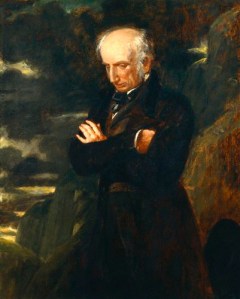
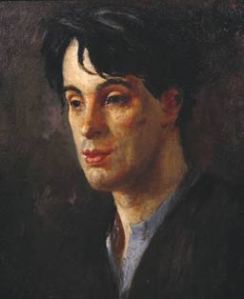
My Irish visit focussed on County Laois – not a region strongly associated with Yeats. But the Georgian mansion in which I stayed (now beautifully and painstakingly restored , as a hotel) was instantly evocative of his ‘Upon a House Shaken by the Land Agitation’, celebrating the virtues of gracious living:

‘…the sweet laughing eagle thoughts that grow
Where wings have memories of wings, and all
That comes of the best knit to the best…’
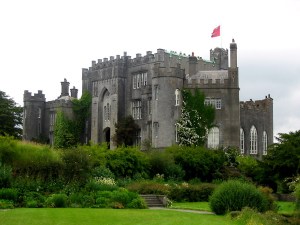
Many such houses were burned to the ground in the 1920s, and those that survived in the area have had widely different fates. Birr Castle remains the home of the Earl of Rosse, though its grounds and Victorian observatory are open to the public; Stradbally Hall is the setting for Ireland’s leading music festival, the Electric Picnic; Leap Castle (the country’s most haunted) is being restored single-handed, by a professional tin-whistle player, Sean Ryan.

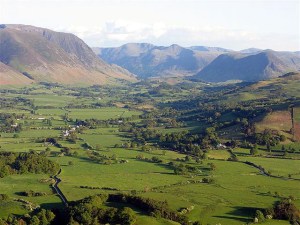
In the Lake District, I visited the village of Lorton, four miles from Cockermouth (the town in which Wordsworth spent his early childhood). Lorton’s most famous inhabitant is an ancient yew tree, to which Wordsworth devoted a short poem, including the lines

‘This solitary tree! A living thing
Produced too slowly ever to decay;
Of form and aspect too magnificent
To be destroyed.’

This has proved over-optimistic: the tree is only half the size it once was; but it is still an impressive sight, and the fact that Wordsworth made the pilgrimage to see it brings a small thrill.
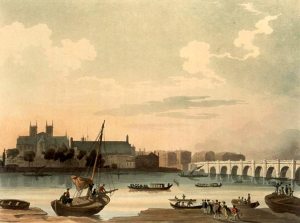
Wordsworth did not, to my knowledge, ever visit Ireland, nor Yeats the Lake District; the one place they had in common was London. The fact that Wordsworth, the great poet of nature, should have written the most famous of all poems in praise of the capital – ‘Upon Westminster Bridge’ – has always intrigued me. It is curious too (though in keeping with the tradition of the Irish artist in exile) that Yeats’s most famous poem, ‘The Lake Isle of Innisfree’, was inspired by a shop window in the Strand:

‘I will arise and go now, for always night and day
I hear lake waters lapping with low sounds by the shore.
When standing on the roadway, or on the pavements grey,
I hear it in the deep earth’s core.’
Wordsworth might have found in this an echo of his own ‘Lines Composed a Few Miles Above Tintern Abbey’, with its gratitude for memories of nature ‘’mid the din/Of towns and cities’. But I doubt that he would have thought much of Yeats’s lake and ‘bee-loud glade’: it’s far too tame, a world away from the grandeur of the Cumbrian scenery ,which formed his own sensibility with its ‘huge and mighty Forms’. The waterfalls and seascapes which characterise Yeats’s early West of Ireland poems would have left him equally unimpressed, for all the delight of fairies dancing

‘Where the wave of moonlight glosses
The dim grey sands with light…’

Yeats’s Celtic Twilight is a soft, dreamy thing which the harsh winds that blow with ‘strange utterance’ through Wordsworth’s ‘The Prelude’ might rip away in a moment.

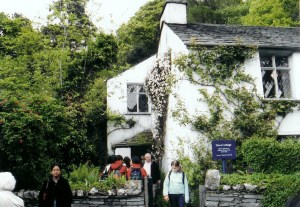
Let us turn the tables, though, and imagine Yeats visiting Wordsworth at Dove Cottage. He would certainly have approved of the domestic set-up – Mary and Dorothy Wordsworth, indulging William as he himself was indulged by his young wife Georgie. But the building itself? Surely not in keeping with Yeats’s notion of the poet’s role in society: for him the Duke of Urbino’s court or Lady Gregory’s Coole Park were where a great artist belonged, at once creating beauty and finding inspiration in beautiful things. Even the much larger Rydal Mount, to which Wordsworth moved in 1813, would hardly fit the bill.
Perhaps Wordsworth takes him across the fells to visit the family’s old home in Cockermouth. Now owned by the National Trust, it ranks second only to Cockermouth Castle in the town. ‘That’s more like it,’ thinks Yeats; but Wordsworth has a bitter tale to tell about the aftermath of his father’s death, and the failure of John Wordsworth’s employer, a landowner on a grand scale, to repay an enormous sum owing to the family. No wonder he doesn’t share his guest’s enthusiasm for the splendid dwellings of the rich.

He might approve, though, of the home Yeats creates for himself in later life. Thoor Ballylee in County Galway is a ruin restored

‘With old mill boards and sea-green slates,
And smithy work from the Gort forge…’

but even after refurbishment it’s pretty uncomfortable. To Yeats its greatest importance is as a symbol from which he draws inspiration for ‘The Tower’ and other great late poems. Wordsworth is stirred by ruins, too, from those of Tintern Abbey, to the ruined cottage which symbolises a peasant family’s suffering in the eponymous poem.

Can we picture the two men working side by side as Wordsworth did with Coleridge? Not easily. For one thing, Wordsworth likes to walk while he is composing, while for Yeats writing is ‘sedentary toil’. But from time to time he climbs to the top of the tower and looks about him. How different Galway in the 1920s is from the gentle countryside of his youth!

In the final part of ‘Mediations in Time of Civil War’ he sees phantoms of hatred sweeping across the sky in a ‘rage-driven, rage-tormented and rage-hungry troop’.

Perhaps Wordsworth accompanies him up onto the roof after dinner and they confront the tumult like a pair of King Lears, the wind blowing their white hair into halos. But I suspect not: Wordsworth has seen enough of bloody civil strife during the French Revolution – for him such things are best considered in the light of a new day, as in ‘Resolution and Independence’:

‘There was a roaring in the wind all night;
The rain came heavily and fell in floods;
But now the sun is rising calm and bright;
The birds are singing in the distant woods…’

For today’s visitor to the Lake District, these lines recall the terrible floods which assailed Cockermouth and Workington last winter. I think Wordsworth would be impressed by how his birthplace has picked itself up again, and reassured that the stoicism of the local people still endures – though saddened by the way in which traditional agriculture has been eclipsed by tourism.
As for Yeats’s homeland, it is significant that when Ireland was forced to accept the EU’s financial support a few months ago, the Irish Times quoted his ‘September 1913’ in its leader:

‘Was it for this…
…………that all the blood was shed,
For this Edward Fitzgerald died,
And Robert Emmet and Wolfe Tone,
All that delirium of the brave?’

Only Yeats at his most magnificently scathing could do justice to the ignominy brought upon his country and the spectacle of picturesque landscapes lost to thousands of unfinished houses.

It is possible that the two great poets would not have got on at all. Wordsworth was not known for his kindness to younger writers, and made a poor impression on Keats when the latter came to pay his respects. Yeats counted Wordsworth among his early heroes, but was more critical of him in middle age:

He strikes me as always destroying his poetic experience, which was of course of incomparable value, by his reflective power. His intellect was commonplace and unfortunately he had been taught to respect nothing else.

Nevertheless, roaming the countryside together, I think they would have found shared sympathies – for example, their concern for ordinary people, such as the shepherd deserted by his son in Wordsworth’s ‘Michael’, or the old pauper in Yeats’s ‘Adam’s Curse’ breaking stones ‘in all kinds of weather’. Indeed, if I had to choose the poem by Yeats that brought him closest to Wordsworth, it would be his description of his ideal reader, ‘The Fisherman’:

….his sun-freckled face,
And grey Connemara cloth,
Climbing up to a place
Where stone is dark under froth,
And the down-turn of his wrist
When the flies drop in the stream;
A man who does not exist,
A man who is but a dream…’

Return to Cultural Essays

Anthony Gardner April 2011. The public domain photos are Wordsworth by Robert Haydon, Yeats by Augustus John, Birr Castle, The Lorton Valley, Westminster Bridge and Hall, painted in 1808, a year after Wordsworth declared ‘Earth hath not anything to show more fair’ and Dove Cottage today. Anthony is profiled below and his novel ‘The Rivers of Heaven’ is published by Starhaven.

1 Comment

Filed under Community, Poetry, The Arts

THE 6TH PHOENIX ARK CULTURAL ESSAY

ART AND HISTORY: BLURRING THE LINES by Saul David

It is 40 years since the liberal Marxist historian E.H. Carr published his celebrated ‘What is History?’ As a young student in the 1980s I was intrigued, and slightly alarmed, by Carr’s contention that all historians are subjective, in the sense that they choose which ‘facts of the past’ to turn into ‘historical facts’; and that you should always study historians – and the potential bees in their bonnet – before the facts. ‘When you read a work of history,’ he wrote, ‘always listen out for the buzzing. If you can detect none, either you are tone deaf, or your historian is a dull dog… By and large, the historian will get the kind of facts he wants. History means intepretation.

Yet Carr was convinced that history was a social science and not an art, because historians, like scientists, seek generalizations that help to broaden their understanding of a subject. He felt that while historians could not predict the exact future, their generalizations could give an insight to both the present and the future. It all sounded pretty convincing to me – as a student. But as someone who has since taught history at university, written both popular history and historical fiction for commercial publishers, and presented history programmes for TV and radio too, I find it increasingly hard to see history as an academic discipline, let alone a science. Most professional (or academic) historians are taught, and teach in our turn, that the unpublished and preferably untouched archive – first-hand and contemporaneous – is king. But is it really to be trusted? Most works of history are constructed from a mixture of incomplete and often partial sources – both primary and secondary – that can mislead, as well as illuminate. The very records themselves available have often been ‘written by the winners’ and even at its best and most reliable (in the sense that the author has not actually made anything up, or deliberately omitted details he knows will undermine his argument), history can give no more than a hazy artist’s impression – almost like an early daguerrotype – of a past event or period.

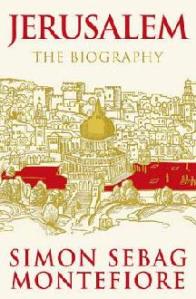
Does this make the writing and study of history a pointless exercise? Not at all. Even in its typically biased and unsatisfactory form, the best history can still give us some insight into the past and, potentially, the present and the future too (and to do that it does not require Carr-ite ‘generalisations’). Certainly most political crises are rooted in recent (and occasionally longer-term) history, and can only be properly understood (and potentially fixed) if decision makers are aware of the historical context. The key players in the Palestine peace process, for example, would do well to read Simon Sebag Montefiore’s even-handed Jerusalem: A Biography. Yet it is of course a cliché that the greatest lesson of History is that no one learns the lessons of history. If that were not so it would be to imply that there is something teleological to History itself, moving to a Telos, an unfolding purpose, and giving some perfect ‘lesson’. Much as Fukayama tried to imply, with his rather idealistic best-selling thesis on ‘The End of History’, by suggesting the liberal Nation State is now the accepted solution to those supposed lessons. But what happened after 9/11 and in Iraq might suggest the opposite and, of course, unless you are a Marxist, History is not deterministic, things not inevitable, though they may seem so viewed in hindsight. Which is why the ‘artistic’ and ‘intellectual’ values of good histories themselves, to influence culture and insight, and affect contemporary decision-making, so vitally comes into play. That is History as dialogue and living culture.

Which brings me though to the concept of history in fiction and literature. Since the recovery of the past is to an extent an act of imagination, involving the prejudices and capacity of the beholder, can the novelist, with their perceptions of reality, character, why and how things happen, not get just as close to a possible reality of ‘what really happened’, or ‘what it was like’? Tolstoy believed so, being the kind of auto didact who would brook no other perceptions of truth. People famously marvel at the human truth of his fiction, War and Peace or Anna Karenina, yet dismiss his theories on history, which at times approached the almost scientific, the atomically deterministic, in his ideas on the lack of free will, or the mysterious actions of the Russian soul in defeating Napoleon. Yet actually those dismissed ‘Historical’ ideas were probably essential in turning him into the kind of prophet he became, who ended up dismissing the value of fiction too. There is the theory too that History should actually just be a growing collection of personal biographies, although again comes the question of how good, true or biased is the biographer, since you tend to fall in love with your subject. From the artist’s perspective, a great writer like Bulgakov believed that you could only get to the truth of an artist’s life by trying to inhabit his very style, much like Keat’s ‘Negative Capability’, and hence his glorious ‘storytelling’ of Moliere’s life.

Must there not be rules or at least standards though, beyond the complete acceptance of the subjective, and moving towards the purely fictional? If history itself often becomes a fact of cultural bias, or propaganda, do the problems of Historical truth make it acceptable that Hollywood often takes such extraordinary liberties with historical fact, or that dictators do? I do not think so, British writers on the Second War do not think so, especially for serious ‘world’ histories. Or is there a fascinating cultural space in the Dream Factory where American or British voices, playing Roman generals, in language suitable for 1920’s Chicago, proves that we are all always being strangely translated, like Bottom in a Midsummer Night’s Dream?

Then you might move intellectually into the realm of modern scientific insights into Space-Time, and ‘reality’ at the subatomic level, the Quantum perception that the viewer affects the experiment, and wonder what it is we are truly perceiving, and with what mechanism, or who gets closer to truth, the historian, the scientist or the artist? Perhaps only all together, and of course ‘truth’ itself is a loaded concept. Like Wittgenstein’s perception of the imprecision of language then, should we just define truth as a guiding ‘tool’ to that ‘which is not false’? That is the rigour of not falsifying fact, yet the motivations of human character and action are always filled with falsehood, as truth, and influenced by prevailing beliefs too.

Studying A-Level history, I had two very different teachers: one who gave me a stock answer to particular questions; the other insisted there was no one answer, and that we were to construct the most plausible scenario from the evidence available. I thought the latter lazy and misguided; only later did I understand that history’s value is to train you never to shut your mind to an alternative scenario. It really is, as Carr put it, ‘an unending dialogue between the past and the present’; and one that relies more on a historian’s instinct (particularly about human behaviour and motivation) than is generally admitted. Maybe this is why so many historians (myself included) have recently turned their hands to fiction. For only by removing the shackles of so-called historical methodology – including the strict embargo on supposition and extrapolation – are we able, finally, to get close to the ‘truth’. I suppose, for each of us, its value and quality, in a living cultural sense, depends on both the rigour and depth of our own imaginations and, as in many disciplines, what really matters are the kind of questions we are willing to ask about what is ultimately important to us all. Saul David March 2011, with suggestions and editorial by David Clement-Davies.

Return to Cultural Essays

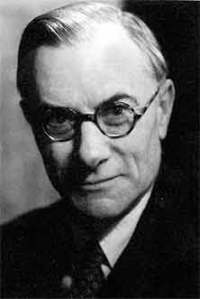
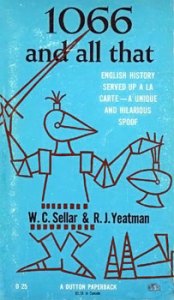
The pictures are public domain photos from Wikipedia and the Guardian bookshop and show EH ‘Ted’ Carr, a rare cover of Seller and Yeatman’s classic, Jerusalem the Biography, The Tao of Physics, and Karl Marx. Saul is profiled below.

Leave a comment

Filed under Books, Education, The Arts