Seeing with Samson and Delilah

I think it was Dr Johnson who said ‘nobody but a fool ever wrote for anything but money’. A chance quip doesn’t make the philosophy of a man, but perhaps that makes everyone at Phoenix Ark, and the 17 million daily word-processing WordPressers too, fools! Perhaps they should see it in ‘holy fool’ terms, like Dostoyevsky’s Idiot, or what Jung said of how we lose the wonder of being alive by not just leaning forward in a train and expressing what a beautiful day it is. In fact, whether lay person or professional author, the key is connection, and even having one engaged response to what you do can be hugely rewarding. It also gives you a chance to express without any wider intention, or need, and perhaps see in a different way.

Seeing, and the story of Samson and Delilah were and are a central theme in the unpublished Scream of the White Bear. A story about belief, the word, and the blinding loss of the redemptive feminine to the male psyche, inside and out. It was wonderful then to see Warwick Thornton’s spare little masterpiece Samson and Delilah. Set among Australian aboriginals, and a teenage love story, it is brutal and ultimately beautiful, stressing above all how so many lives are not lived in words at all, especially at a particular age, and in different cultures. The ‘religious’ themes, the supporting metaphor of story, are only glanced at, with mourning and the tradition of hair cutting reflecting Samson’s loss of power, and a rape and a haze of petrol sniffing, blocked opportunities and a poverty of connection, there to reflect the biblical blinding, the loss of hope.

This Samson is just a kid, trying to find a way, love too, and decidedly unheroic, except for his first tilt at a girl. His Delilah, who he loses sight of in his loss of power, is the heroine who turns everything around. Thornton is aboriginal, and says he hardly learnt to write at all, and the script is virtually non-existent. Instead we have a very raw reality, and the final redemption, the final understanding of what love might really be made of, is one of the most eloquent things I’ve seen. Though raising money was no problem, Thornton did not want the vast ‘circus’ of big budget film making and it is the integrity of the story, its truth, that inspires and wins the day. Perhaps where the heroine suddenly gets a gun from to hunt Kangaroo, in a story that is also partly about brutal economics, is glossed over, but it’s great, and hard to put into words. Thornton is also passionate and moving about the lack of chances and support given to kids, by whites and aboriginals alike. DCD

For the website just click

Leave a comment

Filed under Culture, Education, Environment

Marathons, Moore and Krishnamurti in Rome

It’s the Roman marathon today. Big plastic inflatable gates, sponsored by Pepsi and Adidas, are wobbling in the breeze and spring sunlight near the Piazza Espagna, as thousands run the yellow tape lined course, to cheers and claps, and officials handing out soaking sponges, to cool brows along the cobbled course. Roman tourists though seem only partly interested, with so much to see, and as the bells ring out, it has a decidedly scrubbier and more relaxed feel than London or New York. Last night’s amazing super moon has gone, and today spring Rome is beginning to open up and blossom. On the internet Michael Moore is twittering his over easy attacks on the US action in Tripoli, without answering the question of how murderous or mad Gaddafi is, or what should be done to stop more killing. How do you think clearly if you always have the same bad guy?

I stayed in bed reading a little gem of a book, Freedom from the Known, by Krishnamurti. It takes up the essentially Buddhist theme of opposites in thought, and a freedom from them, to perceive without fear or judgement, and to really try to know yourself and the world. Essentially to close off or go beyond the over rational mind, above all dictated by what we call knowledge, which too often is simply to commune with the dead past. A very good lesson for Phoenix Ark! Rome is a place where the past is ever present, but actually, since the thread of 2000 years is so clear, that continuity liberates into the immediate and the present.

I thoroughly recommend Krishnamurti. Without arrogance, with a simple and honest insistence, he addresses the interconnections of everything, in a very short and readable little book, and so the responsibility to see clearly, yourself and others. He is wonderful on fear, on pleasure and pain, and on the approach to what might be called ‘God’, though without the structures, prohibitions and neuroses of religion. It’s a wholeness of connection really, that beyond the veil of words, tries to get back to the experience of something truly life-giving, love and joy. It also breathes out something else – peace.

But being in the so-called ‘eternal city’ I should quote something he says, though from a book that is very much not about quotations. ‘Sorrow and love cannot go together, but in the Christian world they have idealised suffering, put it on a cross and worshipped it, implying that you can never escape from suffering except through that one particular door, and this is the whole structure of an exploiting religious society.’ DCD

3 Comments

Filed under Non Fiction

THE 5TH PHOENIX ARK CULTURAL ESSAY

CHANGING THE CULTURE, BY SEEING THE WOOD FOR THE TREES! by Peter Bennett

I am not a writer, as such, nor a storyteller, a very rich tradition among many of the cultures I’ve been privileged to visit and work with. But I do have a passionate love both of wildlife and trees. Before I’m accused of being a Prince Charles style ‘Tree Hugger’, an accusation I can in fact easily accept, I remember some of those tales from childhood where trees play such an inspiring role. Think of their mystery in Fairy Tales, think of the triumphant Ents in Tolkien’s Lord of the Rings, overthrowing the mechanical horrors of Isenguard, think of the doorway to other worlds they represent in so many myths and stories. This past year has been one of the toughest, yet most productive, in the 17 year story of our Charity, Rainforest Concern, and trees are indeed our passionate concern.

If I may turn to realities though, 2009 ended with the Copenhagen summit on climate change. High on the agenda there was avoided deforestation, in other words, efforts to curb deforestation in mainly tropical areas, for their importance in storing carbon. What they also protect in terms of a biodiversity of life and culture, human and animal, is rarely underlined enough. Although Copenhagen was generally perceived as a disaster, due to the US and China’s inability to agree on a legally binding accord on reduction in emissions, the single issue that was consistently prominent in discussions was forests. Perhaps people are at last beginning to see the wood for the trees then, although what both represent in terms of natural beauty, undiscovered medical breakthroughs, mystery, inspiration and spirituality is almost impossible to quantify, in terms of the economics driven models of modern life. But Reducing Emissions from Deforestation and Forest Degradation in Developing Countries (REDD) has at least become a key part of the international negotiations on climate change. Nonetheless, this is still only an expectation, with no real agreement yet, and in the meantime forests need our help more than ever. Let’s cross our fingers and our branches that the modest progress which it is generally agreed was made at the summit in Cancun in Mexico last December will offer real hope in future, but that progress remains very modest.

As always too, it’s my firm belief that we cannot wait until governments act decisively to protect our natural environment, and Copenhagen and Cancun illustrate how important it is to act privately and strategically to conserve our forests, and the vast diversity of life they support. Most significantly, last October our partnership with Gaia Amazonas succeeded with the declaration of a new national park in the Caqueta Basin of Amazonian Colombia. A staggering one million hectares of pristine wilderness, the newly created area, is the first park to be run by the indigenous people who still live there, as they have always done. The trees, the animals, the earth and the skies are a vital part of their culture, and one to protect, while doing so also helps to protect a biodiversity of cultures right across our planet. Indeed it protects the lungs of the planet itself. Thanks to the generosity of a unique foundation, we have now secured funding to dramatically increase this protected area.

However, conservation work should not be measured purely in terms of large tracts of protected forest. By contrast, the Pacuare Reserve in Costa Rica, at just 1,000 hectares, witnessed the largest number of leatherback turtle nests in the project’s 20 year history. This we hope may represent a turnaround in the decline of these magnificent creatures, still categorised as ‘critically endangered’. There are other success stories in Chile, Costa Rica, Panama, Ecuador, Brazil, Peru and Romania.

Thankfully and not before time, there has recently been a growth in robust certification standards for carbon forestry projects too, and we’re very much in tune with these developments. The charity’s Forest Credits programme continues to gather momentum and has just launched its dedicated website: www. forestcredits.org.uk. All the funds generated through the programme will go to protect and expand our first verified carbon offset conservation project in the Choco-Andean Corridor in Ecuador: the Neblina Reserve. Another two Forest Credits projects are in the pipeline for verification. But, for a Cultural Essay, it is right to end on a more literary note. Remember how long those great, wise trees in Lord of the Rings took to stir themselves and fight back against the dark. If that is just storytelling, perhaps everywhere people, if not governments, are beginning to wake up to their vital defence, and all that thrives in and around them. Peter Bennett March 2001. Peter is the founder and head of Rainforest Concern. To see all the work the charity does visit their website by clicking HERE

Return to Cultural Essays

Leave a comment

Filed under Environment

TRAVELLING VOICES

I thought of a great newspaper travel column idea once, walking along down Fifth Avenue in New York. Namely broadcasting snatches of conversations overheard abroad, foreign or home voices, in different places.

One just happened walking down the Via della Croce in Rome, with some American voices.
Gorgeous foreign scene: Tired, rucksack carrying family, walking towards the Spanish Steps.
Blonde woman: ‘Honey, I’ve no idea, I think we’re lost.’
Pause.
Dark man: ‘No honey, just up there’s the American Steps.’
Er – no, but hopefully just a slip of the brain!

Leave a comment

Filed under Education

THE 4th PHOENIX ARK CULTURAL ESSAY

LOVING ANIMALS by Eugenia Anastassiou

From the legend of Androcles and the Lion, to Kipling’s Jungle Book, through the moving story of social alienation and redemption in Paul Gallico’s Snow Goose the theme of the deep bonds and devotion between animals and humans has been explored many times in literature.

Yet last week, in Helmand in Afghanistan, life seemed very poignantly to imitate literature. Twenty-eight year old Lance Corporal Liam Tasker, an Arms and Explosives Search dog-handler in the Royal Army Veterinary Corps, was shot on mission. As his body was being taken back to Camp Bastion, a comrade-in-arms, his own search dog Theo, who witnessed Lance Corporal Tasker’s death, died from a seizure. Reports from battle-hardened soldiers in the field mentioned that Theo had ‘died from a broken heart’. Today the soldier-master and his dog are being repatriated together, making their final journey back home, as a team. Lance Corporal Liam Tasker and Theo died on Tuesday March 1st 2011. His death brings the total number of UK military personnel to have died in Afghanistan to 358, and Theo is the sixth British military dog killed in action in Iraq and Afghanistan since 2001.

Even as human beings, we often cynically question the theory of people (let alone animals) dying from a broken heart. How does Shakespeare’s Rosalind have it in As You Like It? ‘No one ever died for love’. Certainly art, poetry and literature though go a long way in perpetuating that naturally romantic, idealised form of death. Can animals feel such a thing as heartbreak, or is it just anthropomorphic clap-trap, worthy only of the Daily Mail?

There are undoubtedly many well-known instances where animals, especially dogs it seems, have grieved and mourned the death, both of their own and their owners. Phoenix Ark’s founder told me how, visiting a wolf sanctuary in Colorado, an alpha wolf who had lost his mate, dug a half hole in the sandy ground and lay down to grieve. That night, when the pack usually picked up each other’s haunting evening wolf song, the others stayed eerily silent, as he howled, as if in a mark of respect. Howl, howl, howl. Wild elephants are known to pass around the bones of their dead , as though the touch of their trunks is transferring some deeper pereception of life and death.

As for our emotional relationship with animals though, the touching 19th century tale of the Scottish Skye terrier, Greyfriars Bobby, made into a rather over-sentimentalised movie, a statute and virtual industry, is the true story of a dog whose love for his dead master John Gray, a night watchman for the Edinburgh City Police, meant he spent every day sitting on Jock’s grave in Greyfriars Kirk, for fourteen years until his own death. More recently, in 2002, during Mugabe’s violent attacks on both his own people and white farmers in Zimbabwe, the image of Squeak, a Jack Russell staunchly guarding the mutilated body of his owner and refusing to move, made headlines across the world.

Apart from anecdotal evidence, and the instincts of writers, scientists are now beginning to analyse higher feelings in animals, especially the strong attachment between man and dog. Heading some of this research is neuro-psychiatrist and leading autism specialist Professor Jaak Panksepp, who has attempted to map out animal brains and further confirms emotions such as happiness, even possibly humour, as well as sadness and separation anxiety, as part of their fundamental psychological make-up – just like humans. To many it is quite obvious and rather makes a mockery of supposedly vital research grants being spent on studies that can lead British scientists to the remarkably obvious conclusion that a stag actually feels stress during a hunt!

But at last science bears up a level of anthropomorphism. Indeed, while we perhaps can see everything, and sometimes too much, of ourselves in the great mirror of nature, it would be impossible to understand animals without the intrinsic langauge of emotion, that is so much part of ourselves. Various dog experts, animal psychologists and vets commenting on ‘The Curious Incident of the Dog With A Broken Heart’ find it unusual or impossible, since dogs, like all pack animals, have a strong survival instinct, and eventually adapt to new situations or new owners. But in this case, especially because of the heightened circumstances of Theo being a war-dog and working with Lance Corporal Tasker in such stressful conditions as Afghanistan, the bond would surely become even more intense. Just look at their photograph above.

As for emotion and its destructive effects, Dr. Roger Mugford, an animal psychologist who also happens to treat the Queen’s corgis, offers the explanation that ‘dogs being highly sociable animals, suffer from a form of depression which inhibits not only their appetites but also their immune system. This makes them susceptible to infection and can be fatal’. But isn’t this also the way humans can weaken, and even die of a broken heart, with apologies to Shakespeare?

Other animal experts and behaviouralists will probably put up endless arguments against Theo dying of a broken heart, dismissing it as trite sentimentality, made up to make people feel better about a tragic outcome. Why should humans be so limited and arrogant though, as to presume that Lance Corporal Tasker could not instil such an extraordinary bond, a tribute indeed, and that Theo never sensed, as Anaïs Nin put it: ‘Love (which) never dies a natural death. It dies because we don’t know how to replenish its source…..it dies of illness and wounds; it dies of weariness’. March 2011 Eugenia Anastassiou. Eugenia has worked in Television and Film on many political and sociological documentaries and is passionately involved in ideas and culture. Her essay is a very welcome edition to a little publisher, that prides itself on its animal stories.

Return to Cultural Essays

1 Comment

Filed under Books, Culture, Science

WORLD BOOK NIGHT

World Book Night, launched in London’s Trafalgar Square last Saturday, brainchild of Cannongate’s Jamie Byng, in alliance with the BBC, and the wonderful idea to give away one Million free books to readers has certainly created a buzz, and hopefully will do so in future. For the culture of reading it is tremendous, despite the carping about affecting the perceived price and value of books, for the culture of authors though it seemed dominated by the heavy weights, from Yan Martel to Philip Pulman. It would have been nice to see more independents taking a role, more indy voices, and a bigger voice for those who think that publishing is in crisis, in part because some big publishers have been so ruthless in following lead titles and lead authors.Today’s publishing challenge though is as much about changing technologies and the disappearance of traditional ‘gate-keepers’ in the best sense. It is the eternal paradox of the publishing industry, that financial need and desire to forge forward with success stories, but also to try to promote the unheard, the original, and the off-the-wall literary challengers. Still, when Phoenix Ark began, and called on Independents to join together to create some kind of wider cultural debate, there was hardly a stampede, and this has got people talking, and reading too, always a good thing.

To find out more about World Book Night and perhaps prepare for next year, just click

Leave a comment

Filed under Books, Culture, Publishing

TAKING A REAL ROMAN BATH

‘How come some people don’t wash?’ said Santiago disapprovingly, looking at some grubby, foot-sore Roman pedestrian, as we sped down the LungoTevere out of Rome, and towards the wine dark sea. ‘Perhaps they haven’t got a shower!’ someone else suggested, humanistically. We weren’t on the way to bathe in the Mediterranean, we were on the road to dip our historical imaginations, if that’s not too much of a mixed metaphor, in the astounding ruins at Ostia Antica. Ostia means mouth, and the city grew up as a feed port to Rome, on the estuary mouth of the Tiber, before it fell into terminal decline around the 7th Century AD.

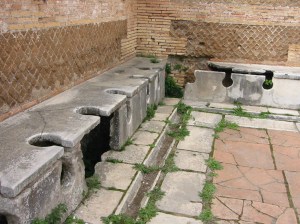
What is it that really fires an historical imagination though? For me, as a ten-year old boy, I remember it was the small, significant detail, which so vividly captured the ancient every day. Hence goggling at the ruts in the cobbled pavement at Pompey, where chariot wheels had scored deep grooves into the thoughtless stone. At Ostica Antica it was sitting on a simple loo seat, a perfectly rounded half-hole in a slate of marble, inside low stone walls, long before our flushed, taken-for-granted days of Thomas Crapper. Or leaning on a bar counter, in a perfectly deserted alleyway, where once Romans and Ostians would have stopped for wine or beer, or perhaps a wild boar sandwich.

Actually, at Ostia, it is far more than the significant detail, or even a sudden encounter with a floor mosaic, a half statue, or a fresco. I think wandering around yesterday was the most magical experience of ruins I’ve ever had. The remains of the city are huge, and what is most delightful is that in early March at least, almost completely deserted. Romans, most of the year, are making for the sun worshipping sands of Ostia’s big beeches, now 3KM away, after centuries of tidal retreat. Perhaps they should build a temple to King Canute. Most visitors to Ostia Antica too still stick to the central via, past the wonderfully preserved theatre, and up to the impressive capitol. So I jumped off the beaten track and picked my way through abandoned mill houses, villas, shops and weed-strewn streets, trying to summon back the vanished inhabitants, washed and unwashed. I had an encounter with the ‘Gods’ too, among the sun-brushed pines, in an open field, ringed by pilasters and edged by a main road, where unregarding cars add an electric buzz to the mystery. There stood the temple of Attis, fronted by goat-hoofed statues of the God Pan, proving it’s all about the piping, and behind a gate, the Egyptian war Goddess herself, who, with her starry crown, looked like a recumbent version of the Statue of Liberty. Ate she is, after the Romans adopted her, and in Mark Anthony’s murderous, revenge summoning curse in Shakespeare, following Julius Caesar’s murder.

But apart from the spiritual side of Roman life, it is of course Roman civic utility that is most in evidence at Ostia. Hence the huge apartment complex, the Villa of Diana, built around a central fountain and courtyard, where Mr and Mrs Roman lived in the closest proximity. It is the equivalent of a modern city housing estate, without the concrete horrors and the drug dealers, perhaps. But beyond the temples and administrative buildings, the magnificent Capitol, and the all important theatre, what really dominates Ostia are the Baths of Neptune. Built, I think, after Hadrian, the bath complex, one of several, is huge, still containing the most astounding mosaics, and there all Ostians became not only the great washed, but the very fit too, since the Frigidarium, Tepidarium and sweating hot-houses were bounded with Gymnasia for sport and exercise. They also contain public toilets, since most Roman houses did not have private loos, or bathing facilities. Senator, priest, patrician and plebeian must at times have rubbed shoulders there, sitting in windless splendour to shoot the breeze, do the business, or wonder where it was all leading. Quite rightly Santiago would ask that all important and still unanswered question later: ‘Were they Unisex?!’ Filthy man. ‘Marcus,’ I heard an imagined voice whisper though, as I turned for home in the glowing evening light, ‘you know that fellow may be an awful Pleb, but he really is very smart and clean.’ ‘Ah yes, Tullius, but then he comes here every day because, quite naturally, he doesn’t have a shower.’ DCD

Leave a comment

Filed under Non Fiction

SCREAM OF THE WHITE BEAR

We’ve had several enquiries about Scream of the White Bear, so long posted on Amazon and elsewhere, but marked as unavailable. The truth is Scream was the very source of difficulty and anguish for the author, in America, and it is still not quite ready. Phoenix’s decision, or rather necessity being invention’s mum, to publish to eBook this year means that it will have to go to Kindle or Ipad anyway. Perhaps we will make it available in paperback print version, if we can. An apology to all David Clement-Davies’ fans, but this situation was forced on him, and thank you for maintaining that interest and support.

13 Comments

Filed under Uncategorized

LIGHT BREAKS WHERE NO SUN SHINES

The previous post needs almost instant up-dating because, with a little support from The Author’s Guild of America, Phoenix are thrilled to share the fact that Abrams in New York have just given back the eRights to both Fell and The Telling Pool. It means that Phoenix Ark Press can now also publish, to Kindle and Ipad, a special joint edition of The Sight and Fell, by David Clement-Davies, novels that should sit naturally together, and which were once separated by publishers.

It feels like the end of a terrible road, and although losing someone you love is probably the only thing that really matters in a human life, a tiny victory for one author to get a reputed and powerful publisher to truly respect an author’s work again, at some fundamental level. David Clement-Davies now has the say back in his own creations, the expression of years of hard and highly committed work, and this little Phoenix might fly after all.

Leave a comment

Filed under America and the UK, Books, Childrens Books, The Phoenix Story

PHOENIX ARK PRESS RELEASE

The fight to build a new publisher, and to take back an author’s rights and say in his own work, continues. Though Abrams will still not communicate about their electronic rights in Fell and The Telling Pool, the founder has discovered that he owns the eRights to that novel in all territories except the USA and Canada. Though with a bit of prodding, the approach of two British publishers, Bloomsbury and Macmillan, in providing files, has been in very marked contrast to a publisher in New York. So another addition to Phoenix Ark this year will be the Arthurian fantasy and rights of passage story, short-listed for the Welsh Tir Na Nog best foreign language book prize, The Telling Pool by David Clement-Davies, available in the UK and other countries on Kindle and Ipad. We can’t wait to design a cover!

Leave a comment

Filed under Uncategorized